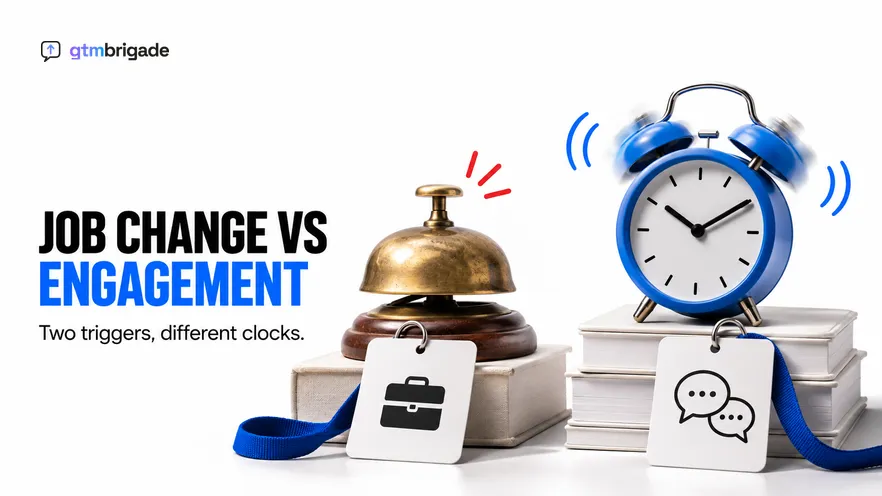
GTM Brigade vs UserGems is a comparison between two products that both sell you a reason to contact somebody, and that disagree about how often a reason should arrive. One waits for a rare, powerful event. The other works with frequent, weaker ones. Picking by signal quality alone is how teams end up with a motion that works beautifully and not very often.
This comparison is ours to publish, and one of the two products reviewed is our own. We state that upfront rather than bury it, and the table below identifies the rows where a different answer fits better.
GTM Brigade vs UserGems: two different clocks
UserGems-class tooling watches people you already know for a change of employer: rare, dated, and very strong when it fires. GTM Brigade watches accounts you want for public activity: frequent, undated, and weaker per event. Everything else follows from that difference.
A job change is close to the best commercial event there is. Somebody who used your product at their last company, got on with it, and has now arrived somewhere with its own budget and its own problems. They know what the thing does and they do not need convincing that the category exists.
A public post is a much smaller event. A buyer at an account you care about has said something about a problem, which tells you the problem is live and gives you a legitimate opening. It is not evidence that they will buy.
The trap is comparing the two on strength alone, because strength is the dimension where one of them wins outright. The dimension that decides a quarter is frequency.
The diagnosis that decides it
Count the useful triggers your team acted on last quarter. If the answer is near zero, you have a coverage problem and the frequent motion is the purchase. If you have strong triggers arriving and nobody working them, you have an ownership problem and neither product fixes it. That count takes an afternoon.
The coverage case is the common one in younger companies, and it has a specific cause. A job-change motion is only as large as your history of people who have used the product and liked it, so a company two years old with a few hundred users has very few champions to track. The motion is excellent and it compounds with age, which makes it a strong second purchase and a weak first one.
The ownership case is the one worth checking before spending anything. Both motions produce an alert, and both die in the same place: the twenty minutes between the alert and a useful reply, which nobody owns. An unread job-change notification in a shared inbox is exactly as valuable as a buyer's post that nobody answered.
What is missing in that case is a sequence of five small steps: notice the event, decide whether it matters, draft something the right person would actually say, get them to approve it, and record that the meeting began there. None is hard alone. They fail because they span three people and no system.
Why frequency matters more than teams expect
A pipeline built only on rare events is unforecastable, because the events arrive on their own schedule and your number does not. That is the practical case for having a frequent motion underneath a rare one rather than instead of it.
The frequent motion has its own weakness and it is worth naming. Attention on the platform is concentrated, so an unfiltered feed pushes a team towards the loudest accounts rather than the ones that could buy. Measured across 56,845 posts from 11,020 creators over a 60-day rolling period, our State of LinkedIn dataset shows the top 1% of content pulling in 40% of total engagement, a distribution the Gini coefficient scores at 0.841.
That is why the watchlist is the part that matters rather than the listening. Responding to whoever happens to post is a popularity filter. Responding to the forty accounts you have decided you want is a commercial one, and it is the same discipline that makes a job-change motion work: a defined set of people worth noticing.
Forrester's research on B2B buying has consistently found that buyers form views from peer and public sources well before they contact a supplier [Forrester], which is why a frequent motion is doing more than filling gaps between rare events. It is where the view gets formed.
UserGems and GTM Brigade, compared
The rows are jobs rather than features, and the second column is ours, so read it as a claim to check. The last three rows are the ones that decide a shortlist.
| UserGems | GTM Brigade | |
|---|---|---|
| Trigger it watches | A contact changes job | A target account posts |
| Frequency | Rare | Frequent |
| Strength per event | Very high | Moderate |
| Who it watches | People you know | Accounts you want |
| Depends on your history | Yes, heavily | No |
| Drafts in a person's voice | No | Yes |
| Routes to a rep | Yes | Yes, by ownership |
| Writes to the CRM | Yes | HubSpot, Salesforce |
| Needs daily human time | No | Ten minutes approving |
Three of those rows are the limit of our own column, and they are in the table rather than underneath it. Our events are weaker one at a time, we do not track where your former users went, and we need a named person to approve drafted comments most days. A team that cannot commit those ten minutes will get nothing from us.
The pairing where job-change signal is compared against a community layer rather than against an engagement motion is Common Room vs UserGems. The full sequence from a buyer's post to an attributed meeting is in the LinkedIn Engagement-to-Pipeline playbook for B2B GTM teams, and the publishing-side comparison is GTM brigade vs Taplio.
The verdict
Buy the job-change tool if you have years of happy users to track and a motion that already works when a champion moves. Buy ours if you need conversations in the months when nobody moves. Most teams past a certain age should run both, with the rare motion as the upside and the frequent one as the base.
One sequencing argument deserves a direct statement, and it cuts against us. A company whose pipeline genuinely runs on former champions arriving at new accounts, with a long customer history and a short target list, has a better fit with a job-change product than with us. In that business we are an expensive addition to something already working, and the honest recommendation is to spend the budget deepening it.
And the case where we are wrong is not only that one. When buyers are discussing challenges on channels beyond LinkedIn, those conversations stay out of reach and the watchlist has nothing to surface. If no named person will spend ten minutes a day approving drafts, the comments either stop or stop sounding human, and both outcomes are worse than not starting. Where the comparison is against outbound email rather than against a signal product, it is GTM brigade vs cold email sequencers, and the enrichment comparison is GTM brigade vs Clay.