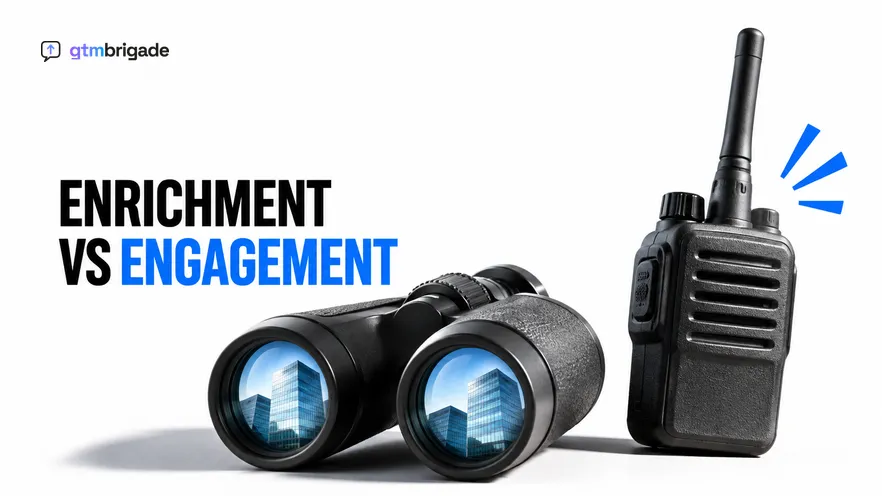
GTM Brigade vs Clay comes up constantly on shortlists and it is a comparison between two tools that do not actually overlap. One answers who you should be pursuing and what is true about them. The other answers what to do at the moment one of those people says something in public.
This page is ours, and one of the two products reviewed here is ours too. We say that upfront, not in a footnote. The table below identifies the rows where we are the wrong choice.
GTM Brigade vs Clay: who against when
Clay-class tooling is a data layer: find the accounts and people matching a definition, enrich them from many sources, and orchestrate the result. GTM Brigade is a response layer: watch a chosen set of accounts, draft a reply in a named person's voice when they post, route it to the right rep, and record what came of it. That is the whole distinction and it holds through every feature release on either side.
Think about the output of each in a given week. A data tool hands you a better list: more accounts that fit, more of them with the field you needed filled in, fewer wasted sends because the enrichment caught something.
Ours hands you a shorter list with timing attached. Four accounts from your target set said something publicly this week, here is what a specific person on your team could usefully reply, and here is the rep who should know.
Both are legitimate and most mature teams end up with both. They get compared because the category language has collapsed: everything that produces a reason to reach out is called a signal tool, which flattens a real difference between knowing who and knowing when.
The diagnosis that decides it
Ask your team to name the fifty accounts that matter most this quarter. If they cannot, or the list is stale, the data problem is binding. If they can name them instantly and nothing happens when those accounts act in public, the response problem is binding. It takes one meeting and it decides the purchase.
The data case is common in teams that have grown past their founder's address book. The definition of a good customer has drifted, the list in the CRM is two years old, and reps are working from whatever they can assemble themselves. Enrichment and orchestration tooling addresses exactly that, and no engagement product substitutes for it.
The response case looks completely different from the inside. The target list is good and current, the reps know their accounts, and buyers at those accounts post about their problems regularly without anybody at your company noticing or replying usefully.
What is missing in the second case is a sequence of five small steps that nobody owns: notice that a named account acted in public, decide whether it matters, draft something the right person would actually say, get them to approve it, and log that the resulting meeting started there. None is hard alone. They fail because they span three people and no system, so each handoff is a place where a moment expires.
Why a list without timing underperforms
A correct message sent at an arbitrary moment competes with every other message in the inbox and has nothing to anchor it. That is the structural weakness of list-driven outbound, and better data makes the message more accurate without making the timing less arbitrary.
The reverse failure is just as real. Attention on the platform is concentrated enough that an unfiltered feed is a popularity filter rather than a commercial one. The numbers from our State of LinkedIn dataset make this concrete: 56,845 unique posts from 11,020 active creators, tracked on a rolling 60-day window in a continuously measured record, show the top 1% of posts taking 40% of all engagement, a Gini coefficient of 0.841.
Read together, those two failures explain why the tools are complements rather than rivals. The list decides which conversations are worth your team's attention, and the trigger decides when to spend it. A team with one and not the other is either accurate and badly timed or responsive and pointed at the wrong people.
Forrester's research on B2B buying has consistently found that buyers form views from peer and public sources well before they contact a supplier [Forrester], which is why a moment when a buyer is already talking about the problem is worth more than a moment chosen by your sequence.
Clay and GTM Brigade, compared
The rows are jobs rather than features, and the second column is ours, so read it as a claim to check. The last three rows are the ones that decide a shortlist.
| Clay | GTM Brigade | |
|---|---|---|
| Layer it sits in | Data | Response |
| Question it answers | Who, and what is true | When, and what to say |
| Account discovery | Core strength | Out of scope |
| Enrichment | Core strength | No |
| Watches public activity | Partly | Core strength |
| Drafts in a person's voice | No | Yes |
| Routes to a rep | Manual | Yes, by ownership |
| Writes to the CRM | Yes | HubSpot, Salesforce |
| Needs daily human time | No | Ten minutes approving |
Three of those rows are the limit of our own column, and they are in the table rather than underneath it. We do not discover accounts, we do not enrich anything, and we need a named person to approve drafted comments most days. A team that cannot commit those ten minutes will get nothing from us.
If you are specifically replacing a data tool for LinkedIn signal rather than adding to one, the Clay alternative page covers that case directly. The full sequence from a buyer's post to an attributed meeting is in the LinkedIn Engagement-to-Pipeline playbook for B2B GTM teams, and the publishing-side comparison is GTM brigade vs Taplio.
The verdict
Buy the data tool if your team cannot name who it is pursuing. Buy ours if it can, and nothing happens when those people show up in public. Both gaps are common, and closing one does nothing for the other.
We will make the sequencing case honestly, even though it cuts against us. A team without a clear target list will get more from a quarter of defining and enriching one than from any response motion, because a watchlist assembled from guesses watches the wrong accounts and does it efficiently. If that is you, start with the data and come back when the list is real.
And the case where we are wrong is not only that one. When your buyers talk through their problems on channels outside LinkedIn, those conversations stay invisible to us and the watchlist has no signal to track. If no named person will spend ten minutes a day approving drafts, the comments either stop or stop sounding human, and both outcomes are worse than not starting. Where the comparison is against outbound email rather than against a data layer, it is GTM brigade vs cold email sequencers, and the in-voice comparison is GTM brigade vs Aware.