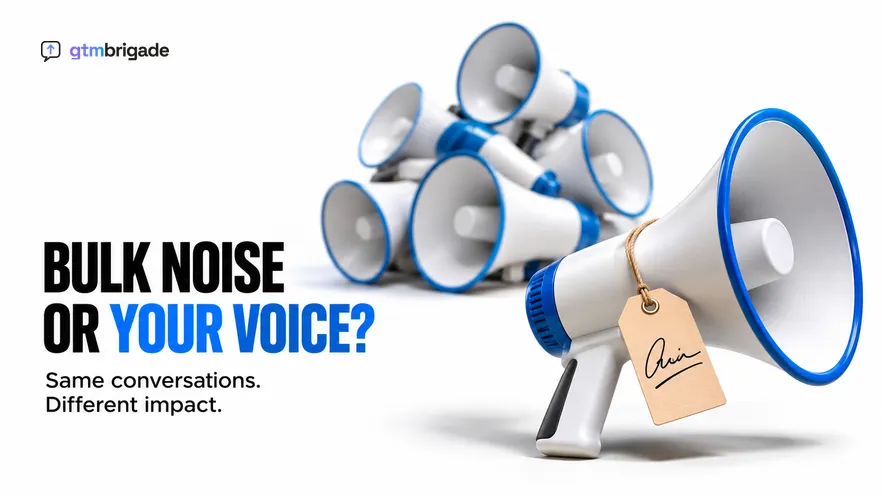
GTM Brigade vs Aware is a comparison between two tools that both put your team into other people's comment sections. The disagreement is about what to optimise once you are there: how much of the conversation you cover, or how well the few comments you make land and what happens after them.
This page is ours, and one of the two products compared here is ours too. We say that upfront rather than in a footnote. The table below identifies the rows where our product is not the right choice.
GTM Brigade vs Aware: coverage against fidelity
Aware-class tooling optimises for coverage: more of the conversation seen, more of the team taking part, and activity you can report on. GTM Brigade optimises for fidelity and follow-through: fewer accounts, comments that sound like a named person, and a route from that comment to a logged meeting. That difference survives every feature release on either side.
Think about what each one produces at the end of a week. A coverage tool produces a larger footprint: your company appeared in more conversations, more of your people were involved, and there is a number for it.
Ours produces a shorter list with more attached to each item. Twelve comments on posts from accounts you named, each written as something your founder would actually say, each one the rep who owns that account knows about, and two of them already in the CRM as the start of a conversation.
Both are legitimate. They answer different questions, and the teams that get this wrong usually bought the one that produced a better-looking weekly report rather than the one matching their gap.
The diagnosis that decides it
Read your last month of comments as a buyer would. Very few comments means a participation problem. Plenty of comments that could have been posted under anybody's name means a fidelity problem. It takes ten minutes and it is the step most teams skip.
The participation case is real. A team that has decided engagement matters and still is not doing it has a habit problem, and tooling that surfaces conversations and lowers the effort of joining them addresses exactly that.
The fidelity case looks completely different from the inside. The activity is there, the dashboard is healthy, and the comments are agreeable and interchangeable: nice post, great point, this resonates. Nobody replies, because there is nothing to reply to.
What is missing in the second case is a sequence of five small steps that nobody owns: notice that an account you want said something, decide whether it is worth a reply, draft something a specific person would say, get that person to approve it, and record that the resulting conversation began there. None is hard alone. They fail because they span three people and no system.
Why volume is the weaker lever
Attention on LinkedIn is concentrated enough that commenting more is a poor default strategy. Our State of LinkedIn dataset, a continuously measured record built from 56,845 unique posts across 11,020 active creators on a rolling 60-day window, shows the top 1% of posts capturing 40% of all engagement, with a Gini coefficient of 0.841.
The practical reading is that most posts earn almost nothing, so a wide comment surface is mostly spread across conversations nobody is watching. Picking fewer posts that matter to accounts you want beats appearing under more posts that do not.
There is a second cost to volume that rarely appears in a business case. A generic comment is recognised as generic, and a buyer who has seen three of them from your company has learned something about you that you did not intend to teach.
That cost is asymmetric, which is why it is worth paying attention to. A good comment earns a small amount of credit with one buyer and a few of their followers. A visibly templated one tells an entire comment section that your company automates its sincerity, and it does that under a post the buyer wrote themselves, in front of exactly the audience you were trying to reach. The upside of a comment is narrow and the downside is public, so the sensible response to concentrated attention is to make fewer comments and mean them rather than to widen the surface.
Forrester's research on B2B buying has consistently found that buyers form views from peer and public sources well before they contact a supplier [Forrester], which is why the character of a public comment is a commercial fact rather than a matter of taste.
Aware and GTM Brigade, compared
The rows are jobs rather than features, and the second column is ours, so read it as a claim to check. The last three rows are the ones that decide a shortlist.
| Aware | GTM Brigade | |
|---|---|---|
| Optimises for | Coverage | Fidelity |
| Problem it fixes | Too little engaged with | Comments go nowhere |
| Account selection | Broad listening | Curated watchlist |
| Drafts for you | Partly | Yes, in your voice |
| Who approves | Whoever comments | A named person |
| Routes to a rep | No | Yes, by ownership |
| Writes to the CRM | No | HubSpot, Salesforce |
| Reports activity | Core strength | Partly |
| Needs daily human time | Optional | Ten minutes approving |
Three of those rows are the limit of our own column, and they are in the table rather than underneath it. We do not give anyone something worth saying, we do not report breadth of activity the way a coverage tool does, and we need a named person to approve drafted comments most days. A team that cannot commit those ten minutes will get nothing from us.
If you are specifically replacing a commenting tool rather than adding to one, the Aware alternative page covers that case directly. The full sequence from a buyer's post to an attributed meeting is in the LinkedIn Engagement-to-Pipeline playbook for B2B GTM teams, and the publishing-side comparison is GTM brigade vs Taplio.
The verdict
Buy the coverage tool if the honest answer is that your team barely comments. Buy ours if your team comments plenty and none of it sounds like a person or reaches a rep. Both failures are common and the fix for one does nothing for the other.
One ordering point cuts against us and deserves plain language. A team that has never built an engagement habit will get more from six weeks of consistent presence than from a routing and attribution system, because the system needs active conversations before it has anything to route. If that describes your situation, build the habit first and return once it exists.
And the case where we are wrong is not only the early one. When buyer conversations happen on platforms other than LinkedIn, those signals are invisible to us and the watchlist has no activity to track. If no named person will spend ten minutes a day approving drafts, the comments either stop or stop sounding like a human, and both outcomes are worse than not starting. Where the comparison is against outbound email rather than against engagement, it is GTM brigade vs cold email sequencers.