Why an Aware alternative cannot be chosen on the voice claim
Every tool that drafts LinkedIn comments claims to write in your voice, which makes the claim worthless for shortlisting. Looking for an Aware alternative on the strength of that promise gets you a list of vendors who all say the same sentence. The useful questions are about mechanism, and they are answerable in a demo.
We build GTM Brigade, which is one of the options in this category, and we state that up front so you can discount accordingly. Where we could not verify something about another vendor we have left it out rather than guessing, and nothing here characterises the output quality of a competitor product, because that is not something we can fairly test from outside.
What we can do is give you the test we would want run on us.
What makes a comment read as machine-written
A generic comment is worse than no comment, because it costs the rep credibility with precisely the buyer they were trying to reach. Buyers now spot the pattern quickly, and the pattern is consistent.
The first tell is restatement. The comment summarises the post back to the person who wrote it, adding nothing. It reads as attendance rather than contribution.
The second is agreement without information. Strong point, completely agree, this is so true. Nobody is offended by these and nobody remembers them either, and a string of them under one name teaches the buyer to scroll past it.
The third is category language. Phrases that appear in vendor marketing and almost never in speech. A rep who would say we lost two deals to this last quarter instead writes about operationalising alignment, and the shift is audible.
There is a fourth tell that is easy to miss because it looks like effort. The comment is long. Six sentences of thoughtful-sounding text under someone else post reads as a bid for attention rather than a contribution, and buyers treat it the way they treat a cover letter. Two sentences that add one fact outperform a paragraph almost every time.
What survives contact with a buyer is the opposite: one concrete thing the poster did not say. A number from your own deals, a counterexample, a mechanism, a case where the advice fails. That concrete thing has to come from somewhere the model can actually reach, which is why the mechanism questions below matter more than the marketing copy.
The mechanism questions that separate these tools
Ask how the voice is produced and what it learns from, because those two answers predict the output better than any sample. There are four questions and they take five minutes.
Is there one house voice or a model per rep. A house voice applies one configured tone to the whole team, which produces comments that are recognisably from the same tool even when they carry different names. A model per rep learns each person separately, so the sales leader and the SDR do not sound alike. Since the entire point of the motion is that a named human engages a named buyer, per-rep is the shape that matches the goal.
Does it learn from edits or from approvals. This is the question that separates tools that improve from tools that plateau. An approval says the draft was good enough to send, which is weak information. An edit says precisely what the person would rather have written, which is strong. A system learning from edits keeps improving after the first month. One learning from approvals mostly does not.
Can it reach your own material. A comment containing a real number from your deals is only possible if the system can see something beyond the post it is replying to. Ask what it can draw on and where that comes from.
Does the rep approve before posting. The answer should be yes, always, with no configuration that changes it.
| One house voice | A model per rep | |
|---|---|---|
| Learns from | A configured style guide | That person own edits |
| Team output | Recognisably one tool | Recognisably different people |
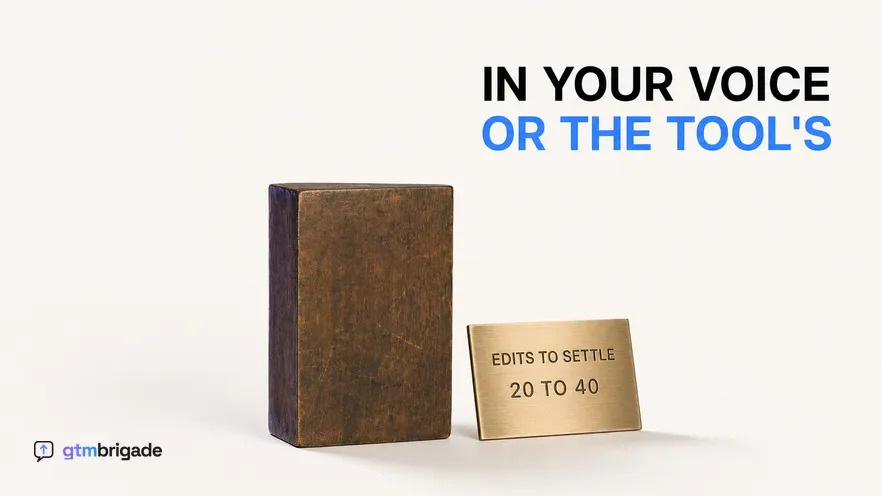
| Settles after | Configuration | Roughly 20 to 40 edited comments |
| Improves over time | Only when reconfigured | Continuously, while edits continue |
| Fails when | Two reps are genuinely different | A rep sends drafts unedited |
The last row is worth dwelling on. A per-rep model stops learning the moment reps publish drafts without editing them, and the comments drift back toward neutral within about a month. If your edit rate falls to nearly zero, that is not success, it is the model going quiet.
Why the rep has to approve every comment
Automated posting under a personal profile is the one design choice in this category that has no acceptable configuration. It should be a hard no from any vendor, including us.
The first reason is account risk. LinkedIn spent 2025 and 2026 enforcing against automated session and scraping patterns across this ecosystem, and several established tools were cut off or shut down in that window. Anything that acts under a person credentials without them present sits on the wrong side of that line, and the account at risk belongs to your rep rather than to the vendor.
The second reason is the model. Every edit a rep makes is the training signal that keeps drafts improving. Remove the human from the loop and the edits stop, which means the drafts stop getting better at exactly the moment you have scaled them.
The third reason is the one that actually ends careers. Comments post under a real person name, on a public profile, where the buyer, their colleagues and your prospects can all see them. A system that publishes unattended will eventually publish something confidently wrong under that name, and the apology is more expensive than every minute the automation saved.
The time saved by removing approval is small in any case. Approving an edited draft takes seconds. The cadence that works is five to eight comments a day, so the entire approval burden is a couple of minutes.
The ten-minute test to run in any demo
Bring five real posts from your own target accounts and ask for drafts on those, not on the vendor examples. Vendor examples are chosen because they work.
Read the five drafts and ask one question of each: would you send this under your own name, to that specific person, today. Not whether it is well written. Whether you would sign it. Most people find two of five pass, which is a reasonable starting point, and the ones that fail usually fail on the three tells above.
Then edit two of them properly, the way a rep would, and ask the vendor what the system does with those edits. Listen for whether the answer is specific. A vague answer about improving over time usually means approvals, not edits.
Finally, ask to see the same five posts again after the edits, if the demo allows it. Even a small shift in the direction you edited is meaningful. No shift at all tells you where the ceiling is.
Two ways this test gets rigged, worth watching for. If the vendor asks for your posts in advance, the drafts you see may have been reviewed by a person, so hand them over in the call instead. And if the sample posts are all from well-known creators writing about broad topics, the drafts will look better than they will in practice, because generic posts are easy to comment on generically. Choose posts from actual accounts you are trying to win, including the awkward ones about a technical detail or a hiring announcement, since those are where drafts usually fall apart.
Score it before you leave the call, while the drafts are in front of you. Written down, two of five is a useful number to compare across vendors. Remembered a week later, every demo becomes about the same.
If you want to try this shape of thing before booking anything, the AI comment generator runs the same exercise on sample posts with no signup.
Voice is one stage of four, not the product
A comment that sounds right and arrives three days late is still a missed window, and voice alone does not fix cadence, routing or reporting. This is the most common reason a voice tool disappoints after a good demo.
Cadence is where programmes die. Fifteen minutes and five to eight comments before the first meeting survives a bad week. An hour every Friday fails on the first busy Friday, not gradually.
Routing decides whether the right person is inside the window a buyer post opens. That is the rep who owns the account, with the deal stage attached, rather than whoever happened to be scrolling.
Attribution decides whether the programme still exists next year. Salesforce State of Sales research has repeatedly found representatives spending a minority of their week actually selling, so a design that asks reps to log engagement by hand stops being followed within a month. The write-back has to be automatic.
There is a reason all four matter more than raw output volume. GTM Brigade runs the State of LinkedIn, built from 56,845 unique posts across 11,020 active creators on a rolling 60-day window, and the top 1% of posts capture 40% of all engagement, with a Gini coefficient of 0.841. Attention is that concentrated, so the value is in reaching chosen people reliably rather than producing more text. The full sequence is in the LinkedIn engagement-to-pipeline playbook for B2B GTM teams.
What this page deliberately does not claim
We have not compared the output quality of other tools in this category, because we cannot test them fairly from the outside and we would not want a competitor characterising ours. No feature matrix and no price comparison either, for the same reason: pricing here is frequently gated and changes without announcement.
What is left is a mechanism comparison and a test you can run yourself. Both stay true longer than a feature grid, and both apply to us as much as to anyone else on your shortlist.
Gartner B2B buying research has consistently found buying groups spend only a small share of the purchase cycle with supplier representatives at all, split across every vendor being considered. That is the real constraint. When access is that thin, a comment that sounds like a person and says something true is worth more than ten that do not, and no tool can supply the something true on its own.
If safety architecture rather than voice is your concern, the Dripify alternative comparison covers that. If you are still choosing between signal capture and a full motion, the Trigify alternative comparison is the closer fit.
Last updated: September 2026