What a Trigify alternative actually needs to replace
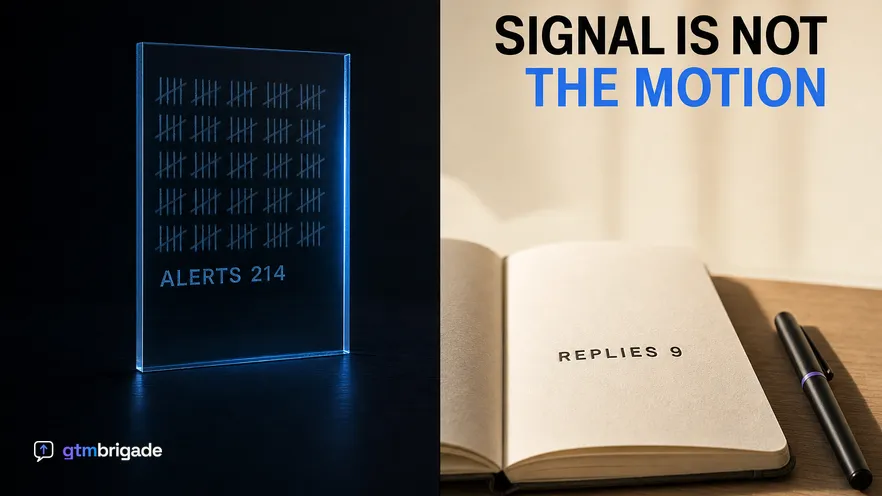
Before shortlisting a Trigify alternative, decide which of two jobs you are buying: capturing the signal, or running the motion that follows it. Trigify sits in the signal-capture category, watching social activity and surfacing what looks like intent. Engagement-led selling needs four further things after that alert fires, and no amount of extra signal supplies them.
We build GTM Brigade, which is one of the options below, and we say that up front so you can discount the rest accordingly. Where we could not verify something about another vendor, we have left it out rather than guessing. Product details in this category change every few months, so treat everything here as a category comparison and check current vendor pages before you buy.
Signal capture and engagement execution are different products
A signal tool ends at the alert. An engagement platform starts there. That is the entire distinction, and it explains most of the disappointment teams report after buying in this category.
Capture answers one question well: something happened, and here it is. That is genuinely useful when a team is flying blind, and for a lot of go-to-market teams it is the first real visibility they have had into what their market is doing in public.
Execution answers four different questions. Who on our team responds. In what voice. Within what window. And how do we know afterwards whether it produced anything. None of those are signal problems, and adding a second signal source does not move any of them.
The failure mode is specific and common. A team buys capture, the alerts arrive, and for three weeks everyone engages enthusiastically. Then a quarter-end lands, the alerts keep arriving, and nobody opens them. The tool is working exactly as sold. The motion around it was never built.
| Signal capture | Engagement platform | |
|---|---|---|
| Core question | What just happened | What we do next, and did it work |
| Ends at | An alert or a feed | A CRM activity on a contact record |
| Voice | Not in scope | A model per rep, learned from edits |
| Cadence | Not in scope | A daily floor a manager can coach |
| Routing | Sometimes, to a channel | To the account owner, with deal context |
| Attribution | Not in scope | Influenced pipeline in HubSpot or Salesforce |
Rows marked not in scope are not criticisms. They are simply outside what a capture product sets out to do.
The four things engagement-led selling needs after the alert
Voice, cadence, routing and attribution are the four stages that turn a signal into a conversation, and all four sit downstream of any capture tool. Each one fails independently, and each one is the reason a different team gave up.
Voice is first because it is the one buyers see. A drafted comment that reads as machine-written costs the rep credibility with precisely the person they were trying to reach. A voice model that learns from a rep's own edits, rather than from a house style guide, settles after roughly twenty to forty edited comments and stops sounding generic.
Cadence is second because it is where programmes die. Fifteen minutes and five to eight comments before the first meeting of the day survives a bad week. An hour every Friday does not, and it fails on the first busy Friday rather than gradually.
Routing is third and is mostly about timing. A buyer's post opens a short window, and the person who should walk through it is the rep who owns the account, not whoever happened to be scrolling. Routing with the account and deal stage attached is what makes that reliable.
Attribution is fourth and is the one that decides whether the programme exists next year. Salesforce's State of Sales research has repeatedly found that representatives spend a minority of their week actually selling, so any process that asks a rep to log engagement manually will quietly stop being followed. The write-back has to be automatic.
The full sequence, with the measurement for each stage, is set out in the LinkedIn engagement-to-pipeline playbook for B2B GTM teams.
When a capture tool is the right answer
If your reps already engage reliably and you only lack visibility, buy capture and stop there. That is a real situation and it is more common in founder-led teams than people expect.
The tell is behavioural. Ask whether, when someone on the team notices a target account posting, a relevant comment appears the same day. If the answer is yes and the only complaint is that people notice by accident, the constraint genuinely is visibility. A capture tool fixes that directly and costs less than a platform.
A second case is breadth. A curated watchlist of 80 to 200 profiles is deliberately narrow, because that is the size a team can engage daily. If you need monitoring across a whole market, for instance job changes across several thousand accounts, that is a different shape of problem and a dedicated signal product serves it better than an engagement platform will.
We would rather say that plainly than sell you something with more surface area than your problem has.
When the gap is the motion, not the feed
If signals already arrive and nothing consistently happens next, more signal is the wrong purchase. The diagnostic is one number: the median time from a target buyer posting to one of your reps commenting.
Measure it for two weeks. If that median is counted in days, the bottleneck is downstream of capture, and buying a second feed will produce a second ignored inbox. If it is counted in hours and the variance is wild, you have a routing problem. If it is consistently short but the comments read as generic, you have a voice problem.
There is a structural reason this matters more than it used to. Gartner's B2B buying research has consistently found that buying groups spend only a small share of the purchase cycle with supplier representatives at all, split across every vendor on the shortlist. When formal access is that thin, the informal surface is where presence is built, and presence is a function of showing up repeatedly rather than being alerted more often.
GTM Brigade is built for that second case. The watchlist is 80 to 200 profiles, weighted roughly half buyers, a quarter amplifiers and a quarter deal-stage targets. Comments are drafted in a per-rep voice model and the rep approves every one. Signals route to the account owner with deal context attached, and every engagement writes back to HubSpot or Salesforce so a CRO can ask what the channel produced and get an answer from the CRM. There is no browser extension and no cookie-based automation in that path.
If you are the person who will be asked to defend the number, the RevOps view of LinkedIn attribution is the page to read next. If you are choosing between named tools rather than categories, the Common Room alternative comparison covers the adjacent case where the incumbent is a community platform rather than a signal feed.
How the difference shows up in a rep's day
The gap between the two categories is easiest to see in what a rep does at nine in the morning. Feature grids obscure it. A walkthrough of one hour does not.
With capture only, the rep opens a feed of alerts. Some are from accounts they own, most are not. They pick a few, open LinkedIn in another tab, read the post, write a comment, and move on. Nothing records that any of it happened. By Thursday the feed has several hundred unread items and the rep has stopped opening it, because triage is now the job rather than selling.
With the full motion, the rep opens a channel that already filtered to their accounts, with the deal stage attached. Each item carries a drafted comment in their own voice that they edit and approve, which takes seconds rather than minutes. The engagement writes itself back to the CRM contact. The commitment is five comments and it is finished before the first meeting.
The second version is not better because it has more features. It is better because it survives a bad week, and almost every programme in this category dies of a bad week rather than a bad tool.
What this comparison does not tell you
We have deliberately not published a feature matrix or a price comparison for other vendors, because we could not verify either to a standard we would want applied to us. Pricing in this category is frequently gated, changes often, and varies by seat count and contract length.
So treat this page as a comparison of two product shapes rather than two products. Take the diagnostic question, the median time from buyer post to rep comment, and the three checks below into whatever demo you run next. They work regardless of which vendors end up on your list, and they will tell you more than any grid we could publish.
If a page anywhere promises you a current feature-by-feature table across five tools in this space, check the date on it, then check three of the claims against the vendors' own sites. That exercise is usually short.
What to check before you switch anything
Three checks separate a good decision from an expensive one, and none of them appear on a feature grid. Run them against every vendor on your shortlist, including us.
Check the CRM write-back first. Ask to see an engagement appear as an activity on a contact record in your own instance, not in a demo tenant. If that path does not exist, you will not be able to report on the programme, and a programme nobody can report on gets cut in the first tight quarter.
Check the voice next. Ask whether the tool models each rep separately or applies one configured house voice. Then read five drafted comments and ask whether you would send them under your own name.
One more thing is worth asking, and vendors rarely volunteer it. Ask what happens to the programme when a rep leaves. If the voice model, the watchlist and the engagement history live only against that person's login, a departure takes the account relationships with it and the next rep starts from nothing. If the watchlist is a team asset and the history sits on CRM records, the handover is a normal one. For a team with any turnover at all, that difference compounds faster than any feature on the shortlist.
Check the access architecture last, and take it seriously. LinkedIn spent 2025 and 2026 enforcing against automated session and scraping patterns across this ecosystem, and several well-known tools were cut off or shut down in that window. How a vendor reaches LinkedIn is now a durability question about your programme, not a technical footnote.
Last updated: September 2026