The choice a Common Room alternative actually presents
Choosing a Common Room alternative is a choice between breadth across many signal sources and depth on one, and the right answer depends entirely on where your buyers are. Common Room sits in the community and signal intelligence category, consolidating activity from multiple places into one view of people and accounts. That is a genuine advantage for some companies and dead weight for others.
We build GTM Brigade, which is the narrow option in this comparison, and we state that up front so you can weight the rest accordingly. Where we could not verify a detail about another vendor we have left it out rather than guessing, and everything here is a comparison of product shapes rather than current feature lists. Check vendor pages directly before you buy.
Breadth is a real advantage, for a specific kind of company
Multi-source signal platforms earn their price when non-LinkedIn sources genuinely drive deals. That is not a hedge. For a meaningful set of companies it is plainly true, and no amount of LinkedIn depth substitutes for it.
Developer tools are the clearest case. A question in a community Slack, an issue opened on GitHub, or a spike in usage on a free tier can each be a stronger buying signal than any social post, because the person is already working with the product. Open-source companies and products with active user communities are in the same position. For them, a view that stops at social is a view that misses the best signals they have.
Products with strong community motions sit in the same bucket. If your market has a forum where practitioners argue about the category, the people arguing are frequently the people who will champion a purchase internally, and their activity does not appear on a social feed in any usable form.
The honest framing is that breadth is not a feature, it is a bet about where your market lives. When the bet is right, a consolidated view is worth what it costs.
Depth is the other bet, and it is the more common one
For most sales-led B2B companies, one source produces nearly all the pipeline, and everything after the signal is where the work actually is. If your buying committee is revenue, marketing or operations leadership, that source is usually LinkedIn, and the constraint is not that you cannot see enough.
Depth means four things a signal view does not typically cover. A voice model per rep, so a drafted comment reads as that person rather than as a tool. A daily cadence small enough to survive a bad week, which in practice is fifteen minutes and five to eight comments before the first meeting. Routing to the account owner with the deal stage attached, so the right person is inside the short window a buyer post opens. And a CRM write-back, so a revenue leader can ask what the channel produced and get an answer from the same reporting as the rest of the funnel.
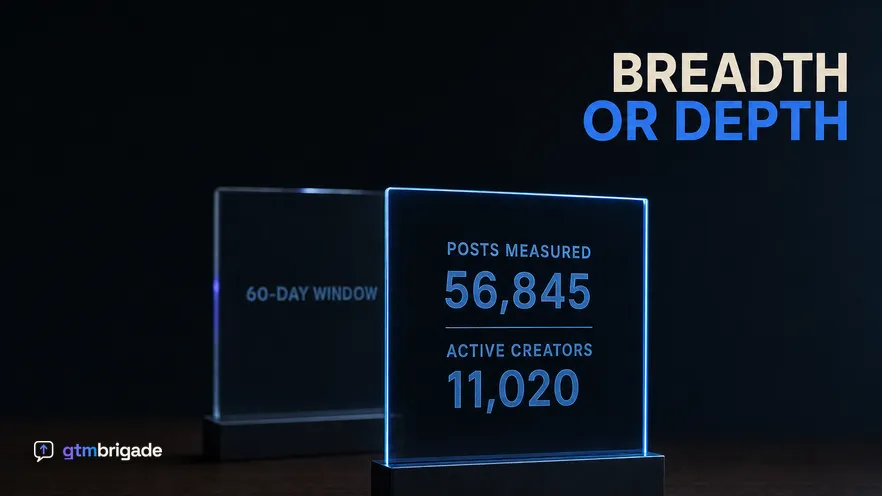
There is a reason those four matter more than the size of the feed. GTM Brigade runs the State of LinkedIn, a continuously measured dataset built from 56,845 unique posts across 11,020 active creators on a rolling 60-day window, and it shows the top 1% of posts capturing 40% of all engagement, with a Gini coefficient of 0.841. Attention is that concentrated. Seeing more of it does not get you any of it. Engaging a chosen buyer does, because a comment on their post reaches them regardless of how your own posts performed.
The full sequence is in the LinkedIn engagement-to-pipeline playbook for B2B GTM teams.
The two shapes, side by side
These are two different products solving two different problems, and the comparison only makes sense once you know which problem you have. The rows below describe categories rather than current feature sets.
| Multi-source signal platform | LinkedIn engagement platform | |
|---|---|---|
| Bet | Buyers are spread across many surfaces | Buyers are concentrated on one |
| Strongest for | Developer tools, community-led products, open source | Sales-led B2B with a defined buying committee |
| Unit of work | An account view assembled from many sources | A named buyer on a curated watchlist |
| Voice | Not typically in scope | A model per rep, learned from edits |
| Cadence | Not typically in scope | A daily floor a manager can coach |
| Attribution | Varies by vendor, verify it | CRM activity on the contact record |
| Fails when | Most of your pipeline comes from one source anyway | Your buyers genuinely are not on LinkedIn |
The last row is the one to take seriously in both directions. A narrow tool pointed at a market that is not on LinkedIn is a bad purchase, and we would rather say that than win the deal.
What breadth costs when your market is narrow
A consolidated view of sources you will never act on is not neutral, it is a tax on attention. This is the part that rarely appears in a comparison, because it is a cost of ownership rather than a missing feature.
The first cost is triage. A feed assembled from five sources produces more items than one assembled from one, and a rep with three hundred unread items stops opening the tool. That happens whether or not the extra items were relevant, because the rep cannot tell which are relevant without reading them. Narrower feeds get opened.
The second cost is configuration that never finishes. Multi-source platforms need each source connected, mapped and tuned, and the sources that were connected last are the ones nobody maintains. Six months in, a team commonly finds that two integrations have been silently failing and nobody noticed, because no single person owned a source that was not driving deals.
The third cost is the argument about ownership. Community signals usually belong to whoever runs community, product signals to product, and social signals to sales. A platform spanning all three needs an owner spanning all three, and in most companies that person does not exist. The tool then belongs to nobody, which is a slower and quieter death than being cancelled.
None of that is an argument against breadth when the breadth is real. It is an argument against buying breadth speculatively, on the theory that more sources must be better. They are better only if you will act on them.
What we have not compared here
We have deliberately not published a feature matrix or a price comparison against other vendors, because we could not verify either to the standard we would want applied to us. Pricing in this category is often gated, varies by seat count and contract length, and changes without announcement.
That leaves this page as a comparison of two product shapes, which is the part that stays true for longer than a quarter. The first-touch exercise below and the three demo checks at the end work regardless of which vendors end up on your shortlist, and they will tell you more than a grid assembled from marketing sites.
If you find a page promising a current, complete, feature-by-feature table across several tools in this space, check the date on it, then verify three of its claims against the vendors' own documentation. That check is usually short and usually settles how much of the rest to trust.
The test that settles it in an afternoon
Take your last thirty closed-won deals and find the first touch on each one. It is tedious and it is more decisive than any demo.
If a meaningful share of those deals started in a community, a forum, a support channel or product usage, you need breadth and the multi-source platform is the correct purchase. If nearly all of them trace back to LinkedIn, whether that is a post, a comment, a connection or an inbound message after a rep engaged, then the extra sources are surface area you will not act on.
Run the same exercise on open pipeline as a check, because closed-won skews toward however you were selling a year ago. If the two lists disagree, trust the open pipeline, because that is the motion you are actually running now.
Two cautions on how the exercise goes wrong. Do not accept the CRM source field as the answer, because it usually records the last form somebody filled in rather than the first time the buyer heard of you. Ask the rep who closed each deal where it really started, and expect the two answers to disagree on roughly a third of them. And do not exclude deals that arrived as referrals, because a referral from someone who has watched your team post for a year is a LinkedIn-originated deal wearing a different label.
Gartner's B2B buying research has consistently found that buying groups spend only a small share of the purchase cycle with supplier representatives at all, and that share is split across every vendor on the shortlist. When formal access is that thin, being present on the surface where the committee already spends time matters more than counting how many surfaces you can watch.
What to verify in any demo, including ours
Three checks decide whether a tool in this category will still be in use in six months, and none of them appear on a pricing page. Run them against every vendor you shortlist.
Verify the CRM write-back in your own instance. Ask to see an engagement land as an activity on a real contact record, not a screenshot from a demo tenant. Salesforce's State of Sales research has repeatedly found representatives spending a minority of their week actually selling, so any design that relies on a rep logging engagement by hand will quietly stop being followed within a month.
Verify what happens when a rep leaves. If the watchlist, the voice model and the engagement history live only against one person's login, a departure takes the relationships with it. If the list is a team asset and the history sits on CRM records, the handover is routine.
Verify who the tool is for on a Tuesday morning. Ask which role opens it first thing, and what they do in the first five minutes. If the answer is a manager reviewing a dashboard, the tool will be reported on rather than used. If the answer is a rep clearing a short queue before their first meeting, it has a chance of becoming a habit. Habits survive quarters; dashboards do not.
Verify the access architecture. LinkedIn spent 2025 and 2026 enforcing against automated session and scraping patterns, and several established tools in this ecosystem were cut off or shut down in that period. How a vendor reaches the platform is a durability question about your programme rather than a technical footnote.
If your shortlist is signal feeds rather than community platforms, the Trigify alternative comparison covers that adjacent case. If it is data enrichment, the Clay alternative comparison is the closer fit.
Last updated: September 2026