What is engagement-led GTM?
Engagement-led GTM is a go-to-market motion that picks the buyers first and engages them in public before anyone sends a cold message. The unit of work is a named account, not a post. That single inversion is what turns LinkedIn engagement to pipeline instead of into impressions, because every action the team takes is aimed at a person who could sign a contract.
The conventional motion runs the other way. A team writes content, publishes it, watches the reach numbers, and hopes a buyer is somewhere in the audience. Reach is then treated as the leading indicator, and the gap between reach and revenue is filled with assumption. Engagement-led GTM removes the assumption by choosing the audience in advance and engaging it directly, which means the leading indicator is a named buyer who has seen your rep three times this month.
Nothing about this is new as an idea. What is new is that it can now be measured, and measurement is what turns a habit into a programme.
This connects closely to Taplio vs Trigify.
Why LinkedIn engagement to pipeline breaks down for most teams
LinkedIn engagement to pipeline breaks down at measurement, not at execution. Teams post consistently, engage occasionally, and then cannot say what any of it produced, because the engagement data and the pipeline data live in two systems that nothing joins. A programme that cannot answer that question is judged on the mood of the quarter.
Most B2B teams already do the first half of this well. They post, they have a point of view, and a few people on the team have real followings. Then the programme stalls, and it almost always stalls in the same place: nobody can say what any of it produced.
The reason is structural. Engagement data lives inside LinkedIn, where it is visible one notification at a time and impossible to aggregate. Pipeline data lives in HubSpot or Salesforce. Nothing joins the two, so the question "which deals had LinkedIn touches" has no owner and no answer. A programme that cannot answer that question is not judged on its results, it is judged on how the quarter is going, and in a tight quarter it gets cut.
There is a fourth reason, quieter than the others, which is that the metric the team reports is not the metric the buyer generates. Impressions, follower growth and LinkedIn's own Social Selling Index all measure how much a person uses the platform. None of them measures whether a buying committee at a target account has heard of your rep. Reporting the first set while hoping for the second is how a programme accumulates two years of green dashboards and no attributable revenue.
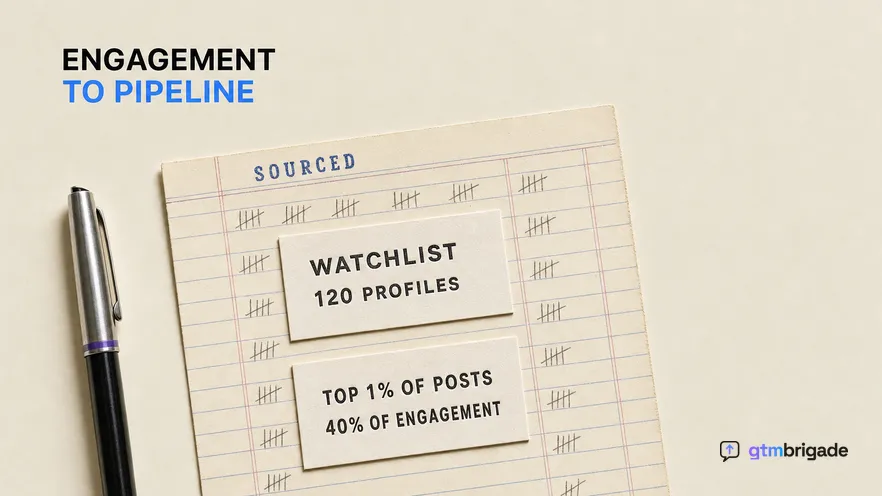
There is a second reason, and it is about where attention actually goes. GTM Brigade runs the State of LinkedIn, a continuously measured public dataset built from 56,845 unique posts across 11,020 active creators on a rolling 60-day window. The top 1% of posts capture 40% of all engagement, with a Gini coefficient of 0.841. That is a distribution, not a ranking, and it has a practical consequence: publishing more is a lottery ticket. Engaging a chosen buyer is not, because a comment on their post reaches them whether or not your own post reached anyone.
The third reason is that the buyer is not spending much time with you in the first place. Gartner's B2B buying research has consistently found that buying groups spend only a small minority of the purchase cycle with supplier sales representatives at all, and that time is split across every vendor on the shortlist. If a rep gets a single-digit share of a buying group's attention through the formal process, the informal surface where that buyer already spends time becomes the more productive place to be present.
Stage 1: build the watchlist before you write anything
The watchlist is the programme, and everything after it is execution. Build 80 to 200 profiles by hand, split roughly half buyers, a quarter amplifiers and a quarter deal-stage targets, against current title and current employer. A list built from a CRM export or padded with competitors produces activity that never reaches a buyer.
The watchlist is the whole programme. Everything downstream is execution.
A working list holds 80 to 200 profiles. Below 80 there is not enough posting activity for weekly signal, and reps conclude the channel is dead. Above 200 the list cannot be engaged daily, goes stale within a month, and quietly becomes a spreadsheet nobody opens. Most teams land between 120 and 150.
The composition matters more than the size. Roughly half should be buyers, meaning people who could realistically close within four quarters. A quarter should be amplifiers: advisors, peer founders, investors and operators whose engagement signals trust to the buyers watching. The last quarter should be deal-stage targets sitting inside currently active pipeline, because multi-threading a live deal is the fastest payback in the whole playbook.
Two warnings, both learned expensively. Do not build the list from a CRM export: it carries closed-lost contacts from eighteen months ago and people who have since changed employer. And do not fill it with competitors, who neither buy from you nor engage your reps. Build it by hand, against current title and current employer, and accept that it takes four to eight hours of a sales leader's time spread over two or three sittings. The exercise is half the value, because it forces the team to say out loud who they actually sell to.
Stage 2: capture the voice so the comments survive contact with a buyer
A voice model per rep is what keeps drafted comments from costing credibility. It should learn from the rep's own edits rather than their approvals, settle after roughly twenty to forty edited comments, and never post without the rep approving the text. One house voice across a whole team defeats the point, because the buyer is meant to recognise a person.
A generic comment is worse than no comment. It costs the rep credibility with exactly the person they were trying to reach, and buyers now recognise machine-written text quickly.
The practical fix is a voice model per rep rather than one house voice. It should learn from the rep's own comment history and, more importantly, from their edits, because an edit is a much stronger signal of preference than an approval. In practice a model settles after roughly twenty to forty edited comments, at which point drafts stop reading as generic and start reading as that person on a good day.
Two rules keep this honest. The rep approves every comment before it posts, without exception. And the draft is a starting point, not an output: if a rep is publishing drafts unedited, the voice model has stopped learning and the comments will drift back toward generic within a month.
Stage 3: set a cadence a rep can actually keep
Fifteen minutes and five to eight comments a day beats an hour once a week, every time. The mechanism is familiarity, and familiarity is built by frequency rather than intensity. Set the commitment as a daily floor a sales manager can coach against, not a weekly target people clear on Thursday afternoon.
Cadence is where good programmes die, and they die of ambition rather than neglect.
A cadence that survives contact with a real sales week is short and daily. Fifteen minutes, five to eight comments, on posts from the watchlist, before the first meeting of the day. That is roughly thirty engagements a week per rep, which is enough to be noticed by a buyer and small enough to survive a quarter-end.
The alternative, an hour of LinkedIn every Friday, fails predictably. It gets cancelled the first busy Friday, then the second, and by week five the habit is gone. Frequency beats volume here because the mechanism is familiarity, and familiarity is built by showing up repeatedly rather than intensely.
What the rep comments on matters as much as how often. A comment that adds a fact, a counterexample or a number earns a reply. A comment that agrees pleasantly does not, and a string of them teaches the buyer to scroll past that name. The practical test before posting is whether the comment would still be worth reading if the rep's employer were removed from it.
Give the cadence a floor rather than a target. A floor of five comments a day is a commitment a sales manager can coach against. A target of thirty a week is a number people hit on Thursday afternoon by commenting on anything.
Stage 4: route the signal to the person who owns the account
A buyer's post opens a short window, and routing is what gets the right rep into it. The account owner should know within minutes that a watchlist profile has posted, with the account and deal stage attached. Without routing, engagement falls to whoever happens to be scrolling, which is rarely the person holding the relationship.
Timing is most of the value, and timing is the thing manual processes lose first.
When a watchlist profile posts, the rep who owns that account should know within minutes, not at the end of the day. A buyer's post about a problem you solve opens a short window in which a comment reads as relevant rather than opportunistic, and that window closes as the post ages out of everyone's feed.
Routing is what makes this operational rather than heroic. The signal goes to a shared channel, tagged with the account and the deal stage, so the person who engages is the person with the context. Without routing, engagement defaults to whoever happens to be scrolling, which is usually the most online person on the team rather than the account owner.
Stage 5: attribute it, or the programme dies at the next board meeting
Attribution here is narrow: match the engaged profile to a CRM contact, write the engagement back as an activity, and let normal pipeline reporting do the rest. The bar is not statistical elegance. It is that a revenue leader can ask what LinkedIn produced last quarter and get a CRM number rather than a screenshot.
This is the stage teams skip, and skipping it is why the previous four stop mattering.
Attribution here means something narrow and achievable: match the engaged profile to a CRM contact, write the engagement back as an activity on that contact record, and let normal pipeline reporting take over. Once the join exists, sourced and influenced pipeline can be filtered by whether a LinkedIn touch occurred, and the answer holds up in front of a CRO because it uses the same reporting the rest of the funnel uses.
Be careful what you promise here. Engagement rarely produces clean single-touch sourced pipeline, and claiming it does invites a finance review that the programme will lose. Influenced pipeline is the honest and defensible frame: these accounts had LinkedIn touches from our team before they converted, and these did not. That comparison is enough to justify the headcount, and it has the advantage of being true. Salesforce's State of Sales research has repeatedly found that representatives spend a minority of their week actually selling, with the rest lost to administration and internal work. A programme that adds manual logging to that load will not survive, which is why the write-back has to be automatic rather than a rep's responsibility.
What to measure at each stage
Measure the stage you are on, not the stage you want to be on. A team three weeks into a rollout that reports pipeline is reporting noise, and will draw the wrong conclusion from it. Each stage has one number worth watching and a point at which that number becomes readable.
Measure the stage you are on, not the stage you want to be on. A team three weeks in that reports pipeline is reporting noise.
| Stage | The metric that matters | What it tells you | When it becomes readable |
|---|---|---|---|
| Watchlist | Profiles live, and share posting monthly | Whether the list can produce signal at all | Week 1 |
| Voice | Edit rate on drafted comments | Whether the model has settled or is still guessing | Week 3 to 6 |
| Cadence | Comments per rep per day, as a floor | Whether the habit survived a busy week | Week 2 onward |
| Routing | Median time from buyer post to rep comment | Whether you are inside the window or outside it | Week 4 |
| Attribution | Influenced pipeline with a LinkedIn touch | Whether any of it produced revenue | Quarter 1 |
Two of these are worth watching more closely than the others. Edit rate tells you whether the voice model is working: a rate that stays very high means drafts are not usable, and a rate that falls to nearly zero means reps have stopped reading them. Median time to comment is the single best proxy for whether routing is real, because it degrades immediately when the process becomes manual.
What a GTM team should do in its first week
Week one builds the list, picks two committed reps, and wires the CRM write-back before a single comment goes out. None of it involves publishing. Retrofitting attribution onto three months of engagement is technically possible and never actually happens, so the plumbing goes in while the programme is still small.
Week one is deliberately unglamorous, and none of it involves publishing.
Start by writing the watchlist by hand, in two sittings, against current titles and current employers. Split it roughly half buyers, a quarter amplifiers, a quarter deal-stage targets, and stop at 150 even if the temptation is to keep going.
Then pick the reps who will actually do this. Two committed reps beat eight assigned ones, and a programme that starts small can be pointed at as evidence later. Give them the daily floor, five comments before the first meeting, and make the sales manager responsible for the floor rather than the reps.
Set up the CRM write-back before the first comment goes out, not after. Retrofitting attribution to three months of engagement is possible and nobody ever does it. Finally, agree in advance what you will report at the end of the quarter and to whom, because the reporting format decides which of the five stages actually gets built.
Read the State of LinkedIn benchmarks before you set any target, so the numbers you commit to are grounded in what the channel currently does rather than what it did in 2022. If you are the person who will be asked to defend the programme, the RevOps view of LinkedIn attribution is the part to read twice.
If your shortlist is signal capture rather than sequencing, the Trigify alternative for Engagement-Led selling covers that comparison directly. And if the category label itself is what needs settling first, start with what is social selling in 2026?
The bottom line
Engagement-led GTM is not a content strategy with a sales veneer. It is a target list, engaged daily, in public, with the result written back to a CRM record. The first four stages are habits and the fifth is plumbing, and teams reliably build the habits and skip the plumbing.
Build the watchlist first, keep the cadence small enough to survive a bad week, and put the attribution in before you need it. The programme that gets renewed next year is the one that can answer, from the CRM, what it produced.
Last updated: September 2026