Taplio vs Trigify is the wrong comparison, and here is the right one
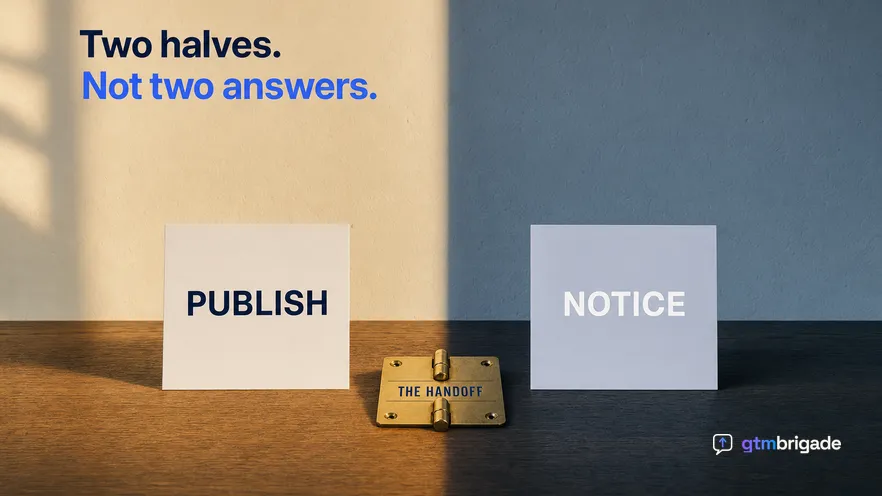
These two products sit on opposite halves of the same motion: one helps you publish, the other helps you notice. Comparing them directly is like comparing a printing press with a pair of binoculars, and the reason teams do it anyway is that both are sold as LinkedIn tools.
We build GTM Brigade, which operates in the same space, and we say so up front so you can weight the rest accordingly. This page compares the two jobs rather than named product internals, because we cannot verify either vendor current implementation from outside and would not want a competitor characterising ours. Ask both, and us, exactly which half of the motion they perform.
The comparison that actually helps is not which of these is better. It is which half of the motion your team is currently missing, because the answer determines which purchase produces anything at all.
The publishing half
Publishing tooling exists to make one person produce content consistently, so that an audience forms around them over time. That is Taplio's side of the line, and it is a real and difficult job.
The problem it solves is consistency. Almost everyone in B2B who tries to build presence stops after a few weeks, because producing something worth reading on a schedule is harder than it looks and the early feedback is discouraging. Tooling that supplies prompts, drafts, scheduling and a record of what worked addresses exactly that failure.
What publishing tooling produces, when it works, is standing. People in your market recognise a name. When that name appears in a comment or a message, it is not a stranger. That is genuinely valuable and it is slow: the first two months of posting reach almost nobody, which is the normal experience and not a sign of failure.
What it does not produce is a list of people to talk to. An audience is not a pipeline, and the gap between the two is where most personal-brand efforts in B2B quietly end. Reach goes up, meetings do not, and nobody can explain why.
The listening half
Signal tooling exists to notice things your buyers do in public and put them in front of the right rep. That is Trigify's side of the line, and it solves the opposite failure.
The problem here is attention rather than production. Your buyers are already saying things publicly. Some of those things are openings: a complaint about a problem you solve, a role change, a question, a post that attracted a lot of discussion. Nobody on your team sees them, because nobody can watch that many people that closely, and the moments pass.
What signal tooling produces is timing. It converts an undifferentiated feed into a short list of moments worth acting on this week. Unlike publishing, it works quickly, because the moments already exist and the tool is only surfacing them.
What it does not produce is standing. When a rep with no presence in the market responds to a buyer post, they are a stranger arriving with an opinion, which lands differently than the same words from someone the buyer half-recognises. Signal points you at the door. It does not decide how you are received when you knock.
Why the concentration of attention favours noticing
Attention on this platform is extremely unevenly distributed, which makes noticing cheaper than broadcasting. Our State of LinkedIn dataset, a continuously measured record built from 56,845 unique posts across 11,020 active creators on a rolling 60-day window, shows the top 1% of posts capturing 40% of all engagement, with a Gini coefficient of 0.841.
Read from the publishing side, that is a hard number. It says most posts earn almost nothing, and that building an audience means competing for a very concentrated pool of attention against people who have been at it for years.
Read from the listening side, the same number is encouraging. Concentration means the moments worth responding to are few, identifiable and predictable. You do not have to monitor everything. You have to notice the small number of occasions when someone who matters said something that mattered, and a short, well-chosen watchlist catches most of them.
That asymmetry is the strongest practical argument for starting with the listening half if you have to choose one. The publishing half asks you to win a contest with heavily skewed odds. The listening half asks you to show up where the attention already is.
The two halves, compared on what they cost and produce
The table compares jobs rather than vendors, and neither column is automatically the right answer for your team. A team with no market presence at all genuinely needs the left column first, whatever the timelines say.
| Publishing half | Listening half | |
|---|---|---|
| Core job | Produce content consistently | Notice buyer activity |
| Produces | Standing and recognition | Timing and openings |
| Time to first result | Months | Weeks |
| Scales with | Your own persistence | Size of the watchlist |
| Fails when | Output is generic or stops | Reps do not act on what is surfaced |
| Main metric | Audience and reach | Conversations started |
| Who has to participate | One person, regularly | Every rep, briefly |
| What it cannot do | Tell you who to talk to | Give you standing when you arrive |
The bottom row is the whole argument in two cells. Each half is defeated by the thing the other one supplies, which is why teams that buy only one tend to report the same experience: it worked, in the sense the vendor promised, and no pipeline appeared.
The gap neither half covers
Nothing in either column closes the loop between noticing and responding with standing. That handoff is where the motion actually produces pipeline, and it is manual in most stacks.
The loop looks like this when it works. A rep has some presence, so their name is not unfamiliar. A signal surfaces that a named buyer said something relevant. The rep responds publicly, usefully, under their own name, and is recognised rather than dismissed. The exchange is visible, so when it turns into a meeting the attribution is a link rather than a claim.
Every step in that sequence is straightforward. What is hard is that it crosses two tool categories and a human, and the human is the bit that drops it. A signal that arrives without a drafted response, routed to a rep who was not expecting it, gets acted on far less often than a vendor dashboard would suggest.
This is the gap we build into, and we are obviously not neutral about it, so treat the description as a claim to check rather than a finding. The neutral version is the diagnostic: if you have both halves and still no conversations, the loss is in the handoff rather than in either tool.
What each half costs you when it is the only one you have
A publishing programme with no listening half produces reach that nobody converts. A listening programme with no publishing half produces responses from strangers. Both are real losses and both get misdiagnosed as the tool underperforming.
Take the publishing-only case first, because it is the more expensive of the two. A rep or a founder posts consistently for six months and the numbers improve: more followers, more impressions, occasional comments from people at target accounts. Nothing is written down about who those people were. The engagement is treated as a vanity metric because nobody connected it to an account list, and the programme gets cut in a budget round on exactly the evidence that should have saved it. The audience was real and the follow-up never existed.
The listening-only case fails faster and more quietly. Signals arrive, reps respond, and the responses land with people who have no idea who is talking to them. The replies are polite and go nowhere. After a few weeks the reps stop opening the queue, because the effort-to-outcome ratio is poor, and the tool is renewed for another year while nobody uses it.
What both failures share is that the missing half is invisible in the reporting of the half you bought. Reach looks fine. Signal volume looks fine. The number that would show the problem, conversations that actually started, is usually not on either dashboard.
Which half is your team missing
Take 30 target buyers and answer two questions about them. The answers tell you which purchase would produce something and which would sit unused.
First: in the last quarter, did any of these people post or comment publicly? If almost none did, stop here. Neither half of this category has raw material in your market, and you should spend the budget elsewhere rather than on a motion with nothing to act on.
Second: if one of them posted something directly relevant to what you sell, would anyone on your team have seen it, and would the buyer recognise the name of whoever replied? A no to the first part is a listening gap. A no to the second is a publishing gap. A no to both means starting with listening, because it produces something in weeks while presence accumulates in the background.
Gartner research on B2B buying has consistently described buyers spending most of their decision process away from suppliers, and Forrester work points the same way: the seller is absent for most of the journey. Both halves of this category are attempts to be present during that absence. Publishing tries to be present passively, by being known. Listening tries to be present actively, by turning up at the right moment. The teams that do well tend to run both and treat the handoff between them as the actual product.
The verdict
If you can only buy one, buy the listening half, unless your reps are completely unknown in the market. That is the recommendation, stated plainly, with the reasoning above and the caveat that we compete in this space.
Buy publishing tooling when the honest answer to "would our buyers recognise any of our reps" is no, and when someone on the team is genuinely willing to write every week. Without that willingness the tool does not help, because it automates the scheduling rather than the having-something-to-say.
Buy signal tooling when your reps have some standing and the problem is that nothing gets followed up. That is the more common situation in teams that have been at this a year or two, and it is the faster of the two to show a result.
If you want the version of this argument aimed at replacing the publishing half specifically for a sales team rather than a founder, we cover it on the Taplio alternative page. And if what you actually need is the connective layer between the two halves, the engagement-to-pipeline playbook is the method written out in full, tool-independent, so you can run it by hand before buying anything at all.