What is engagement-led GTM?
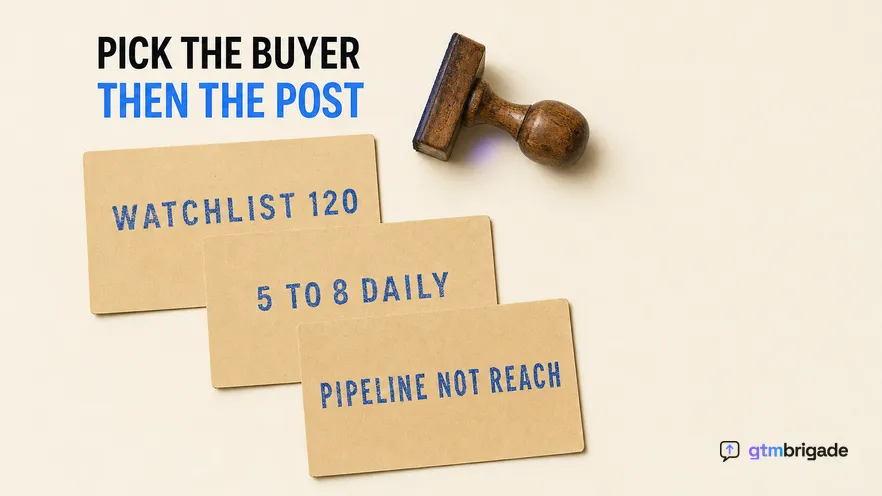
Engagement-led GTM is a go-to-market motion in which a team selects a list of named buyers and engages them in public, on the surface where they already spend time, before any outbound contact. The list comes first, the engagement is public, and the result is measured in pipeline.
Each of those three clauses is doing work. The list comes first, which distinguishes it from content-led motions where the audience is discovered after publishing. The engagement is public, which distinguishes it from outbound, where the first contact is private and cold. And it is measured in pipeline, which distinguishes it from social media programmes reported in reach.
The name is recent. The practice is not, and any experienced seller will recognise it as the digital form of what used to happen at conferences and in industry associations: become a known quantity to the people who buy, before you need anything from them.
Where it sits between ABM and outbound
Engagement-led GTM occupies the space between account-based marketing and outbound, and borrows the targeting discipline of one with the human directness of the other. Placing it precisely is the fastest way to understand it.
Account-based marketing selects accounts and reaches them with campaigns: advertising, content, events, coordinated email. The targeting is rigorous and the contact is largely mediated. Its natural scale is hundreds of accounts, because campaigns scale in a way that people do not.
Outbound selects contacts and reaches them directly, cold, at volume. The contact is human and the targeting is often loose, and the credibility has to be manufactured inside the message itself, which is why cold messages are so hard to write.
Engagement-led GTM selects individuals, reaches them directly, and does so in public before asking for anything. Its scale is deliberately small, 80 to 200 people, because a human has to engage them daily. That constraint is the defining property rather than a limitation.
| ABM | Engagement-led GTM | Outbound | |
|---|---|---|---|
| Unit | An account | A named buyer | A contact record |
| Scale | Hundreds of accounts | 80 to 200 people | Thousands |
| Surface | Ads, email, events, content | Public feeds | Inbox and phone |
| Sequence | Warm the account, then sell | Build familiarity, then ask | Ask immediately |
| Measured in | Account engagement | Pipeline with a prior touch | Reply and meeting rates |
The three are compatible and frequently run together. The most common working pattern is to select accounts with ABM discipline, engage the individuals inside them publicly, and only then run outbound into a list that already recognises you.
Why the list has to be small
The watchlist is 80 to 200 people because that is what a team can engage every day, not because more data was unavailable. This is the constraint teams most often try to remove, and removing it breaks the motion.
Below roughly 80 profiles there is not enough posting activity to produce weekly signal. Reps open the queue, find nothing, and conclude the channel is dead. Above roughly 200 the list cannot be worked daily, so it ages, and within a month it is a spreadsheet nobody opens. Most teams settle between 120 and 150.
Composition matters more than the number. Roughly half should be buyers who could realistically close within four quarters. A quarter should be amplifiers, meaning advisors, peer operators and investors whose engagement signals trust to the buyers watching. The final quarter should be deal-stage contacts inside currently active pipeline, because multi-threading a live deal is the fastest payback available.
Build it by hand against current title and current employer. A CRM export carries closed-lost contacts from eighteen months ago and people who have since moved. The exercise of building it manually takes four to eight hours of a sales leader time and is half the value, because it forces the team to state who they actually sell to.
Why public engagement rather than more content
Publishing reaches whoever the ranking decides. Engaging reaches the person you chose. That asymmetry is the reason the motion is built the way it is.
GTM Brigade runs the State of LinkedIn, a continuously measured public dataset built from 56,845 unique posts across 11,020 active creators on a rolling 60-day window. The top 1% of posts capture 40% of all engagement, with a Gini coefficient of 0.841. Attention is that concentrated, which means publishing more is a lottery ticket even when the content is good.
A comment under a buyer post is not subject to that distribution. It arrives in their notifications, attached to something they already care about, because they wrote it. The mechanism is direct rather than probabilistic.
There is a second reason, about access. Gartner B2B buying research has consistently found that buying groups spend only a small share of the purchase cycle with supplier representatives at all, and that share is divided across every vendor on the shortlist. If formal access is that thin, the informal surface where the committee already spends time is where presence gets built.
The related individual practice, and what changed about it recently, is covered in what is social selling in 2026.
The four stages that make it operational
A motion is a list plus four repeatable stages, and teams reliably build the first three and skip the fourth. Each fails independently and each has ended somebody programme.
Voice is what the buyer sees. A drafted comment reading as machine-written costs the rep credibility with precisely the person they wanted. A model that learns from each rep own edits, rather than a house style guide, settles after roughly twenty to forty edited comments, and the rep approves every comment before it posts.
Cadence is where programmes die. Fifteen minutes and five to eight comments before the first meeting survives a bad week. An hour every Friday fails on the first busy Friday, and the failure is abrupt rather than gradual. Set a floor a manager can coach against rather than a weekly target.
Routing decides whether the right person is inside the short window a buyer post opens. The signal should reach the rep who owns the account, with deal stage attached, within minutes. Without it, engagement falls to whoever happens to be scrolling.
Attribution decides whether any of it exists next year. Salesforce State of Sales research has repeatedly found representatives spending a minority of their week actually selling, so a design that asks reps to log engagement manually stops being followed within a month. The write-back has to be automatic. The complete sequence, with the measurement for each stage, is in the LinkedIn engagement-to-pipeline playbook for B2B GTM teams.
Who owns it, and why that question sinks programmes
Engagement-led GTM straddles marketing and sales, and a programme with no single owner dies quietly rather than loudly. This is an organisational problem rather than a tactical one, and it is the most common cause of a good pilot never scaling.
Marketing usually owns voice, positioning and whatever content the team publishes. Sales owns the accounts, the conversations and the pipeline number. The watchlist sits precisely between them, which means it belongs to nobody by default.
The failure is predictable. Handed entirely to marketing, the programme optimises what marketing can measure, and within two quarters it has become a content calendar with reach reporting attached. Handed entirely to sales, it produces bursts of activity that stop the first busy week, because no function is accountable for the cadence when quota pressure arrives.
What works is narrow and specific: one named owner for the list, a sales manager accountable for the daily floor, and a single agreed pipeline number reported to one executive. The list owner does not have to be senior. They have to be the person who updates it monthly and says no when somebody wants to add four hundred more profiles.
Agree the reporting line before the first comment goes out, because the reporting format determines which of the four stages actually gets built. A programme that will be judged on reach will never have attribution built for it.
What it costs to run
The recurring cost is about fifteen minutes per rep per day, plus a monthly hour on the list. Stating that honestly matters, because the most common objection is that reps have no time, and the answer is that the version which requires real time is the version that fails.
The daily cost is the cadence: five to eight comments before the first meeting. Reading the posts properly takes most of that time, and drafting takes very little if drafts are available to edit. This is deliberately smaller than most teams expect, and it is smaller than the hour-a-week commitments that collapse.
The monthly cost is list maintenance: removing people who moved, promoting deal-stage targets that closed, adding accounts that entered pipeline. An hour, done on a fixed date, by the person who owns the list.
The setup cost is front-loaded and mostly one-off: four to eight hours building the first list, and whatever the CRM write-back takes to wire up. Do the write-back before the first comment rather than after, because retrofitting attribution onto three months of engagement is technically possible and effectively never happens.
How to measure it
Measure coverage first, reciprocity second, and pipeline third, in that order and on that timescale. Reporting the third number in week three produces noise and usually a wrong conclusion.
Coverage is the share of named buyers your team has engaged in the last ninety days. It is unglamorous and it immediately exposes a programme that is busy without being aimed at anyone.
Reciprocity is how many of those buyers engaged back, whether that is a reply, a reaction, a profile view or a message. It is the closest available proxy for familiarity and it moves before pipeline does, which makes it the leading indicator worth watching weekly.
Pipeline with a prior touch is the share of newly opened pipeline where someone on your team had engaged the buyer beforehand. This is the number an executive will ask for. Be careful how you frame it: influenced pipeline is defensible, single-touch sourced attribution usually is not, and overclaiming invites a review the programme will lose.
Where engagement-led GTM does not fit
If your buyers are not active on a public professional network, this motion has nothing to work with, and no amount of process fixes that. Saying so plainly is more useful than qualifying it.
Some markets sell to roles that simply do not post: parts of manufacturing, public sector procurement, clinical and laboratory buyers, and much of the trades. For those, the surface does not exist and the equivalent motion runs through associations, events and referrals instead.
It also fits poorly where deal values are small enough that a daily human habit cannot be justified per account. If a rep needs two hundred customers a year to hit quota, engaging 150 people by hand is the wrong shape of work, and a volume motion is the honest answer.
The test is quick. Take twenty named buyers from real target accounts and check whether they have posted or commented in the last sixty days. If most have not, do something else. The next definition worth reading is what is warm outbound, which covers the case where engagement is the warm-up rather than the whole motion.
Last updated: September 2026