What is social selling?
Social selling is the practice of using a social network to build familiarity and credibility with named buyers before and during a sales conversation, rather than treating the network as a broadcast channel. The defining feature is that the audience is chosen in advance. You know who you are trying to become familiar to, and you can name them.
That distinguishes it from social media marketing, which addresses an audience and is measured in reach. It also distinguishes it from outreach, which asks for something. Social selling is the work that happens before the ask, and it is what decides whether the ask gets a reply.
The mechanism is unremarkable and well understood outside sales. People respond more readily to names they recognise. A buyer who has seen a rep contribute something sensible under three posts in their own feed reads that rep first message differently from a stranger. Nothing more sophisticated than that is required for the practice to work.
What changed by 2026
The definition did not change, but one common shortcut stopped working: reach is no longer a usable proxy for social selling. For most of the last decade a team could publish consistently, watch impressions rise, and reasonably assume some buyers were in the audience. That assumption no longer holds.
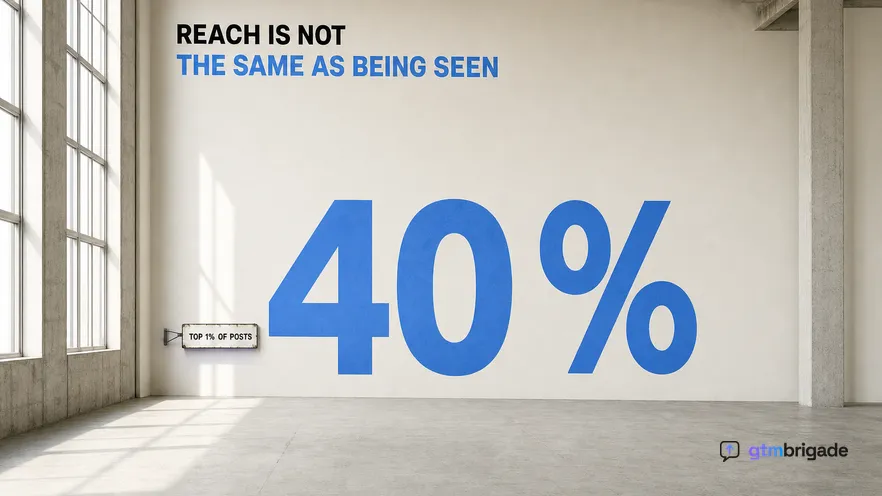
GTM Brigade runs the State of LinkedIn, a continuously measured public dataset built from 56,845 unique posts across 11,020 active creators on a rolling 60-day window. The top 1% of posts capture 40% of all engagement, with a Gini coefficient of 0.841. That is an extremely concentrated distribution, and it has a blunt consequence for anyone selling: publishing is a lottery ticket. Most posts, including good ones, reach very few of the people you care about.
Engaging a chosen buyer is not a lottery. A comment on their post reaches them regardless of how your own content performed, because it arrives in their notifications rather than in a feed ranked against everything else.
The second change is enforcement. LinkedIn acted against automated session and scraping patterns through 2025 and 2026, and several established tools in the ecosystem were cut off or shut down in that window. Shortcuts that let a small team behave like a large one became unreliable, which pushed the practice back toward doing a smaller number of things deliberately.
What social selling is not
Three activities get called social selling and are not, and the confusion is why so many programmes report failure. Naming them is the fastest way to make the definition usable.
Sending connection requests at volume is list building. It produces a larger network and no familiarity, because nothing has been contributed. A larger network of people who do not recognise you is not an asset.
Sending direct messages to strangers is cold outreach that happens to use a social network as the transport. It can work, and it is not this. Teams that skip straight to messaging and conclude the channel is dead have usually tested cold outreach in a new venue rather than testing social selling at all.
Publishing content on a schedule is content marketing. It supports social selling and does not constitute it, because it addresses an audience rather than named people. A team can post daily for a year without a single target-account buyer noticing.
The common thread is direction. All three push outward from the seller. Social selling starts from a named buyer and works back.
How to measure it without fooling yourself
Measure whether buyers at target accounts engage back, and whether those accounts appear in pipeline. Everything else is activity. This is harder than reporting impressions, which is why impressions persist.
The first number is coverage: what share of your named target buyers has any interaction with your team in the last ninety days. It is unglamorous and it exposes programmes that are busy without being aimed.
The second is reciprocity: how many of those buyers have engaged back, meaning a reply, a reaction, a profile view or a message. Reciprocity is the closest available proxy for familiarity, and it moves before pipeline does, which makes it the leading indicator worth watching.
The third is pipeline with a touch: of the accounts that entered pipeline this quarter, how many had prior engagement from your team. This is the number a revenue leader will ask for, and it requires that engagement is written back to CRM records automatically. Salesforce State of Sales research has repeatedly found representatives spending a minority of their week actually selling, so any process depending on reps logging engagement by hand stops being followed within a month.
| Metric | What it tells you | When it moves |
|---|---|---|
| Coverage of named buyers | Whether the programme is aimed at anyone specific | Week 2 |
| Reciprocity from those buyers | Whether familiarity is building | Week 6 |
| Pipeline with a prior touch | Whether it produced revenue | Quarter 1 |
| Impressions and followers | How the content performed, not who saw it | Immediately, and misleadingly |
The last row is in the table because it will be reported whether or not you ask for it. Knowing what it does not tell you is the useful part.
What social selling looks like in a rep's week
The practice is smaller and more repetitive than the term suggests, and that is why it works. Descriptions of social selling often make it sound like a strategy. In a working team it is a fifteen-minute habit with a list attached.
The rep opens a queue filtered to accounts they own, before the first meeting of the day. Five to eight of those buyers have posted since yesterday. The rep reads the posts properly, which takes most of the time, and comments on the three where they have something concrete to add: a number from a deal, a case where the advice fails, a question that is genuinely open rather than rhetorical.
They skip the rest without guilt. A comment for the sake of appearing is worse than silence, because a string of empty agreement under one name teaches the buyer to scroll past it.
Roughly once a week the rep publishes something themselves, usually a version of an argument they have already made in a comment or on a call. Publishing is the smaller half of the practice, which surprises people, and it is the half most teams over-invest in.
Nothing about this requires a content calendar, a personal brand, or an ambition to become known in the industry. It requires a list, a quarter of an hour, and the discipline to skip posts where you have nothing to say.
The mistake that ends most programmes
Almost every failed social selling programme failed on cadence, not on content quality. This is worth stating plainly because teams usually diagnose it as the opposite.
The pattern is consistent. A programme launches with enthusiasm and an ambitious commitment: an hour a week per rep, a post every day, a content calendar. It runs for three weeks. Then a quarter-end arrives, the hour gets cancelled, and it is never rescheduled. By week seven the programme exists only in a slide.
The underlying mechanism is familiarity, and familiarity is built by frequency rather than intensity. Five comments a day for a quarter produces recognition. One long session a month produces nothing, even if the total time is similar, because the buyer sees a name once and forgets it.
There is a second-order effect that makes the collapse worse than it looks. When a programme stops, the reps who did engage have taught a set of buyers to expect them, and then they disappear. That is a slightly worse position than never having started, because the team has spent effort to produce an impression of inconsistency. Restarting six months later begins from below zero rather than from nothing.
So set a floor rather than a target, and set it low enough to be embarrassing. Five comments before the first meeting is a commitment a sales manager can coach against, and it survives the week where everything else is on fire. A target of thirty a week is a number people hit on Thursday afternoon by commenting on anything, which is how the practice quietly becomes the thing it was supposed to replace.
Why the Social Selling Index is a poor scorecard
LinkedIn Social Selling Index measures how thoroughly a person uses LinkedIn, which is a usage metric wearing the clothes of a revenue metric. It is worth being specific about the mismatch, because the score is convenient and free and therefore widely adopted.
A rep can raise the score by completing a profile, connecting more, posting more and using more features. None of those require a single buyer at a target account to notice them. Conversely, a rep with a mediocre score who comments thoughtfully under fifteen buyers posts every week is doing the thing that produces pipeline.
Use it, if at all, as a hygiene check on whether a rep profile and activity are minimally in order. Do not use it as the programme scorecard, and do not set targets against it, because people optimise what is measured and this measures the wrong thing.
Where it fits in a go-to-market motion
Social selling is one stage of a motion, and it fails when treated as the whole thing. The stages around it are what convert familiarity into revenue.
It begins with a watchlist, which is the named list of buyers, amplifiers and deal-stage contacts the team will engage. Without it, engagement drifts toward whoever is loudest, and the practice becomes content marketing again.
It runs on a cadence small enough to survive a bad week. Fifteen minutes and five to eight comments before the first meeting of the day works. An hour every Friday does not, and it fails on the first busy Friday rather than gradually.
It needs routing so the rep who owns the account is the one who engages, inside the short window a buyer post stays live.
And it needs attribution, or it will not be renewed. Gartner B2B buying research has consistently found buying groups spend only a small share of the purchase cycle with supplier representatives at all, split across every vendor on the shortlist. Being present on the surface where buyers already spend time is a rational response to that, but only if someone can show what it produced.
The complete sequence, with what to measure at each stage, is in the LinkedIn engagement-to-pipeline playbook for B2B GTM teams. The team-level version of this practice, where the account list rather than the individual rep is the unit, is engagement-led GTM.
Last updated: September 2026