What a Dripify alternative should actually be judged on
Shopping for a Dripify alternative on features misses the thing that decides whether your programme survives: how the tool reaches LinkedIn. Access architecture is the durability question in this category, and it is the one least often asked in a demo.
We build GTM Brigade, which is one of the approaches described below, and we say that up front so you can weight the rest accordingly. This page compares architectures rather than named products, because we cannot verify another vendor current internals from outside and we would not want a competitor characterising ours. Ask every vendor on your shortlist, including us, to describe their access model in writing.
The stakes are unusual here. In most software decisions a bad choice costs money and time. In this one it can cost a rep their professional network, which is not yours to spend.
Where the risk actually comes from
The risk is created by software acting under a person credentials while that person is not present. It is not created by using tools, by automation in general, or by any particular vendor logo.
That pattern covers connection requests sent on a schedule, messages dispatched in sequences, profile visits performed in bulk and follows executed in batches. What makes it detectable is not sophistication but rhythm: people do not send forty connection requests at 09:00 every weekday, and they do not visit two hundred profiles in an afternoon without pause.
This is why the category ships the features it ships. Warming periods that ramp activity slowly. Daily caps. Randomised delays between actions. Human-like behaviour settings. Each of those exists to make automated activity resemble a person, which is a straightforward acknowledgement of what is being done.
There is a structural problem with that approach. It is an arms race against the platform, run by a vendor, using your rep account as the stake. The vendor loses a customer if it goes wrong. The rep loses their network.
What changed in 2025 and 2026
Enforcement moved from occasional to systematic, and several established tools in this ecosystem were cut off or shut down inside that window. That is the single most important development for anyone choosing in this category now.
LinkedIn acted against automated session and scraping patterns across the ecosystem through 2025 and 2026. Products that had operated for years became unavailable, changed how they worked, or stopped. We keep a dated record of that period in the LinkedIn tool enforcement timeline, updated as events occur, and it is worth reading before committing to any vendor in this space.
The practical consequence is that durability became a buying criterion. A tool that works today and is cut off in eight months costs you the migration, the retraining and whatever accounts were restricted along the way. That risk does not appear on a pricing page and it should be part of the comparison.
The second consequence is that shortcuts stopped being reliably cheaper. When a small team could behave like a very large one, volume was a genuine edge. As that became unstable, the arithmetic shifted toward doing a smaller number of things deliberately, which is a change in economics rather than in ethics.
Why teams buy the risky pattern anyway
Sequencer automation is bought for a rational reason, and pretending otherwise makes the comparison useless. It promises coverage that a small team cannot achieve by hand, and for a while it delivers exactly that.
The appeal is arithmetic. Two reps cannot personally contact two thousand people in a quarter. Software can, and for a period that gap was a genuine commercial advantage held by whoever adopted it first. Teams that grew on it are not being reckless, they are describing something that worked.
What changed is that the advantage became universally available and then unstable. Once every competitor in a market runs sequences, reply rates fall for everyone, and the volume needed to hit the same number rises. That is a treadmill rather than an edge, and it ends with more risk taken for the same result.
The honest position is that volume automation still produces activity, and that activity is worth less each year while the enforcement risk attached to it grows. If your model genuinely requires thousands of contacts per quarter, an engagement motion over 150 people will not replace it, and you should weigh the trade with clear eyes rather than take our framing for it.
Two architectures, compared honestly
The choice is between software acting for the rep and software preparing work for the rep to approve. Everything else in this comparison follows from that.
| Sequencer automation | Approval-based engagement | |
|---|---|---|
| Who acts | The tool, on a schedule | The rep, on every action |
| Human involvement | Configures, then monitors | Reads, edits, approves each item |
| Needs warming and caps | Yes, to resemble a human | No, the actions are human |
| Optimises | Messages sent | Buyers reached with something worth reading |
| Account risk | Carried by the rep | Materially lower, the pattern is absent |
| Fails when | Enforcement changes | Reps stop keeping the cadence |
Both columns have a failure mode and the second one is real. Approval-based engagement depends on a human habit, and habits lapse. A team that will not commit fifteen minutes a day will get nothing from it, and no architecture fixes that.
What the second column removes is the class of risk you cannot manage. A lapsed habit is recoverable next week. A restricted account, in the permanent case, is not.
What approval-based actually means
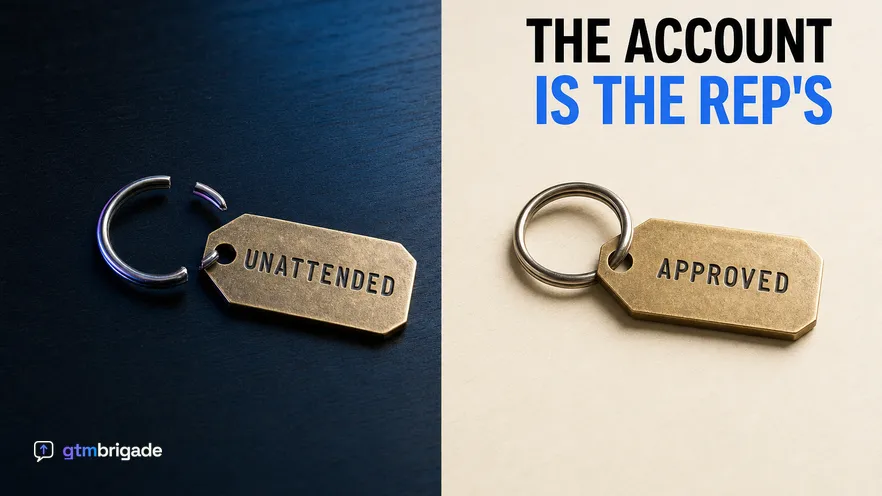
Software finds the posts, drafts the comment and routes the item. The rep reads, edits and approves. Nothing publishes unattended. The distinction matters because almost every vendor claims a human is in the loop, and the claim is often nominal.
The test is specific. Ask what happens if nobody logs in for a day. If the answer is that queued actions execute anyway, the human is not in the loop, they are a configuration step. If the answer is that nothing happens and the queue waits, the loop is real.
In practice the working shape is a short daily queue filtered to the accounts a rep owns, with the deal stage attached, and a drafted comment in that rep own voice ready to edit. The rep spends about fifteen minutes on five to eight items before their first meeting. The commitment is small deliberately, because a cadence that survives a bad week beats one that collapses at quarter-end.
The drafts should be a starting point rather than an output. A voice model that learns from each rep edits settles after roughly twenty to forty edited comments, and if reps are publishing drafts unedited then the model has stopped learning and the comments will drift toward generic within a month.
Why lower volume is not the disadvantage it looks like
Messages sent is not the constraint on most B2B pipelines, so optimising it buys less than it appears to. This is the argument that decides the trade, and it is worth making with numbers rather than assertion.
GTM Brigade runs the State of LinkedIn, a continuously measured public dataset built from 56,845 unique posts across 11,020 active creators on a rolling 60-day window. The top 1% of posts capture 40% of all engagement, with a Gini coefficient of 0.841. Attention is extremely concentrated, which means broadcasting more of anything, posts or messages, competes against that distribution rather than escaping it.
Engagement does escape it. A comment under a chosen buyer post arrives in their notifications, attached to something they wrote and already care about. Reaching fifteen named buyers that way is worth more than several hundred messages into inboxes that filter unrecognised senders by default.
Gartner B2B buying research has consistently found buying groups spend only a small share of the purchase cycle with supplier representatives at all, split across every vendor on the shortlist. When access is that scarce, quality of contact dominates quantity of contact, and volume strategies are competing for a share that is capped no matter how many messages they send.
What a restricted account actually costs
The asset at risk is the rep professional network, and your company does not own it. Teams evaluating this trade usually price the software and not the downside, which is the wrong way round.
Start with what is lost. A restriction removes access to the connections a rep built over a career, the conversation history inside them, and the profile that carries their reputation. In a permanent case none of that is recoverable, and it does not transfer to a new account because the connections were relationships rather than records.
Then consider who absorbs it. The company loses a channel and some pipeline, which is recoverable within a quarter. The rep loses an asset they will carry to their next three jobs, and they lose it because of a tool decision made above them. Salesforce State of Sales research has repeatedly found representatives already spending a minority of their week actually selling, so the goodwill cost of adding personal risk on top of that lands harder than it looks on a slide.
There is a quieter cost as well. Once one rep is restricted, the rest of the team stops using the tool properly, whatever the official position is. The programme does not get cancelled, it gets quietly abandoned, which is harder to detect and harder to fix.
Price the downside explicitly when you evaluate. Not as a probability, which nobody can supply honestly, but as a question: if this happens to your best rep in month four, what do you do. If there is no acceptable answer to that, the architecture is the wrong one regardless of the feature comparison.
What to ask every vendor, including us
Four questions, and get the answers in writing rather than in a call. They apply to us as much as to anyone else on your list.
How do you access LinkedIn. Ask for specifics: a browser extension, a cloud session, an official integration, or nothing at all beyond what the rep does themselves. Vague answers about proprietary technology are answers.
What happens if nobody logs in for a day. This is the human-in-the-loop test above, and the answer separates real approval from nominal approval.
What happened to your customers during 2025 and 2026 enforcement. Any vendor operating through that period has a real answer, and how willingly they give it tells you something on its own.
Who carries the risk if an account is restricted. In practice the rep does, whatever the contract says, so what you are really asking is whether the vendor acknowledges it. A vendor that says the risk is zero is either not describing their own architecture accurately or has not thought about it.
If your shortlist is signal capture rather than sequencers, the Trigify alternative comparison covers that case, and the full motion this architecture supports is set out in the LinkedIn engagement-to-pipeline playbook for B2B GTM teams. Where the tool in question is the other one most often on the same shortlist, the Expandi alternative for safe LinkedIn Outreach applies the same four questions.
Last updated: September 2026