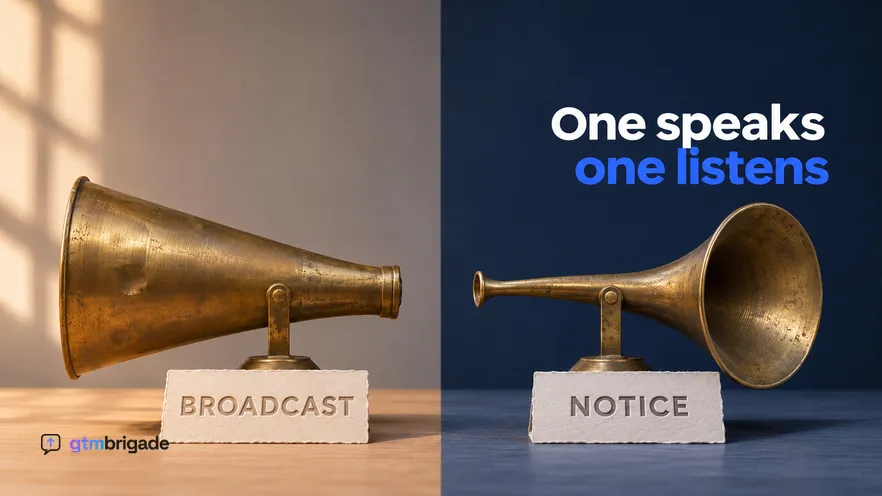
GTM Brigade vs Taplio is a comparison between two tools that both live on LinkedIn and face in opposite directions. One points at your feed and helps you publish. The other points at everybody else's feed and helps you respond. Picking by feature list is how teams end up owning the one that fixes a problem they did not have.
We publish this page and we are one of the two products on it. That disclosure belongs here rather than in a footnote, and the table below names the rows where we are the wrong answer.
GTM Brigade vs Taplio: which direction each one faces
Taplio-class tooling is built to get you publishing: ideas, drafts, a schedule and audience growth. GTM Brigade is built for the moment after somebody else publishes, when a buyer says something in public and nobody on your team responds. That is the whole distinction, and it survives every feature release on either side.
Think about where each tool's work lands. With a scheduling tool, the output is a post on your own page. You wrote it, it goes out on Tuesday, and the value is cumulative recognition: more people in your market know who you are and roughly what you think.
With ours, the output lands on a buyer's post. Somebody at an account you care about writes about a problem, your founder's voice appears underneath it with something useful rather than a compliment, and the rep who owns that account is told it happened. The value is a conversation that started from the buyer's own words.
Both are legitimate. They are just not substitutes, and the teams that get this wrong almost always bought the one they had heard of rather than the one matching their gap. The tell is a renewal conversation in which nobody can say what changed.
The diagnosis that decides it
Count your last ninety days. Under five posts from the people who should be posting means production is your constraint. Twenty posts and no meetings you can trace means follow-up is your constraint. It takes two minutes and almost nobody does it before booking demos.
The production case is real and common. Most founders who decide to build presence stop within weeks, because writing something worth reading on a schedule is hard and the early feedback is thin. Tooling that supplies a prompt, a draft and a calendar removes the two usual excuses, and for that team it is the right purchase.
The follow-up case looks completely different from the inside. The posts go out, the impressions are fine, the comments are mostly from peers, and the pipeline review each month contains nothing attributable to any of it. Adding more posts to that pattern produces more of the same pattern.
What is missing in the second case is a sequence of five small steps that nobody owns: notice that a buyer acted in public, decide whether it matters, route it to the rep who holds that relationship, help them respond as themselves rather than as a template, and record that the resulting meeting began there. None of those is hard alone. They fail because they span three people and no system, so each handoff is a place where a moment expires.
Why volume is the weaker lever
Attention on LinkedIn is concentrated enough that publishing more is a poor default strategy. Our State of LinkedIn dataset, a continuously measured record built from 56,845 unique posts across 11,020 active creators on a rolling 60-day window, shows the top 1% of posts capturing 40% of all engagement, with a Gini coefficient of 0.841.
The practical reading is that most posts earn almost nothing, and that is the normal outcome rather than evidence of a bad post. A team that responds to weak results by doubling output is buying a larger share of a pool it barely touches.
It also explains why the same post from two different people produces wildly different results. That reflects accumulated standing, which publishing builds slowly and no tool shortcuts. Comparing your first quarter against somebody with three years of presence is comparing two stages of one process.
Forrester's research on B2B buying has consistently found that buyers form views from peer and public sources well before they contact a supplier [Forrester], which is exactly why presence is worth building and exactly why being present in a buyer's own conversation beats being present in your own.
Taplio and GTM Brigade, compared
The rows are jobs rather than features, and the second column is ours, so read it as a claim to check. The last three rows are the ones that decide a shortlist.
| Taplio | GTM Brigade | |
|---|---|---|
| Problem it fixes | Nothing gets posted | Nobody follows up |
| Where the work lands | Your own post | A buyer's post |
| Core job | Drafting, scheduling | Watchlists, replies, routing |
| Drafts for you | Yes, posts | Yes, comments |
| Who approves | You, before posting | A rep, before replying |
| Writes to the CRM | No | HubSpot, Salesforce |
| Builds your audience | Yes, directly | No, not its job |
| Gives you something to say | Partly | No, that is still yours |
| Needs daily human time | A writing slot | Ten minutes approving |
Three of those rows are the limit of our own column, and they are in the table rather than underneath it. We do not build your audience, we do not supply the thing worth saying, and we need somebody to approve drafted comments most days. A team that cannot commit those ten minutes will get nothing from us.
If you are specifically replacing a publishing tool rather than adding to one, the Taplio alternative page covers that case directly. The full sequence from a buyer's post to an attributed meeting is in the LinkedIn Engagement-to-Pipeline playbook for B2B GTM teams.
The verdict
Buy the scheduling tool if the honest answer is that your team does not publish. Buy ours if you publish well and cannot name a meeting that came from it. Both failures are common and the fix for one does nothing for the other.
There is a sequencing argument worth stating plainly, because it works against us. A team with no presence at all will get more from eight weeks of consistent publishing than from any engagement programme, since a comment from an account nobody recognises does less work than the same comment from a known one. If that is you, start there and come back in a quarter, when the same comment will carry more weight and cost you nothing extra to send.
And the case where we are wrong is not only the early one. If your buyers discuss their problems somewhere other than LinkedIn, we cannot see those conversations and the watchlist has nothing to watch. If nobody will spend ten minutes a day approving drafts, the comments either stop or stop sounding like a person, and both outcomes are worse than not starting. The adjacent comparison, where the question is lists against watchlists rather than publishing against responding, is GTM brigade vs Sales Navigator.