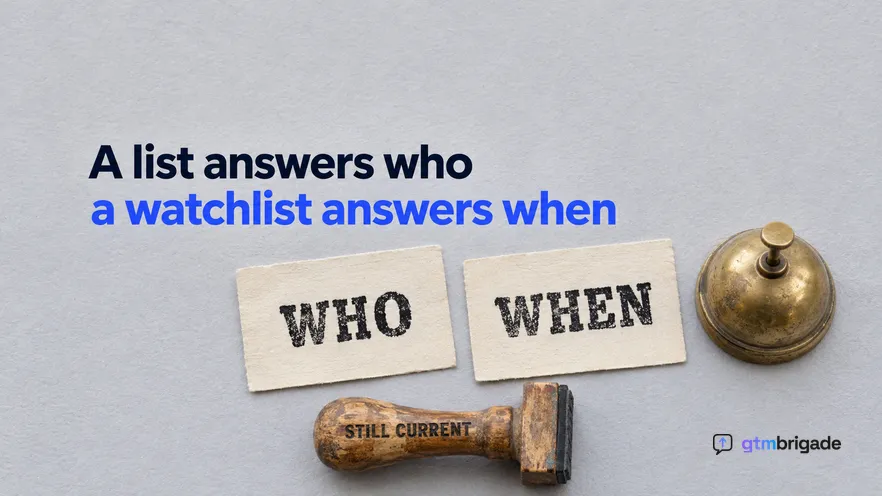
GTM Brigade vs Sales Navigator is a comparison between a list and a watchlist. Both start from the same thing: a set of accounts you have decided you want. What differs is whether the tool helps you assemble that set or helps you know when somebody on it is worth calling today.
We publish this page and we are one of the two products on it. The table names the rows where we are the wrong answer, and the verdict names the case where you should buy the other one.
GTM Brigade vs Sales Navigator: assembling against watching
Sales Navigator-class tooling is built to answer who. Filter the market, find the right titles at the right companies, save them, work through them. GTM Brigade is built to answer when: it watches that set and tells the right rep the moment somebody on it says something in public. Both are necessary in a mature motion and they are not interchangeable.
The distinction matters because the two failures look nothing alike. A team without good search tooling does not know who it is selling to. Its outreach is scattered, its list is built from guesses, and no amount of timing intelligence helps, because the people being watched are the wrong people.
A team with a good list and no timing has the opposite problem, and it is harder to see. The list is accurate. The messaging is reasonable. Every message still lands on an arbitrary day, chosen by whoever was working the queue, which is why reply rates sit where they sit.
What a watchlist adds is a reason to send today rather than on some other day. That is a smaller claim than most tooling makes and it is the one that moves reply rates, because it changes the only variable that was being left to chance.
A saved list is not a watchlist
A saved list is a static set of names you work through at your own pace. A watchlist is the same set with something attached that notices public activity and routes it while it is still current. The list is the input. The watching is the job.
It is worth being concrete about what the watching involves, because teams assume it is a notification feature. Five steps have to happen in order: somebody notices that a person on the list acted in public, decides whether it matters, routes it to the rep who owns that relationship, helps them respond as themselves rather than as a template, and records that the resulting meeting began there.
None of those steps is difficult alone. They fail because they span three different people and no single system, so each handoff is a place where a moment expires. The marketer who saw the post does not own the account. The rep who owns the account never saw the post.
That last step, the recording, is less glamorous and more decisive than the rest. A motion that cannot show where its pipeline came from gets cut in the first budget review regardless of whether it was working, which is why attribution into Salesforce or HubSpot is a feature rather than a nicety.
Why timing beats volume here
Attention on LinkedIn is concentrated enough that broadcasting more is a poor default, and a window a buyer opened themselves is the cheapest alternative available. Our State of LinkedIn dataset, a continuously measured record built from 56,845 unique posts across 11,020 active creators on a rolling 60-day window, shows the top 1% of posts capturing 40% of all engagement, with a Gini coefficient of 0.841.
The useful reading for a sales team is not about publishing at all. It is that public activity is scarce and unevenly distributed, so the occasions when a specific target account says something in public are rare, identifiable and currently being missed by almost everyone.
That scarcity is what makes the signal worth watching for. If every account posted every day, timing would carry no information. Because most do not, the ones that do have handed you a dated, specific, non-invented reason to start a conversation. It is also the reason the window is narrow: the post is current for a few days and then it is just something that happened, which is why a weekly review of saved activity collects history rather than opportunities.
Forrester's research on B2B buying has consistently found that buyers form views from peer and public sources well before they contact a supplier [Forrester], and Gartner's work on the buying journey points the same way: most of the process happens before a seller is involved [Gartner]. A watchlist is an attempt to be present during that part rather than after it.
Sales Navigator and GTM Brigade, compared
The rows are jobs rather than features, and the second column is ours, so read it as a claim to check. The last three rows decide most shortlists.
| Sales Navigator | GTM Brigade | |
|---|---|---|
| Question it answers | Who to contact | When to contact |
| Core job | Search, filter, save | Watch, draft, route |
| Output | A list of people | A reason to act today |
| Finds your market | Core strength | No |
| Contact data | Core strength | Out of scope |
| Notices public activity | Partly | Core strength |
| Drafts the reply | No | Yes, in your voice |
| Routes to the right rep | Manual | Yes |
| Writes to the CRM | Partly | HubSpot, Salesforce |
Three of those rows are the limit of our column and they sit in the table rather than beneath it. We do not define your market, we do not supply contact data, and we need a person to approve drafted replies most days. A team that cannot commit that will get nothing from us.
If you are specifically looking to replace search tooling rather than add to it, the Sales Navigator alternative page covers that case directly. The full sequence from a buyer's post to an attributed meeting is in the LinkedIn Engagement-to-Pipeline playbook for B2B GTM teams.
The verdict
Buy search tooling if you cannot describe your target market precisely enough to build a list. Buy ours if the list is good and every message still goes out on an arbitrary day. Those are different problems and the fix for one does nothing for the other.
The case against us is worth stating plainly. If your market is undefined, a watchlist watches the wrong accounts and reports faithfully on people who will never buy. Fix the targeting first; it is cheaper and it makes everything downstream work better, including us.
There are two further cases where we are the wrong answer. If your buyers do their talking somewhere other than LinkedIn, we cannot see it and the watchlist has nothing to watch. And if nobody will spend ten minutes a day approving drafts, the replies either stop or stop sounding like a person, which is worse than never starting. The adjacent comparison, where the question is publishing against responding rather than lists against watchlists, is GTM brigade vs Taplio, and the one about engagement that is real against engagement that is manufactured is GTM brigade vs Lempod.