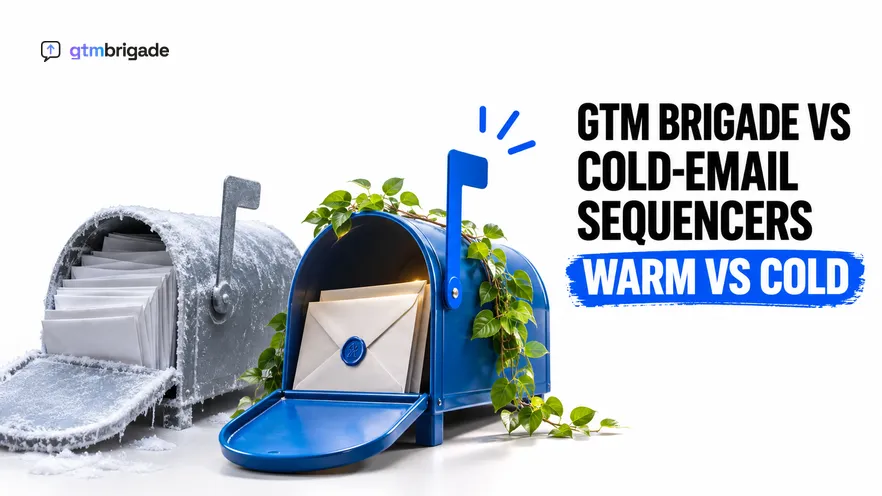
GTM Brigade vs cold-email sequencers is a comparison between interrupting and answering. A sequencer picks people who have told you nothing and writes to them anyway. We wait until somebody at an account you want says something in public, and then help you be the useful reply. Both open conversations. They cost very different amounts to open.
We publish this page and we are one of the two options on it. That disclosure belongs here rather than in a footnote, and the table below names the rows where we are the wrong answer.
The category comparison, written as a use-case page rather than as an argument, is vs cold-email sequencers. This page is about which of the two fits the gap you actually have.
GTM Brigade vs cold-email sequencers: what each one starts from
A sequencer starts from a list, so relevance has to be inferred. We start from something the buyer did, so relevance is supplied by the buyer. Everything else about the two tools follows from that single difference.
Picture the sequencer's input. A title, a company size, a technology, maybe a funding event. From those, a message is written that guesses what the recipient is dealing with this week. Sometimes the guess lands. Mostly it does not, which is why the mathematics of the channel are volume mathematics.
Now picture ours. Somebody at an account on your watchlist writes publicly about a problem. That is a statement of what they care about this week rather than a guess at it, so a reply engaging with the actual point arrives as a contribution rather than as an intrusion.
The asymmetry worth noticing is permission. Nobody invited the sequencer's email. The person who posted did invite responses, which is what posting is for, so the same words land differently purely because of where they appear.
The constraint nobody budgets for
A sequencer's real cost is deliverability rather than the seat price. Inbox providers have tightened what they tolerate, and a domain that sends volume to people who do not engage pays for it on every future send, including the ones that matter.
This is the part that catches teams out, because the damage is slow and shared. The sequence runs, the open rates drift down, and the eventual bill arrives as deteriorating placement across every message the company sends, including replies to warm conversations and invoices from finance.
Treating a sending domain as a renewable resource is the expensive assumption. It is closer to a credit rating: cheap to spend, slow to repair, and the repair work happens at exactly the moment you need the channel to perform.
None of which argues for abandoning cold email. It argues for sending less of it to better-chosen people, which is the same conclusion most careful operators have reached independently, and it is why the two tools sit together more comfortably than vendors on either side admit.
Whether your buyers are visible at all
Take twenty target accounts and count how many have somebody posting or commenting publicly in the last month. That number decides this purchase more than any feature. If it is most of them, answering is available to you. If it is almost none, we have nothing to watch.
Our State of LinkedIn dataset, a continuously measured record built from 56,845 unique posts across 11,020 active creators on a rolling 60-day window, shows the top 1% of posts capturing 40% of all engagement, with a Gini coefficient of 0.841.
Two readings follow, and the second is the one that matters here. Attention is concentrated, so publishing more into that distribution is a weak lever. And the activity that does exist is highly visible, which means the buyers who are active are easy to find and currently being answered by almost nobody.
Forrester's research on B2B buying has consistently found that buyers form views from peer and public sources well before they contact a supplier [Forrester], which is the argument for being present in those conversations rather than only in an inbox.
Cold-email sequencers and GTM Brigade, compared
The rows are jobs rather than features, and the second column is ours, so read it as a claim to check. The last three rows are the ones that decide a shortlist.
| Cold sequencer | GTM Brigade | |
|---|---|---|
| Starts from | A built list | A public action |
| Reaches silent buyers | Yes | No |
| Relevance comes from | Your inference | The buyer |
| Main constraint | Deliverability | Buyer visibility |
| Volume model | High send count | Few, chosen replies |
| Writes to the CRM | Usually | HubSpot, Salesforce |
| Risk when overused | Domain reputation | Reads as formulaic |
| Gives you something to say | Partly | No, still yours |
| Needs daily human time | Little | Ten minutes approving |
Three of those rows are the limit of our own column, and they are in the table rather than underneath it. We cannot reach a buyer who says nothing in public, we do not supply the substance of the reply, and we need somebody to approve drafts most days.
The full sequence from a buyer's post to an attributed meeting is in the LinkedIn Engagement-to-Pipeline playbook for B2B GTM teams. Where the comparison is publishing against responding rather than cold against warm, that is GTM brigade vs Taplio, and where it is detection against response, GTM brigade vs Trigify.
What this costs to run
A sequencer's running cost is mostly list and domain work. Ours is a standing ten minutes of human attention. Both are real and they fall on different people, which is why the purchase decision often sits with whoever has capacity rather than with whoever has the problem.
The sequencer's hidden labour is list hygiene: sourcing, verifying, suppressing, warming domains and rotating them when placement slips. None of it is visible in a demo and all of it decides whether the channel works in month six.
Ours is narrower and harder to delegate. Somebody who can speak credibly in the founder's voice has to read drafted comments and approve or reject them, most working days. That is ten minutes rather than an hour, and it cannot be handed to somebody with no context, because an approved comment that misreads the thread is worse than silence.
The verdict
Buy the sequencer if your buyers are invisible, and buy ours if they are visible and nobody is answering them. Most teams discover they need both, in that order, with the warm motion taking the accounts it can reach and cold outbound handling the rest.
The case where we are clearly wrong deserves stating plainly. A market whose buyers do their talking in private, or somewhere we cannot see, gives a watchlist nothing to work with, and no amount of drafting quality compensates. Industries where the buying committee is genuinely absent from public conversation are real, and in those a sequencer is the correct instrument rather than a compromise.
The other failure case is organisational rather than market-based. If nobody will spend ten minutes a day approving drafted comments, the replies either stop or stop sounding like a person, and the second outcome is worse than not starting. That is a standing commitment rather than a configuration, and it is the honest thing to check before a demo rather than after one.