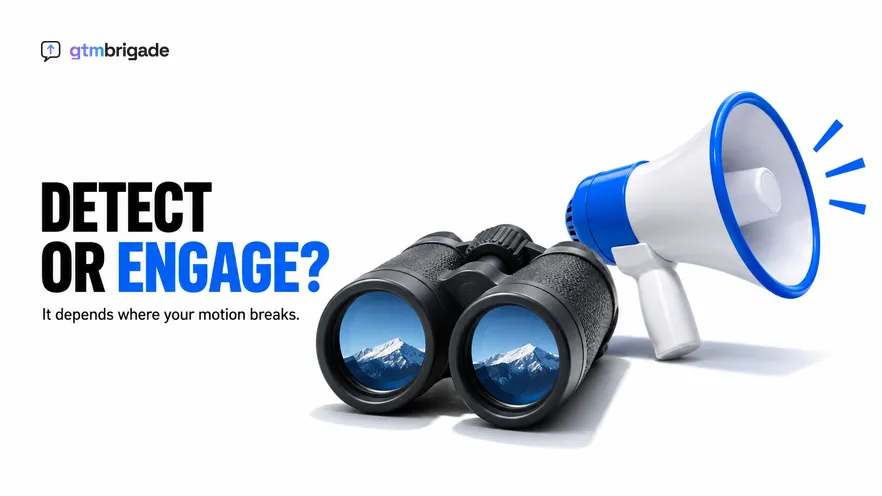
GTM Brigade vs Trigify is a comparison between knowing and answering. Signal tooling tells you that somebody at an account you care about just did something. We help you be the useful reply underneath it. Those are adjacent steps in one motion, and a team usually has a gap at exactly one of them.
We publish this page and we are one of the two products on it. That disclosure belongs here rather than in a footnote, and the table below names the rows where we are the wrong answer.
GTM Brigade vs Trigify: where each one stops
Signal-detection tooling of the Trigify class watches public activity, judges what counts and delivers it into your stack. GTM Brigade starts at the point where that alert has arrived and nobody has done anything with it. The products are sequential rather than overlapping.
Detection is a genuinely hard job and worth paying for. Deciding which of thousands of public actions constitutes a buying signal, attaching it to the right account and getting it into a system your reps already use is engineering work most teams cannot do themselves.
What detection cannot do is respond. An alert is a fact about the past: somebody moved. Turning that into a conversation requires a human who knows the account to say something worth reading, within a window measured in hours rather than days.
That is the handoff where most signal programmes quietly fail. The feed works, the alerts are accurate, and they accumulate in a channel nobody owns, because responding well is a writing task and the alert arrived in a tool built for routing.
The diagnosis that decides it
Count last month's signals and the share that produced a reply from a named person within a day. A low first number means you need detection. A large first number and a small second means you need the other half. It takes ten minutes and it is rarely done before a demo.
The detection case is straightforward. If nobody on the team can say which of your target accounts was active in public last week, you are not choosing between tools, you are choosing between having the information and not having it.
The response case is the one that gets misdiagnosed, because the symptom resembles a data problem. Alerts arrive, nothing happens, and the team concludes the signals must be low quality. Sometimes they are. More often they are fine and the next step was never assigned to anybody.
The step that is actually missing is small and spans people: notice, judge, route to the rep who holds the relationship, help them respond as themselves, and record that the meeting began there. Each is easy alone. They fail because each handoff is a place where a moment expires.
Why the response has to be public
A reply underneath a buyer's own post uses context the buyer supplied, in a venue they chose for responses. A private message triggered by the same signal throws both away. That is the argument for engagement over notification.
Our State of LinkedIn dataset, a continuously measured record built from 56,845 unique posts across 11,020 active creators on a rolling 60-day window, shows the top 1% of posts capturing 40% of all engagement, with a Gini coefficient of 0.841.
The useful reading for this comparison is about scarcity of response rather than scarcity of attention. Most posts, including posts from senior buyers at good accounts, receive very little thoughtful engagement. A substantive reply is therefore unusually visible, because it is competing with congratulations and emoji.
Forrester's research on B2B buying has consistently found that buyers form views from peer and public sources well before they contact a supplier [Forrester], which is why a visible answer does work that a private one cannot: other people in the same market read it too.
Trigify and GTM Brigade, compared
The rows are jobs rather than features, and the second column is ours, so read it as a claim to check. The last three rows are the ones that decide a shortlist.
| Trigify | GTM Brigade | |
|---|---|---|
| Watches public activity | Core strength | Yes, by watchlist |
| Decides what counts | Core strength | Yes, narrower |
| Delivers to your stack | Yes | HubSpot, Salesforce |
| Drafts the response | Out of scope | Yes, in your voice |
| Routes to the owner | Partly | Yes, by relationship |
| Responds in public | Out of scope | Core strength |
| Attributes the meeting | Partly | Yes, at reply time |
| Gives you something to say | No | No, still yours |
| Needs daily human time | Little | Ten minutes approving |
Three of those rows are the limit of our own column, and they are in the table rather than underneath it. Our watchlist is narrower than a broad detection net by design, we do not supply the substance of a reply, and we need somebody to approve drafts most days.
If you are specifically replacing signal tooling rather than adding to it, the Trigify alternative page covers that case directly. The full sequence from a buyer's post to an attributed meeting is in the LinkedIn Engagement-to-Pipeline playbook for B2B GTM teams, and where the question is publishing against responding, that is GTM brigade vs Taplio. The breadth-against-depth version of this argument is GTM brigade vs Common Room.
What each one costs to run
Detection's running cost is tuning. Ours is a standing ten minutes of human attention. Both are ongoing, both fall on different people, and neither appears in a pricing table.
Tuning is the work of deciding what counts. Set the net too wide and the feed fills with activity nobody would call a signal, which trains the team to ignore it. Set it too narrow and real movement goes unseen. That calibration is never finished, because the market and the account list keep changing.
Our cost is narrower and harder to delegate. Somebody who can speak credibly in the founder's voice has to read drafted comments and approve or reject them most working days. It is ten minutes rather than an hour, and it cannot be handed to somebody with no context, because an approved comment that misreads the thread is worse than silence.
There is a shared cost worth naming too. Both motions need the rep who owns the relationship to be identifiable, which sounds administrative and is the thing that most often breaks in practice. An alert or a draft with no clear owner is a task that expires quietly, and that single gap accounts for more dead signal programmes than tool quality ever has.
The verdict
Buy detection if you cannot see what your buyers are doing. Buy ours if you can see it and nobody answers. Plenty of teams need both, and the order matters only because buying the wrong half first changes nothing for a quarter.
The case where we are the weaker purchase is a team whose target accounts are wide and loosely defined. A watchlist works because it is narrow, so an organisation that wants to monitor a whole market rather than a chosen list is asking for a detection net, and ours is deliberately not that.
The second failure case is organisational. If nobody will spend ten minutes a day approving drafted comments, the replies either stop or stop sounding like a person, and the second outcome damages more than it builds. That is a standing commitment rather than a setting, and it is worth confirming before a demo rather than after one.