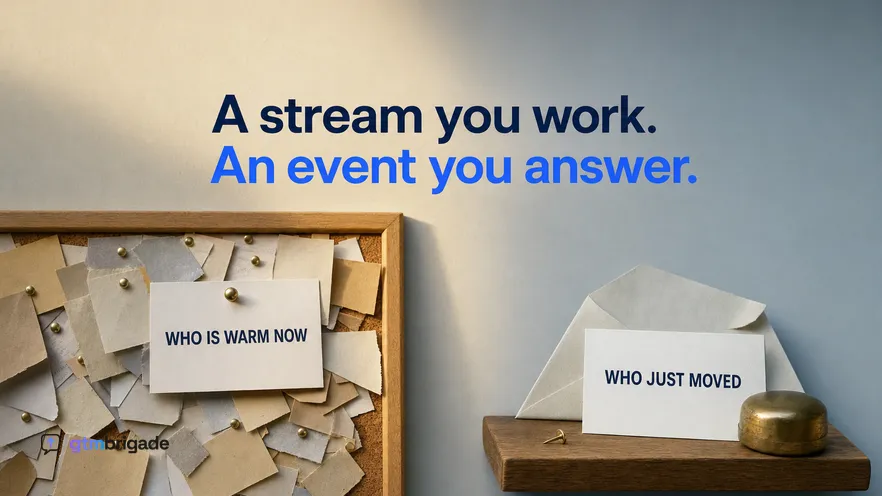
What Common Room and UserGems each mean by buyer signal
Common Room and UserGems both sell buyer signal, and they collect two different kinds of it. Common Room reads the present tense. UserGems reads a change of state. Almost every sensible comparison between them follows from that one distinction.
Common Room aggregates activity across the surfaces where your buyers and users already are: community spaces, social feeds, product usage, support conversations. It resolves that activity to people and accounts and tells you who is currently warm. The output is a stream that is always running and always partially relevant.
UserGems watches for people moving. When a champion, a past buyer or a former user lands in a new role, you hear about it. The output is an event: rare, dated, and unusually easy to act on, because the person on the other end already believes the thing you sell works.
Neither description is a criticism. They are answers to different questions, and the question you actually have determines which one is worth money this year.
Why the tense of a signal changes what you do with it
A stream is something you work; an event is something you respond to. That difference shapes the process around the tool far more than any feature does.
Present-tense signal arrives continuously and unevenly. Some weeks it surfaces three accounts worth a conversation and some weeks none, and the discipline it demands is a daily habit: somebody opens the queue, reads what is there, and acts within the short window a live signal stays live. Teams that check it weekly get almost nothing from it, because by Friday the moment has passed.
Change-of-state signal arrives rarely and predictably matters. There is no queue to work and no habit to build. There is a routing question, which is whether the alert reaches the right rep quickly, and a message question, which is whether the outreach acknowledges the relationship or reads like a template that happens to know where they work now.
The operational consequence is that the two tools fail in opposite ways. A present-tense tool fails quietly through neglect: nobody opens it, and nobody reports that nobody is opening it. A change-of-state tool fails loudly through a bad first message: the alert fires, somebody sends something clumsy, and a warm relationship gets spent for nothing.
Where each one is strong
Common Room is strong where your buyers are visibly active and your accounts outnumber your relationships. It is a breadth instrument, and breadth is what most teams are short of.
If you sell into a market with active public discussion, an engaged user community, or a product with a usage surface you can read, the present tense is rich. You can see who is asking questions, who joined, who is suddenly paying attention, and you can reach them while it is true.
UserGems is strong where your relationships outnumber your visible signal. It is a depth instrument, and depth is what companies with long customer histories are sitting on without using.
If you have a few hundred closed-won accounts and several years of champions, every quarter moves some of those people into new seats with new budgets. That is pipeline you have already earned and are currently not collecting, and it is close to the cheapest source of qualified conversation available to a B2B company.
Where each one is weak
Common Room is only as good as the surfaces it can see, and some markets barely use them. This is the honest limit and it is worth checking before a trial rather than during one.
Take twenty named buyers from real target accounts and look at whether they have posted, commented or participated anywhere public in the last sixty days. In some markets that number is fifteen. In parts of manufacturing, public sector procurement and clinical buying it is nearer zero, and no amount of aggregation creates signal that was never emitted.
UserGems is thin on its own, by arithmetic rather than by design. Even a substantial customer base produces a modest number of relevant moves per quarter, and a motion built entirely on job changes runs out of things to do by the second month.
There is a second limit worth naming. Job-change signal is only as valuable as the relationship behind it. A champion who loved you moves and becomes a warm introduction. A contact who evaluated you once and chose somebody else moves and becomes a cold email with a slightly awkward opening line.
That distinction is not visible in the alert, which is why the routing rule matters more than the alert volume. An alert that reaches a rep with no context about how the relationship actually went produces outreach that assumes warmth it has not earned, and the first message is the one that decides whether there is a second. The teams that get the most from this category do one unglamorous thing first: they grade their historical contacts before switching the alerts on, so that a move by a genuine champion and a move by a lukewarm evaluator arrive as two different instructions rather than as the same notification.
The two compared
The table below sets the two against the decisions a GTM team actually makes, rather than against a feature list. The row that usually decides it is the last one.
| Common Room | UserGems | |
|---|---|---|
| Signal type | Present-tense activity | Change of state |
| Unit | A person engaging now | A person who moved |
| Volume | Continuous, uneven | Rare, predictable |
| Conviction per item | Moderate | High |
| Fails by | Neglect, quietly | A bad first message |
| Needs from the team | A daily habit | Fast routing |
| Suits you if | You cannot see who is warm | You cannot see when champions move |
The last row is the whole decision. Both tools are good at what they do, and buying the one that does not address your bottleneck produces a well-instrumented version of the problem you already had.
Where GTM Brigade sits relative to both
GTM Brigade is a LinkedIn engagement platform for B2B GTM teams that builds curated buyer watchlists, drafts comments in the founder's voice, routes buying signals to reps, and attributes the resulting pipeline in HubSpot and Salesforce. That is a different job from either tool above, and the difference is what happens after the signal.
Common Room and UserGems both answer a question about where to spend attention. Neither spends it. The gap most teams discover three months into a signal subscription is that knowing an account is warm does not produce a comment, a conversation or a relationship, and the daily human work of showing up in front of a named buyer is still entirely theirs to do.
GTM Brigade runs the State of LinkedIn, a continuously measured public dataset built from 56,845 unique posts across 11,020 active creators on a rolling 60-day window. The top 1% of posts capture 40% of all engagement, with a Gini coefficient of 0.841. That concentration is the reason a signal tool alone underdelivers: publishing more content is a lottery ticket, while commenting under a named buyer's own post arrives in their notifications by a direct mechanism rather than a probabilistic one.
So the practical arrangement is a sequence rather than a choice. Signal decides who belongs on the watchlist. Engagement is what makes the eventual conversation possible. Attribution is what keeps the whole thing funded past its first budget review.
Why the follow-through decides the outcome
Every signal tool is a prioritisation layer, and prioritisation is worth nothing without capacity behind it. This is the part of the evaluation that gets skipped, because it is about your team rather than about the software.
Gartner B2B buying research has consistently found that buying groups spend only a small share of the purchase cycle with supplier representatives at all, and that share is divided across every vendor on the shortlist. If formal access is that thin, the value of knowing an account is in-market depends entirely on having somewhere informal to be present.
There is a capacity problem underneath it too. Salesforce State of Sales research has repeatedly found representatives spending a minority of their week actually selling. Adding a stream of alerts to a team that is already short of selling time does not create selling time. It creates a queue that goes unworked, which is the most common outcome of a signal purchase and the least often reported one.
The fix is unglamorous and it is the same in both cases. Decide the daily floor before the tool arrives: fifteen minutes, five to eight comments, before the first meeting. A floor a manager can coach against survives a bad week, and an hour every Friday does not.
How to decide, in one exercise
Run this before a trial, not during one, because a trial answers whether the tool works and not whether you needed it. It takes about an hour.
Pull your last forty opportunities and mark each one with what would have told you it was coming. Some will be visible activity: somebody engaging, asking, participating. Some will be a person who moved. Some will be neither, and that third group is usually larger than anyone expects.
If the first group dominates, your gap is present-tense visibility. If the second dominates, you are leaving earned relationships uncollected and a job-change trigger pays for itself quickly. If the third dominates, neither tool is your problem: your problem is that nobody is building familiarity with named buyers before the deal exists, and a signal subscription will not touch it.
The related comparisons worth reading alongside this one are Clay vs Common Room, which sets observation against the enrichment layer underneath it, Taplio vs Trigify, which covers the content-against-signal split, and a Common Room alternative for LinkedIn pipeline if you have already decided that present-tense signal is the gap. The full sequence sits in the LinkedIn engagement-to-pipeline playbook for B2B GTM teams.
The verdict
Buy UserGems if you have a customer history you are not collecting, buy Common Room if you have accounts you cannot read, and buy neither first if nobody owns the daily engagement habit. That ordering is deliberate.
Job-change signal is the cheapest and most defensible first purchase for a company with a few years of closed-won accounts behind it, because the pipeline it surfaces has already been earned once and the conversion per conversation is unusually high.
Present-tense signal is the stronger purchase for a company selling into a visibly active market, particularly one with a community or a product surface of its own, where the volume justifies a daily habit.
And if the honest answer to the forty-opportunity exercise is that most deals arrived with no prior signal at all, the useful next step is not a purchase. It is deciding who owns a watchlist, what the daily floor is, and where the engagement gets written back, which is what the engagement-to-pipeline playbook covers end to end.
Last updated: September 2026