What Clay and Common Room each actually do
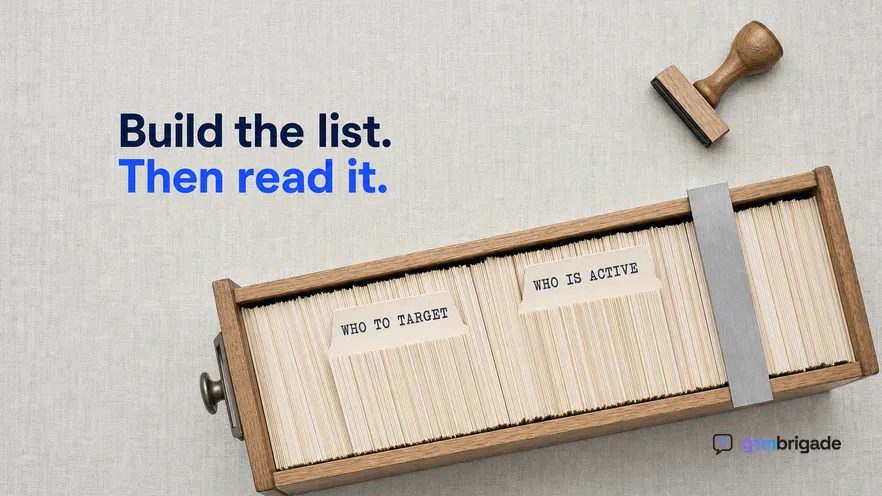
Clay and Common Room get compared because both sit upstream of outbound, and they solve opposite halves of the problem. Clay constructs the list. Common Room watches it. Once that is clear, most of the evaluation answers itself.
Clay is an enrichment and orchestration layer. You describe the population you want, and it assembles it and fills in what is missing, drawing on many data sources in sequence rather than relying on any one of them. The output is a list that is accurate enough to act on today, with the fields you need attached to each row.
Common Room is an observation layer. It reads the surfaces where your buyers and users already are, resolves activity to people and accounts, and tells you which of them are doing something now. The output is a stream of attention, not a population.
The distinction matters because the two fail in opposite directions. A team with excellent enrichment and no observation works a correct list at the wrong moments. A team with excellent observation and no enrichment watches a population it never deliberately chose.
Why enrichment is the harder half to skip
An observation layer needs a defined population to watch, and a team without a current list of named buyers has nothing to point it at. That is the practical reason enrichment usually comes first.
The failure is quiet rather than dramatic. Monitoring switched on over a vague or inherited population reports diligently about people who were never going to buy, and because the reports arrive and look like work, it takes a quarter or two before anyone questions the underlying list.
There is a maintenance argument too, and it is the one most plans underrate. A list is accurate on the day it is built and less accurate every week afterwards. People change roles, companies reorganise, titles get renamed, and a list worked for a year without refresh is substantially wrong by the end of it. Enrichment is a subscription to freshness rather than a one-off construction project.
That is also the strongest argument for an orchestration approach over a single data provider. Every provider has gaps, and the gaps are not the same gaps. Running sources in sequence until a field is filled produces a materially more complete record than any single source, and completeness is what decides whether a rep trusts the list enough to work it.
Trust is the real currency here and it is lost quickly. A rep who opens a list, finds three wrong titles in the first ten rows and one person who left the company a year ago will stop treating the list as authoritative, and no amount of later accuracy fully recovers that. Enrichment quality is therefore an adoption question before it is a data question, which is why the teams that get value from this layer tend to over-invest in the first build and then refresh on a fixed schedule rather than when somebody complains.
Where observation earns its place
Observation is worth buying once the population is real, because it tells you which twenty of two hundred names deserve attention this week. That is a genuine scheduling problem and a hard one to solve by hand.
A watchlist of named buyers is inert without it. Reps either work it alphabetically, which produces mediocre timing, or they work whoever they remember, which produces bias toward the accounts that already like them. Knowing who is active now converts a static list into a queue with an order.
The limit is that some markets emit almost no public signal at all. The test takes ten minutes: take twenty named buyers from real target accounts and check whether they have posted, commented or participated anywhere public in the last sixty days. In some markets fifteen of the twenty have. In parts of manufacturing, public sector procurement and clinical buying, the number is close to zero, and no amount of aggregation invents signal that was never emitted.
Where that test fails, observation is not a weak purchase. It is the wrong purchase, and the money belongs in the motions that work without a public surface: associations, events and referrals.
There is a subtler limit even where the test passes. Activity is not intent, and an observation layer cannot tell the difference between a buyer researching a purchase and a professional who simply posts a lot. Treated as a ranking of who is in-market, it will reliably put your most prolific commenters at the top and your quietest serious buyer somewhere near the bottom. The teams that read it well use it to decide sequence rather than priority: it says who is reachable this week, not who is worth reaching.
The two compared
Set against the decisions a GTM team makes, rather than against a feature list, the split is clean.
| Clay | Common Room | |
|---|---|---|
| Job | Build and enrich a population | Observe a population |
| Question answered | Who is worth targeting | Who is paying attention now |
| Output | A list with fields filled | A stream of activity |
| Decays through | Role and company change | Nothing, it is live |
| Needs from you | A definition of the buyer | A population to watch |
| Fails when | The definition is wrong | Your market is not visibly active |
| Buy first if | Your list is stale or inherited | Your list is clean and unworked |
The last row is the whole decision. If your named-buyer list was built once, eighteen months ago, from a CRM export, the enrichment problem is your problem and monitoring will simply watch it decay in higher resolution.
The half neither one covers
GTM Brigade is a LinkedIn engagement platform for B2B GTM teams that builds curated buyer watchlists, drafts comments in the founder's voice, routes buying signals to reps, and attributes the resulting pipeline in HubSpot and Salesforce. The reason that exists as a separate category is that both tools above stop at the point where the work starts.
Knowing who to target and knowing when they are warm produces a name and a moment. It does not produce a relationship, and it does not produce the twenty seconds of human attention that turns a name into somebody who recognises you. That remains a daily habit performed by a person, and it is where signal programmes go to die.
The concentration of attention explains why publishing more is not the alternative. GTM Brigade runs the State of LinkedIn, a continuously measured public dataset built from 56,845 unique posts across 11,020 active creators on a rolling 60-day window. The top 1% of posts capture 40% of all engagement, with a Gini coefficient of 0.841. Publishing into that distribution is a lottery ticket even when the content is good, while a comment under a named buyer's own post arrives in their notifications by a direct mechanism.
So the honest stack is three layers rather than two: define the population, observe it, and then show up in front of it consistently enough to be a known quantity when the buying cycle starts.
Why the third layer keeps getting cut
It gets cut because it is the only layer that costs human time rather than money, and human time is the scarcest thing in a GTM team. Naming that plainly is more useful than pretending the tooling solves it.
Salesforce State of Sales research has repeatedly found representatives spending a minority of their week actually selling. Into that constraint, a signal subscription adds a queue. The queue is genuinely better than no queue, and it still needs somebody with fifteen minutes and a reason to open it before the first meeting of the day.
Gartner B2B buying research has consistently found that buying groups spend only a small share of the purchase cycle with supplier representatives at all, divided across every vendor on the shortlist. That is the strategic case for the third layer: if formal access is that thin, presence has to be built informally and in advance, or it does not get built.
The fix is a floor rather than a target. Five to eight comments before the first meeting survives a bad week. An hour every Friday fails on the first busy Friday, and it fails abruptly rather than gradually.
It is worth setting that floor before either subscription starts rather than after. A team that has already built the habit gets immediate value from better targeting and better timing, because there is somewhere for the output to go. A team that buys the tools first tends to spend the first quarter admiring the data, and by the time anyone proposes a daily habit the tools have become associated with reporting rather than with selling.
How to sequence a purchase
Buy in the order your gaps appear, and check the gaps before the demos rather than during them. One exercise settles it.
Take your current named-buyer list, sample thirty rows, and check each one against the person's current title and current employer. Count the errors. If more than a fifth are wrong, you have an enrichment problem and everything downstream inherits it.
Then take the same thirty and check whether they have been publicly active in the last sixty days. If most have, observation will pay for itself. If most have not, skip it and spend the budget on the motions that work in your market.
Finally, ask who would act on the output. If the answer is that nobody currently owns a daily engagement habit, that is the first thing to fix, because both tools are prioritisation layers and prioritisation with no capacity behind it changes nothing.
The neighbouring comparisons worth reading are Common Room vs UserGems, which covers the present-tense against change-of-state split inside the signal category, Taplio vs Trigify for the content-against-signal question one layer up, and Dripify vs Expandi vs Waalaxy for what happens when a team skips both layers and reaches for volume instead.
The verdict
Buy Clay first if your list is inherited, stale or built from a CRM export, and buy Common Room first only if your list is clean, current and genuinely unworked. In practice the first condition describes most teams.
Enrichment is the less exciting purchase and the one that determines whether anything above it is worth having. A monitoring tool pointed at a wrong population is not neutral: it generates confident activity in the wrong direction, which is more expensive than no tool at all.
Observation is the right second purchase once the population is real and your market is visibly active, because it solves a scheduling problem that reps otherwise solve badly by memory.
And whichever comes first, decide before either arrives who owns the watchlist, what the daily floor is, and where engagement is written back to the CRM. The full sequence, with the measurement for each stage, is in the LinkedIn engagement-to-pipeline playbook for B2B GTM teams. If you have already concluded that enrichment is the gap, a Clay alternative for LinkedIn signal covers the narrower case.
Last updated: September 2026