What Dripify, Expandi and Waalaxy have in common
Dripify, Expandi and Waalaxy all do the same job: they send connection requests and message sequences on your behalf, at a volume no person would sustain by hand. Everything that separates them sits underneath that shared purpose, and most of it is architecture rather than features.
This matters because feature comparisons in LinkedIn automation converge almost immediately. All three build sequences. All three handle connection requests, follow-ups and conditional steps. All three offer some form of reporting, some form of team management and some form of pacing control. A table of those capabilities is close to identical across the category and tells a buyer almost nothing.
What does differ is where the automation runs, how visible each action is to you while it happens, and what happens to the risk when it goes wrong. Those three questions decide the outcome, and none of them appears on a pricing page.
Where LinkedIn automation runs, and why it is the real split
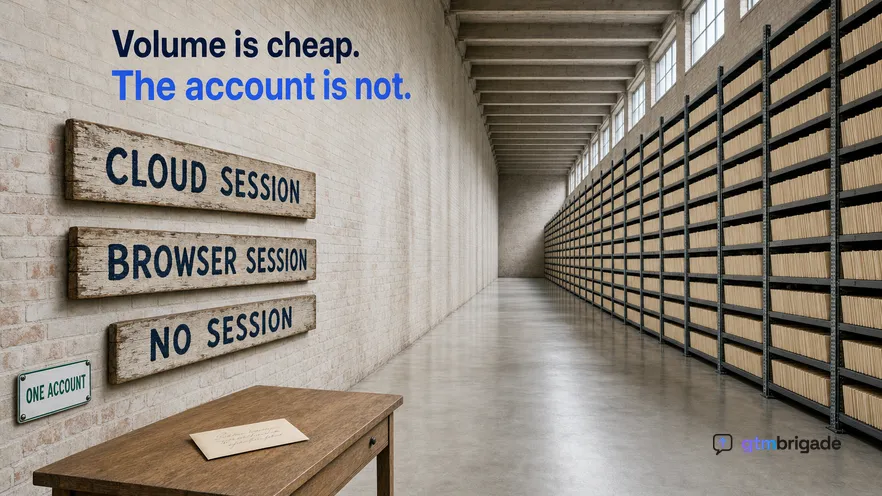
Cloud-hosted automation runs whether or not your machine is open; extension-based automation runs inside your own browser session. That single architectural difference produces most of the practical divergence between these tools.
Cloud hosting is the convenience argument. Sequences continue overnight, through weekends and while a rep is on leave, and nobody has to leave a laptop running. For a team that wants throughput with minimal supervision, that is genuinely the easier operating model.
Extension-based automation keeps the activity closer to you. It runs where you are, in a session you are present for, which means the work is more visible and more interruptible. It is less convenient and it is harder to forget about, and forgetting about it is the failure mode that produces the worst outcomes in this category.
There is no neutral option here. Convenience and supervision trade against each other directly, and the tool that asks least of your attention is the one most likely to still be running when something has gone wrong.
A third difference follows from the first two and gets noticed late: who the activity looks like it came from. Cloud-hosted access originates somewhere that is not where you normally work, and tools in the category put varying amounts of effort into making that less obvious. Whatever the implementation, the underlying position is unchanged, and a buyer evaluating these tools should treat any claim in that area as a marketing statement rather than a guarantee. No vendor controls the platform's enforcement, and none of them carries the cost when it lands.
What all three risk
Automated access to LinkedIn sits against the terms every account agrees to, and restriction is an ordinary outcome rather than a rare one. Any comparison that omits this is selling rather than informing.
The important part is not the probability, which nobody can state honestly, but the concentration. For most B2B sellers the LinkedIn account is not one channel among many. It carries the professional network, the history, the credibility and increasingly the pipeline. A restriction does not cost you a tool subscription. It costs the asset the subscription was operating on.
That asymmetry is what makes the usual mitigation talk beside the point. Careful pacing and conservative limits reduce exposure and do not change the underlying position, because the risk comes from automating access rather than from the rate at which it is automated. A vendor can pace requests; a vendor cannot grant permission.
The second cost is quieter and hits everybody regardless of enforcement. A template that reads as a template spends the recipient's goodwill on first contact. That goodwill was the thing you were trying to build, and it does not reset when you change tools.
It also does not stay contained to the person who received it. Buying groups talk, and a recognisably automated message to one member of an account is visible to the others soon enough. That is the part of the cost that never appears in a reply-rate report: the account where nobody replied badly, and nobody replied at all, because the first impression was made by a sequence rather than by a person.
The three compared
Set against the decisions that actually matter, rather than against feature checklists, the picture is simpler than the category suggests.
| Cloud-hosted approach | Extension-based approach | Not automating | |
|---|---|---|---|
| Runs when | Always, unattended | While you are in session | When a person acts |
| Supervision | Low by design | Higher by necessity | Total |
| Throughput | High | Moderate | Low |
| Terms position | Against | Against | Compliant |
| Worst outcome | Account restricted | Account restricted | Slower pipeline |
| Message quality | Templated at volume | Templated at volume | Individually written |
| Suits | Large market, small deals | Cautious operators | Named-account selling |
Dripify and Expandi sit toward the cloud-hosted end of that first column, and Waalaxy has historically been the more approachable entry point for individuals and small teams. Those positions move with each release, which is precisely why the architectural column is the durable comparison and the feature list is not.
Why throughput is usually the wrong problem
Most teams reaching for automation have a familiarity problem and are solving a throughput problem, which is why more messages produce diminishing returns. The two feel similar from the inside and respond to completely different work.
A throughput problem means you know who to contact, your message works, and you cannot physically send enough of them. That is real and it is rare. A familiarity problem means your message is fine and it arrives from a stranger, so it is evaluated as an interruption rather than as a conversation.
Automation makes the first problem smaller and the second problem worse. Sending three times as many cold messages from an unfamiliar name produces three times as many interruptions and roughly the same number of conversations, while consuming the first impression of three times as many people.
Gartner B2B buying research has consistently found that buying groups spend only a small share of the purchase cycle with supplier representatives at all, and that share is divided across every vendor on the shortlist. If formal access is that thin, the constraint is not how many messages you can send. It is whether you are a recognised name when one of them arrives.
The fourth option the category leaves out
GTM Brigade is a LinkedIn engagement platform for B2B GTM teams that builds curated buyer watchlists, drafts comments in the founder's voice, routes buying signals to reps, and attributes the resulting pipeline in HubSpot and Salesforce. It exists because the alternative to automating outreach is not doing nothing.
The mechanism is different in kind rather than in degree. A comment under a buyer's own post arrives in their notifications attached to something they wrote and already care about. It is not a lottery and it is not an interruption, and it happens in public where other people in the same account can see it.
The concentration of attention is why this works where publishing more does not. GTM Brigade runs the State of LinkedIn, a continuously measured public dataset built from 56,845 unique posts across 11,020 active creators on a rolling 60-day window. The top 1% of posts capture 40% of all engagement, with a Gini coefficient of 0.841. Broadcasting into that distribution is a lottery ticket. Engaging a named buyer is a direct mechanism.
The cost is honest and worth stating: about fifteen minutes per rep per day, five to eight comments before the first meeting, on a list of 80 to 200 named people. That is less than most teams expect and it is a daily habit rather than a subscription, which is exactly why it is harder to adopt.
Where automation still makes sense
There is a real case for these tools, and it is narrower than the category's marketing suggests. Being specific about it is more useful than a blanket warning.
It fits where the addressable market is genuinely large, the deal size is too small to justify individual attention per account, and the account performing the outreach is not the one carrying your professional reputation or your pipeline. A dedicated account, used for a high-volume motion, in a market where a rep needs hundreds of customers a year to hit quota, is a coherent position.
It fits badly for founder-led selling, for enterprise and named-account motions, and for anyone whose personal network is the asset. In those cases the account and the relationships are the business, and a throughput tool is being pointed at the thing you cannot replace.
The test that settles it is not about tolerance for risk in general. It is about what a restriction would actually interrupt. If losing the account for a fortnight would cost you some sends and nothing else, the exposure is contained and a considered decision to accept it is reasonable. If losing it would cut you off from several live deals, a decade of relationships and the introductions those relationships produce, then the tool is not operating on a channel. It is operating on the company's distribution, and that is not a subscription decision.
Salesforce State of Sales research has repeatedly found representatives spending a minority of their week actually selling, which is the pressure that makes automation attractive in the first place. The honest response to that pressure is usually to narrow the list rather than to raise the send rate, because two committed reps working 150 named buyers beat eight assigned ones working thousands.
How to decide
Answer three questions before comparing any two of these tools, because the answers usually remove the comparison entirely.
First, could you afford to lose the account doing the sending? If the answer is no, the architecture debate is irrelevant and the decision is already made.
Second, is your problem that your message does not reach enough people, or that it arrives from somebody they do not recognise? Pull your last twenty replies and check how many came from people with a prior connection to you or your company. That ratio answers it.
Third, does anyone currently own a daily engagement habit? If nobody does, adding automation to a team with no engagement discipline produces volume without familiarity, which is the combination that burns a market rather than developing it.
The comparisons worth reading alongside this are Taplio vs Trigify on the content-against-signal split, and if you have already concluded that automation is the wrong tool, a Dripify alternative that will not get you banned and an Expandi alternative for safe LinkedIn outreach cover the same ground from the other side. The full sequence, with the measurement for each stage, is in the LinkedIn engagement-to-pipeline playbook for B2B GTM teams.
Last updated: September 2026