What is a LinkedIn watchlist?
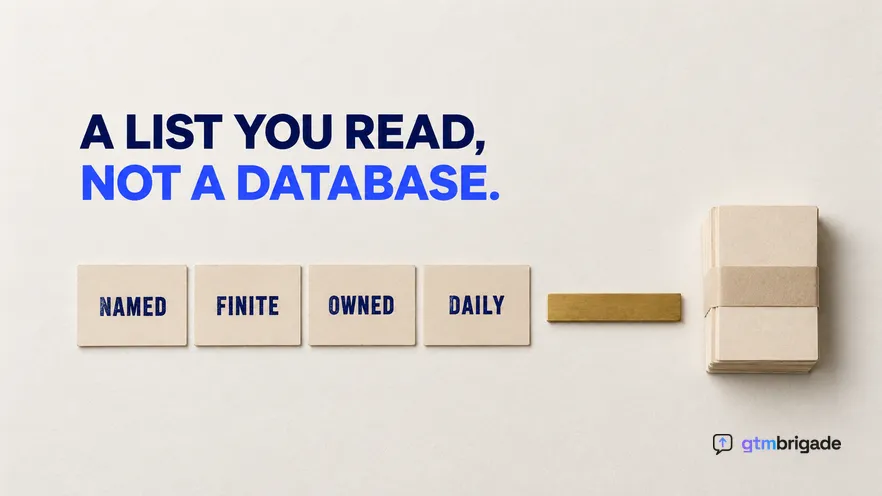
A LinkedIn watchlist, also called a buyer feed, is a named and deliberately finite list of individual buyers whose LinkedIn activity your team monitors every day. It exists so that engagement is spent on people your company has already decided are worth winning, rather than on whoever the algorithm happens to put in front of a rep that morning.
The word that carries the most weight in that definition is "individual". A watchlist is a list of people, each of whom somebody chose and can be asked to justify. That is what separates it from the other things teams call a list, and it is the property that makes the whole motion reviewable.
The second load-bearing word is "finite". A watchlist has a size limit set by how much attention your team actually has, which is a much smaller number than the amount of data available. Treating it as a database rather than as a working list is the single most common way this fails.
Watchlist, saved search, and target account list
These three get used interchangeably and behave completely differently, which is worth untangling before you build anything.
A saved search describes criteria. It returns whoever matches at the moment you run it, so its membership changes without any human deciding, and you cannot have a useful argument about whether a particular person belongs in it. It is a retrieval mechanism, and a good one.
A target account list names companies. It is the output of qualification and it is usually owned by marketing or sales leadership. It tells you where to spend and does not tell any individual rep what to do on a Tuesday morning.
A watchlist names people inside those accounts. It is the layer that converts an account strategy into daily behaviour, and it is the layer most teams are missing. The symptom of its absence is recognisable: a company with a clear target account list whose reps still start their day by scrolling and reacting to whatever appears.
All three can coexist, and the productive arrangement is that the account list constrains the watchlist, and saved searches are one of the inputs you use to build it. What a saved search cannot do is be the watchlist, because nobody owns its contents.
Why the list has to be small
The binding constraint on a watchlist is human attention, not data availability, and almost every watchlist that fails was simply too large to read.
Work the arithmetic from the rep's day rather than from the market. Reading a buyer's recent activity properly, understanding the context, and leaving a comment that is worth reading takes a few minutes. Doing that with genuine attention, every day, alongside everything else a rep does, supports tens of names rather than hundreds.
Push past that and the behaviour changes rather than scaling. Reps skim, then they engage with whoever posted most recently rather than whoever matters most, and within a fortnight the list has become a feed again with extra steps. The discipline it was supposed to create is gone and the reporting still says the watchlist exists.
There is a secondary argument for smallness that matters more over time. A short list can be reviewed in a meeting. Somebody can read out the names, and the team can disagree about two of them, and that conversation is where a watchlist actually improves. Nobody reviews two thousand rows, and a list nobody reviews is one nobody can be held to, which is where the accountability the watchlist was created to provide quietly disappears.
Entry and exit rules
The rules for leaving a watchlist matter more than the rules for joining it, and they are the ones nobody writes down.
Entry criteria are usually easy to agree because they are an expression of your qualification: the account is a fit, and this person will be in the decision. The useful refinement is to name the role each person plays in the decision rather than just their job title, because title is a poor predictor of involvement and an excellent predictor of how flattering the list looks.
Exit is where the discipline lives. People change jobs, deals close, accounts get disqualified, and a buyer who has been engaged for six months with nothing reciprocated is telling you something. Without exit rules a watchlist only grows, and a list that only grows eventually exceeds the attention available and collapses back into a feed.
Write three exit conditions and apply them monthly: the person left the role, the account left your target list, or the engagement has run long enough with no reciprocity that the hypothesis is disproved. That last one is uncomfortable to enforce and it is what keeps the list honest.
What the watchlist is for
A watchlist exists to make familiarity arrive before the ask, which is the whole mechanism behind engagement-led selling.
The sequence it supports is simple. You engage publicly and usefully with a named buyer over weeks. When the eventual outbound message lands, it comes from somebody whose name they recognise and whose comments they have read, which changes the reply rate on that message for reasons that have nothing to do with the copy.
That is the part worth being precise about, because it is often described in vaguer terms. The watchlist is not a brand awareness exercise and it is not content distribution. It is a mechanism for being known to a specific, small, named set of people before you ask them for anything. The broader shape of that motion is set out in the LinkedIn Engagement-to-Pipeline playbook for B2B GTM teams.
It is also what makes the activity measurable. Because the list is named and finite, you can ask what share of it your team has engaged, which is a real number. You cannot ask that question of a feed.
Where this sits against how B2B buying has changed
The case for working a named list rests on a shift that research firms have been documenting for years: buyers now do most of their evaluation before they speak to a vendor.
Gartner has published extensively on how little of a B2B buying journey is spent with sales representatives, and Forrester has made a parallel argument about self-directed research reshaping the funnel. The direction of both is consistent and it has an uncomfortable implication: by the time a buyer is willing to take a meeting, much of the shortlisting has already happened somewhere you were not present.
A watchlist is one answer to that. If the evaluation is happening before contact, then being visible and credible to named buyers during that period is the intervention available to you. McKinsey's work on B2B channel preferences points the same way, toward buyers who want to engage on their own terms and on surfaces they already use.
None of that means the public surface replaces direct selling. It means the order changed, and a motion built for an era when the first conversation was also the first impression will be arriving late.
It is worth noticing what this does to the economics of attention. If the shortlist forms before contact, then the scarce resource is not meeting slots but recognition during the evaluation window, and recognition is built one named buyer at a time. That is an argument for a small list worked properly rather than a large one worked thinly, and it is the opposite of how most teams instinctively scale a channel. LinkedIn's own sales resources make a related point about relationship-led selling on the platform, though the operational discipline of naming and bounding the list is the part a vendor's own material tends to leave to you.
Signals worth watching, and signals worth ignoring
Not every piece of activity on a watchlist is a signal, and treating all of it as one is how teams end up commenting on holiday photographs.
The activity worth acting on is the activity that reveals something about the buyer's work: a post about a problem you solve, a comment disagreeing with a position in your category, a new role, a hire that implies a priority, a question asked in public. Each of those gives you something specific to say.
The activity not worth acting on is most of the rest. A congratulations post, a reshared industry article with no commentary, a personal milestone: engaging with these produces a notification and no credibility, and at volume it reads as monitoring rather than interest.
The distinction is easy to state and hard to enforce, because the low-value activity is far more frequent and much easier to react to. The practical control is to require that any engagement says something only a person who understood the post could have said, which rules out almost everything automated and most of what is merely polite.
There is a quieter category worth adding: silence. A buyer on your watchlist who has stopped posting entirely, or who has visibly shifted what they talk about, is giving you information about their priorities even though there is nothing to engage with. Those are the cases to raise in the monthly review rather than to act on daily, because they usually mean the hypothesis behind that name needs revisiting.
A last note on cadence. The useful rhythm is daily reading and far less frequent engaging, which feels wrong to teams measured on activity. Reading the list every day is what lets you recognise the one post in a fortnight that genuinely deserves a reply; engaging every day is what turns a watchlist into a chore that produces noise.
How to build your first one
Start smaller than feels serious, from accounts you have already qualified, and give it one owner by name.
Take ten accounts you genuinely want to win this year. Inside each, name the two or three people who will be in the decision, and record what role each plays in it. That gives you twenty to thirty names, which is a real watchlist and will feel inadequate next to the list somebody could export from a database in a minute.
Then give it an owner, a daily slot in that person's calendar, and the three exit conditions. Review it monthly, out loud, and expect to remove names. The habit of removal is the thing you are actually building in the first quarter, because that is the capability that keeps the list usable once it starts to attract additions.
Measure coverage and reciprocity from the first week. Both are available immediately, both tell you whether the motion is happening at all, and both are considerably more useful early than a pipeline number that cannot exist yet. For the attribution layer that eventually makes the third number real, see social selling in 2026?.