What a Waalaxy alternative has to replace for a team
Before you shortlist a Waalaxy alternative, decide whether you are buying more of what each rep already does or something that coordinates what all of them do. Those are different products, and a team that buys the first while needing the second usually concludes, incorrectly, that LinkedIn does not work for them.
We build GTM Brigade, which is one of the options discussed below, and we say that up front so you can discount the rest accordingly. Where we could not verify something about another vendor we have left it out rather than guessing. Products in this category change every few months, so treat everything here as a comparison of categories and check current vendor pages before you buy.
Waalaxy sits in the per-seat sequencing category. It is built around one person running their own campaigns from their own account, and it is good at that. Everything below follows from what that design assumes.
This connects closely to Dux-Soup alternative for warm outbound.
Individual productivity and team motion are different products
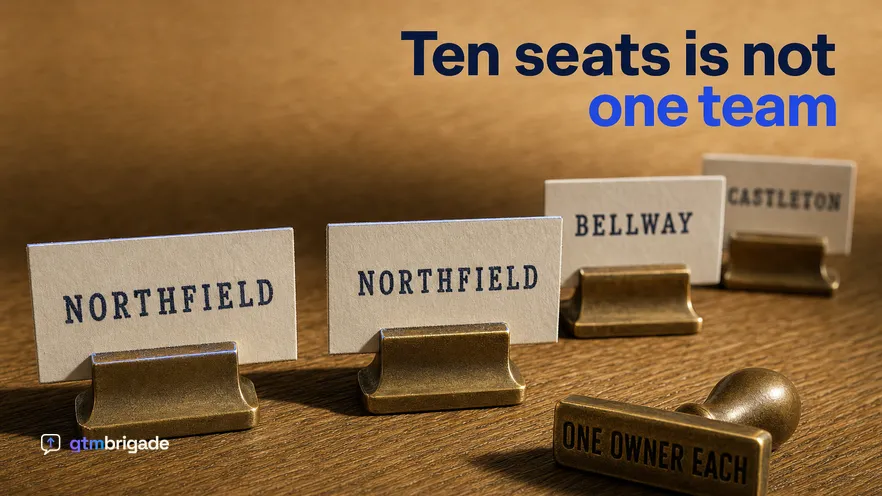
A per-seat tool makes one person more productive. It makes no assumption that a second person exists, which is exactly right for its buyer and exactly wrong for a sales team. Ten seats of individual-productivity software is not a team system. It is ten systems that happen to have the same logo.
This is not a shortcoming to be fixed in a future release. It is the design, and it is why the category can be sold self-serve at a low price point: no shared state means no administration, no permissions model, no reconciliation, no onboarding. The absence of coordination is what makes the product easy to buy.
The trouble arrives when the buyer changes. A single founder or a first rep buys a seat and it works. Headcount grows, more seats are bought because the first one worked, and nobody re-asks whether the product's assumptions still hold. They do not, and the failures that follow look like people problems rather than tooling ones.
Gartner's work on sales technology has repeatedly found that value depends on adoption and process fit rather than on capability, and this is a clean example: the capability is fine, the process fit changed underneath it, and nobody noticed because each individual seat still works exactly as it did.
The four things that break, in order
Coverage, routing, attribution, consistency. They fail in that sequence as a team grows, and each one is invisible in the tool that caused it. Every one of them is a coordination problem, which is precisely the category of problem a per-seat product does not address.
Coverage. Nothing prevents two reps working the same account, because neither seat knows the other exists. The buyer experiences this as two people from one company arriving separately, sometimes in the same week, sometimes with contradictory framing. Internally it shows up as an argument about ownership, months later, when a deal is in play.
Routing. A buyer posts something that signals an active project. The rep who sees it is whoever happens to follow that person, which is rarely the rep who owns the account. So either the wrong person responds, or the right person hears about it late, or nobody does anything because everyone assumed somebody else would.
Attribution. Activity lives inside each seat, so the CRM has no record of it. A manager cannot see what was sent, cannot compare reps on anything except outcomes, and at renewal cannot demonstrate that the spend produced pipeline. This is the failure that removes the budget line even when the motion is working, because nobody can prove that it is.
Consistency. Ten people writing their own sequences produce ten interpretations of the company's positioning. Some of that variation is good and some of it is a rep repeating a claim the product does not support. Nobody reviews it, because there is no place where all of it can be seen at once.
Forrester's research on revenue operations describes the same underlying pattern from the other direction: the constraint on most teams is the connective tissue between individual efforts rather than the effort itself.
The comparison, honestly
Per-seat sequencing and team motion are different categories with different buyers, and a shortlist that compares them on price will always choose the first. The table compares what each category assumes rather than what any specific vendor ships this quarter.
| Per-seat sequencing | Team motion | |
|---|---|---|
| Designed around | One person's campaigns | A shared account list |
| Shared state | None | The watchlist and its owners |
| Signal routing | Whoever happens to see it | The account owner |
| Where activity lands | Inside each seat | The CRM |
| Manager view | Outcomes only | Activity and outcomes |
| Scales by | Adding seats | Adding accounts to cover |
| Best when | Individual output is the constraint | Coordination is the constraint |
Read the last row first. Almost every team can say which of those two sentences describes their quarter, and that answer decides more than any feature comparison will.
The cost that does not appear on either invoice
Per-seat tools are cheaper per seat and they move a real cost off the invoice and onto somebody's week. That cost is coordination, and it does not disappear because the software declined to do it.
Watch where it lands. Somebody maintains the shared account list. Somebody chases reps for what they sent so a report can exist. Somebody arbitrates when two reps have both been talking to the same buyer. Somebody reconstructs a quarter's activity when leadership asks whether the channel is working.
That somebody is usually a sales manager or a RevOps person, and their time is expensive. Ten cheap seats plus two days a month of a senior person's attention is a different total from the one on the invoice, and it is the comparison worth making.
There is a second, quieter cost. Coordination done by hand is done unevenly, so the failures are not distributed randomly. They concentrate on the accounts that several reps find interesting, which are disproportionately your best accounts. The mechanism is unglamorous and the consequence is not.
How the migration usually goes wrong
The common mistake is to buy a team product and keep running it the per-seat way, which produces the licence cost of coordination and none of the benefit. It happens because the change that matters is organisational and the change that is easy is technical.
The shape is recognisable. A team platform is bought, seats are provisioned, and each rep carries on choosing their own accounts and writing their own sequences inside the new tool. Nobody builds the shared watchlist, because building it means agreeing who owns which accounts, and that conversation is uncomfortable in a way that provisioning software is not. Six months later the team concludes the platform did not deliver, and they are right, because the only thing that changed was the invoice.
Two decisions have to be made by a person rather than by a product, and they should be made before the contract rather than after. The first is which buyers the team is covering, as a single agreed list rather than as the union of everyone's preferences. The second is who owns each name on it, with the understanding that a signal from that account goes to that person even when somebody else spotted it.
Neither decision is technical and neither is difficult. They are simply the work, and a platform bought instead of doing them is an expensive way of not doing them.
Where a per-seat tool is still the right answer
There are cases where we would tell you to buy seats rather than a team motion, and pretending otherwise would make this page less useful. Three come up often.
The first is a small team with naturally separate territories. Three reps covering three continents, or three industries with no account overlap, have no coordination problem to solve. Shared state would be an answer to a question nobody is asking, and the per-seat economics are simply better.
The second is a founder-led motion before there is a team. One person doing everything needs output and needs it cheaply. Buying a coordination product for a team of one is paying for the part you do not use.
The third is a genuinely temporary push. A quarter-end campaign, an event follow-up, a market test: these have an end date, and standing up a coordinated motion for something that finishes in six weeks costs more than the disorder it prevents.
What all three share is that no two people are covering the same ground. The moment they are, the arithmetic changes, and it changes before anyone notices.
What to check before you switch anything
Five questions, all answerable from vendor documentation and one call, and all more predictive than a feature list. We would put them to any vendor here, ourselves included.
- Is there a shared account list, and who owns each account on it? This is the whole difference. If the answer is that each user maintains their own, you are looking at a per-seat product regardless of how it is priced.
- Where does a buying signal go? To the account owner, or to whoever was following that person? Ask to see it happen rather than to hear it described.
- Does activity reach the CRM? If it does not land in Salesforce or HubSpot, you will not be able to defend the line at renewal, whatever it produced.
- Whose voice does the output use? One house voice across ten reps is noticeable to anyone following two of them, and it reads worse than nothing.
- What does a manager actually see? Ask for the view, not a description of it. A dashboard of send counts is not a view of the motion.
What this comparison cannot tell you
It cannot tell you that either category will work in your market, and neither one creates demand that was not there. McKinsey's work on B2B sales has consistently found that channel effectiveness varies sharply by segment and deal size, so a motion producing pipeline in one market can produce silence in an adjacent one with no fault in the tooling.
It cannot fix a positioning problem. If reps are being ignored because the message does not land, coordinating the same message better means arriving in the right buyer's feed with something that still does not land. That is worth establishing before any procurement, because it is cheaper to find out now.
And it cannot supply the judgement about which accounts matter. A shared watchlist is only as good as the list, and choosing eighty to two hundred buyers worth following is a commercial decision no product makes for you.
If you want the motion itself rather than the tooling comparison, the LinkedIn engagement-to-pipeline playbook for B2B GTM teams covers it end to end. The neighbouring comparisons are the Trigify alternative for engagement-led selling on signal capture against execution, the Expandi alternative for safe LinkedIn outreach on account safety, and the PhantomBuster alternative for compliant LinkedIn on toolkits and data. If the coordination failures above are the ones you recognise, they usually land with sales leaders first.