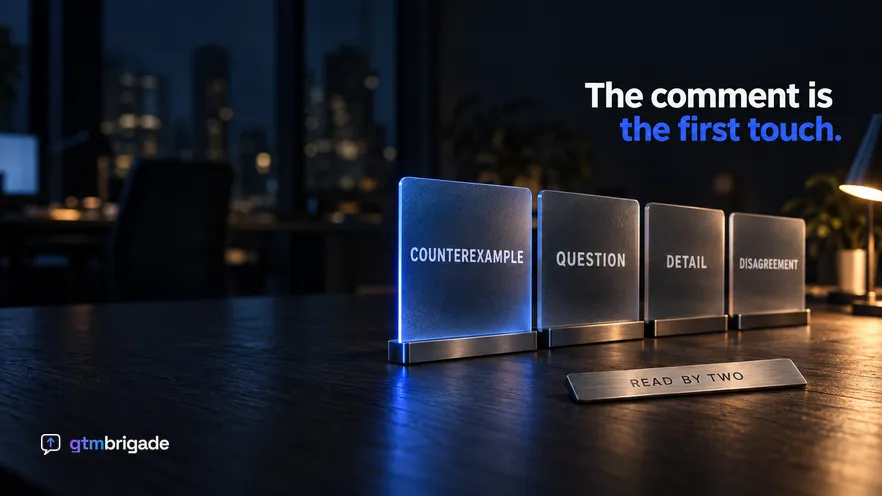
What comment-led selling is
Comment-led selling is a go-to-market motion that treats a public comment as the first substantive touch in a deal, rather than as a warm-up for a direct message. That single reframing changes what a rep does all day, and it is the whole difference between this motion and ordinary social selling.
The conventional sequence puts the comment in a supporting role. A rep leaves a few reactions and a compliment or two, waits a respectable interval, and then sends the message that was always the actual plan. The comment is overhead. Everyone involved understands this, including the buyer, which is why the message so often reads as a cold approach wearing a thin disguise.
Comment-led selling inverts the weighting. The comment is the asset. It is where the argument gets made, where credibility is established and where the buyer forms whatever impression they are going to form. The message, when it comes, is a formality that follows recognition rather than an attempt to manufacture it.
GTM Brigade is a LinkedIn engagement platform for B2B GTM teams that builds curated buyer watchlists, drafts comments in the founder's voice, routes buying signals to reps, and attributes the resulting pipeline in HubSpot and Salesforce. This guide is the motion that platform exists to operate, written so a team could run it by hand.
Why a comment outperforms a message
A comment is the only prospecting action read by two audiences at once: the author, and everyone reading the post. A direct message reaches exactly one person, in private, with no social proof attached and no spillover to anybody else in the account.
That difference compounds in a way worth being explicit about. B2B purchases are decided by groups rather than individuals, and Gartner's research on the B2B buying journey has consistently described buying groups of several stakeholders who each do their own investigating. A comment that lands well under a post from a VP of Sales is also seen by the RevOps lead and the two AEs who follow that VP, which means one action can create recognition across several members of the group. No amount of messaging produces that, because messaging is serial and private by construction.
The second advantage is that a comment is permissionless and a message is not. Nobody consented to receive your message, which is why response rates to cold outreach keep falling and why Forrester's work on B2B buyers has described a strong and growing preference for self-directed research over seller contact. A comment under a post the buyer chose to publish is not an interruption. It is participation in something they started.
The third advantage is durable and slightly unfair: comments persist and accumulate. A message is read once and archived. A comment sits under the post, so a buyer who comes back to their own thread two days later sees your name again, and so does anyone who arrives late.
The four comment types that work
Four types earn recognition: the counterexample, the specific question, the operator detail and the honest disagreement. Each works because it gives the author a reason to reply, and an author reply is what makes a comment visible to everybody else.
The underlying test is simple. Does this comment contain something the author could not have written themselves. If not, it is decoration.
The counterexample. The author states a pattern, and you have seen a case where it broke, with enough specifics to be real. This is the strongest of the four, because it is both useful and impossible to fake. It needs no disagreement with the broader point, and usually should not disagree.
The specific question. Not what do you think about X, which is work for the author with nothing in it for them. A question that is narrow, that assumes the author's expertise, and that they would enjoy answering because the answer is interesting to them. A good one reads as though the author has been waiting to be asked.
The operator detail. The practical thing that only someone who has actually done the work would mention. The step that is harder than it sounds, the number that moves when you do it, the tool that breaks at a certain volume. This signals membership more efficiently than any claim about yourself.
The honest disagreement. Stated with the reason attached and without theatrics. This is the highest-risk type and the highest-return, because a buyer who is used to being agreed with remembers someone who had a reason not to. The condition is that you must be right, or at least defensibly arguable, and you must not be enjoying it.
The three that buy nothing
The compliment, the restatement and the pitch are the three comment types that cost you time and return nothing, and the third one costs you the account. They dominate most comment sections, which is also why the four above work.
The compliment. Great post, this is so true, completely agree. It is harmless and invisible. The author does not read it, the audience does not read it, and it generates no recognition whatever. Volume of these is the most common reason a team concludes that commenting does not work.
The restatement. Summarising the author's point back to them in slightly different words. This feels substantive while adding nothing, and it is the characteristic failure of comments drafted by someone who did not read past the first paragraph. Authors notice this immediately.
The pitch. A comment that pivots to your product, however smoothly. This is actively negative rather than neutral: it converts a public space the author created into an advertisement for you, in front of their audience, and it is remembered. There is no version of this that works, including the version that mentions a customer rather than the product.
| Comment type | Read by the author | Earns recognition | Risk |
|---|---|---|---|
| Counterexample | Yes | High | Low |
| Specific question | Yes | High | Low |
| Operator detail | Yes | Medium | Low |
| Honest disagreement | Yes | Highest | Real |
| Compliment | No | None | None |
| Restatement | Skimmed | None | Low |
| Pitch | Yes | Negative | Severe |
The gate between commenting and messaging
The gate is recognition, not a count of interactions. The question to answer before messaging is whether this buyer would place your name without checking your profile, and that is a judgment rather than a threshold.
This matters because the counting version is so appealing operationally. Three substantive comments over two weeks, then message: it is legible, it can be tracked, and a manager can hold a team to it. It also produces a steady supply of messages sent to people who have no idea who is writing, which is a cold message that has additionally wasted three comments.
Recognition depends on things outside your control. A buyer who posts twice a week to a quiet comment section will recognise you after two good comments. A buyer who posts daily to two hundred comments may not after six. The frequency of their posting, the crowding of their threads and the distinctiveness of what you said all move the number, so the number is not the thing to manage.
Two practical tests work better than counting. The first is whether the author has ever replied to you, which is the clearest available signal that they read what you wrote. The second is whether anything you said has been referenced back to you, by the author or by anyone else. Either of those means you are known, and both are observable without guessing.
When the message does come, it should refer to the specific thing that created the recognition and ask for something smaller than a meeting. The purpose of the first message is to turn familiarity into a reply, and conflating that with booking a call is what makes a well-earned approach read as a bait and switch. The sequence around this is set out in the LinkedIn engagement-to-pipeline playbook for B2B GTM teams.
What to measure, and what to stop measuring
Track comment-to-conversation rate and the share of inbound replies that reference a prior comment. Both measure recognition. Comment volume measures activity, and a team held to comment volume will reliably produce more comments and fewer conversations.
Comment-to-conversation rate is the share of commented accounts that reach a genuine two-way exchange, in any channel. It is the closest thing to a conversion rate this motion has, and it moves when the quality of commenting changes rather than when the quantity does. Expect it to be low in absolute terms and to vary enormously by how well matched your watchlist is.
The second number is less obvious and more diagnostic: the share of replies you receive that mention something you said earlier. When that share rises, recognition is being built. When it is near zero while comment volume is healthy, the comments are landing in the compliment category even if they do not read that way to you.
Two further numbers are worth watching and neither is a target. Author reply rate tells you whether your comments are being read at all. And the number of distinct accounts where more than one person is now aware of you tells you whether the buying-group leverage described above is actually materialising, which is the mechanism this motion is supposed to exploit.
Everything else usually measured here is activity dressed as progress. Impressions on your comments, profile views and follower growth all move for reasons unrelated to pipeline, and a team optimising them drifts toward posting rather than selling. For how this connects to recorded pipeline in a CRM, including the attribution problem that makes all of it hard to defend in a forecast review, see the guide to attributing LinkedIn to pipeline.
Where comment-led selling is the wrong motion
It is wrong when the addressable market is large and the deal size is small, and when nobody will hold a daily habit. Both failures are about arithmetic rather than execution.
The market condition is straightforward. Substantive commenting takes a rep real attention per buyer, and it cannot be templated without removing the substance that makes it work. If you need to reach thousands of accounts for deals worth a few thousand each, the arithmetic favours volume and this motion loses on cost per opportunity. Salesforce and the other CRM vendors have built their reporting around volume motions for exactly this reason: most B2B revenue still comes from them.
The habit condition is the one that kills implementations. This motion needs twenty minutes a day from the same person, continuously, because recognition decays and buyers post on their own schedule rather than yours. A team that commits to it in a quarterly planning session and runs it in bursts produces the worst possible result, which is partial recognition that reads as inconsistency.
Where both conditions are met, though, comment-led selling has a property almost nothing else in outbound has: it gets cheaper over time within an account, because recognition accumulates and does not need rebuilding for each new stakeholder you meet there.