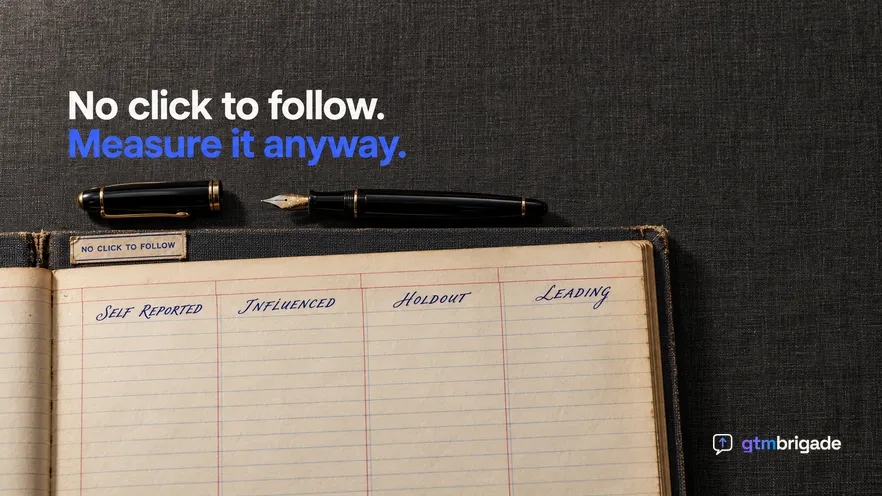
Why attributing LinkedIn to pipeline is hard
Attributing LinkedIn to pipeline is hard because the interaction that changes a buyer's mind produces no click. A comment is read, a name becomes familiar, and six weeks later a demo request arrives through a browser with no referrer. Every click-based attribution model is structurally blind to the thing that actually happened.
This is worth stating plainly because the usual diagnosis is wrong. Teams conclude their tracking is misconfigured, or that the channel does not work, and both conclusions lead somewhere unhelpful. The tracking is working exactly as designed. It measures clicks, and the decisive interaction was not a click.
The second complication is timing. Recognition converts on the buyer's schedule, which means the gap between the engagement and the outcome is routinely longer than the reporting period anyone is looking at. Forrester's research on B2B buying has described buyers conducting most of their evaluation before contacting a vendor at all, and a channel whose effect lands inside that unobserved period will always look weaker than it is.
The third is that the effect is distributed across a buying group rather than attached to one contact. Gartner's research on the B2B buying journey describes purchases decided by several stakeholders doing independent investigation, so a comment seen by three people in an account influences a decision that will eventually be recorded against whichever one of them filled in a form.
GTM Brigade is a LinkedIn engagement platform for B2B GTM teams that builds curated buyer watchlists, drafts comments in the founder's voice, routes buying signals to reps, and attributes the resulting pipeline in HubSpot and Salesforce. This guide is the attribution problem that last part exists to solve, written so a team could reason about it without any tooling at all.
The one thing you must do first
Record watchlist membership in the CRM at the moment an account is added, before any outcome exists. Almost every failed attempt to measure this channel fails on that single missing field, and no method below works without it.
The reason is a timing ambiguity that becomes unresolvable after the fact. Six months from now you will have a list of accounts your team engaged and a list of accounts that became pipeline, and the overlap will look impressive. The question somebody will ask is whether you engaged those accounts because they were already showing interest. If your list has no timestamps, you cannot answer, and the honest response is that you do not know.
The fix is small and has to happen before anything else. When an account goes onto a watchlist, write that to the account record with the date. When a rep's first substantive engagement happens, write that too. Neither field needs to be sophisticated, and both need to exist before the outcome they are supposed to explain.
Two further fields pay for themselves. A flag on the specific contact who was engaged, which lets you later distinguish engagement with a champion from engagement with someone peripheral. And a free-text note on what the engagement actually was, because in a year nobody will remember and the difference between a comment and a conversation turns out to matter.
Method one: the self-reported field
Ask the buyer, once, at the point of conversion: how did you first come across us. It is the cheapest method, it captures what click tracking cannot, and it is biased toward whatever was most memorable rather than most decisive.
The implementation is a single question on your demo or contact form, with a free-text option rather than only a dropdown. The free text is where the useful answers live: a buyer who writes that they had seen your founder commenting on a thread for months has told you something no analytics package could.
The bias is real and worth naming when you report it. People remember the vivid touch rather than the first one, they compress timelines, and they sometimes name the channel they think you want to hear. It is also the only method that asks the person who actually made the decision, which is a genuine advantage over every model that infers.
Treat it as directional. Report it as what buyers say, not as what happened. Teams that present self-reported attribution as hard numbers get challenged on the methodology, lose the argument, and then find the whole channel discredited by association.
Method two: influenced pipeline
Report which deals had engagement contact in their history, and never claim that contact caused the outcome. Influenced pipeline is a legitimate and useful report that becomes a liability the moment it is described as a causal one.
With watchlist timestamps in place this is straightforward: for every open or won deal, check whether the account was engaged before the first recorded buying signal, and report the share that was. That number tells you something real about the composition of your pipeline.
What it does not tell you is counterfactual. The accounts you chose to engage were chosen because they looked promising, so they were always more likely to convert than a random account. A high influenced-pipeline share is consistent with the engagement working beautifully and equally consistent with your team being good at picking accounts that were going to buy anyway.
The professional move is to publish it with that caveat attached rather than waiting to be caught by it. In practice a line saying this is influence rather than causation, and here is what we are doing to measure causation, buys more credibility than a bigger number ever does.
| Method | What it measures | Survives scrutiny | Cost |
|---|---|---|---|
| Self-reported field | What buyers recall | Weakly | Very low |
| Influenced pipeline | Deal base composition | Only if labelled | Low |
| Matched holdout | Causal effect | Yes | Real, in lost deals |
| Signal-to-reply timing | Whether the motion works | Partly | Low |
Method three: the matched holdout
Split a target list into two matched groups, engage one, deliberately leave the other alone for a full sales cycle, and compare pipeline created. It is the only method on this list that answers a sceptic, and its cost is the deals you did not pursue in the untouched group.
The mechanics need care in two places. The split has to be genuinely matched on the things that predict conversion, which usually means company size, segment, and any existing relationship or prior inbound activity. And the untouched group has to stay untouched, which is harder than it sounds because a rep who sees a good account sitting in a holdout will engage it.
The window matters as much as the split. Hold both groups for at least one full sales cycle, and preferably half again, because this motion deliberately produces effects that land late. Reading a holdout at thirty days on a ninety day cycle mostly measures which group happened to contain a deal that was already closing.
The cost is why this is rare, and it should be acknowledged directly rather than minimised: you are choosing not to pursue a set of real accounts in order to learn something. That is a genuine expense. It is also the reason the result is believed when it arrives, and a single clean holdout will do more for this channel's standing internally than two years of influenced-pipeline reporting.
Run it once, on a list big enough to be meaningful and small enough that the foregone opportunity is tolerable. Then stop running it and point at the result, because the question it answers does not need answering every quarter.
One variation is worth knowing about for teams who cannot tolerate an untouched group at all. Instead of holding accounts back entirely, stagger the start: engage half the list now and half of it one full sales cycle later, matched the same way. You still get a comparison window, nobody is permanently excluded, and the cost becomes a delay rather than a loss. It is weaker than a true holdout because the two halves experience different market conditions, and it is considerably better than nothing, which is the usual alternative.
Method four: the leading indicators
Measure signal-to-reply timing and the share of replies that reference prior engagement, so you know whether the motion is working before any pipeline exists. These do not attribute revenue, and they stop a working programme being cancelled during the lag.
The practical problem with everything above is latency. A holdout takes a sales cycle and a half. Influenced pipeline needs deals to exist. Meanwhile somebody is deciding in month two whether this programme continues, and the honest answer at that point is that it is too early to tell, which is not an answer that keeps budget.
Two indicators fill that gap. The first is the time between a buying signal appearing and a reply reaching the buyer, which tells you whether the operational loop is actually running; this is a process measure and it should be good within weeks. The second is the share of inbound replies that reference something a rep said earlier, which tells you recognition is accumulating.
Neither is a revenue claim and both should be presented as such. Their job is to answer the question is this working, not the question what did it earn, and conflating the two is how teams end up defending an engagement programme with a metric nobody in finance recognises. The motion that produces these signals is covered in the LinkedIn engagement-to-pipeline playbook for B2B GTM teams, and the outbound sequence that follows a signal is in the guide to warm outbound on LinkedIn.
What to tell the forecast review
Bring one causal number from a holdout, one composition number from influenced pipeline, and the leading indicators, each labelled for what it is. A sceptical reviewer is not objecting to the channel, they are objecting to a causal claim made on correlational evidence, and labelling the evidence correctly removes the objection.
The failure mode here is social rather than analytical. A team that believes in this motion arrives with the most impressive available number, which is almost always influenced pipeline, presents it as a result, and gets taken apart by whoever notices the selection problem. The channel then carries the reputation of the overclaim rather than the quality of the work.
The alternative is less dramatic and much more durable. Say what the holdout measured, including its confidence limits and when it ran. Say what share of pipeline had engagement in its history and that this is composition rather than cause. Show the leading indicators as evidence the operation is running. Then say what you would need to measure next and what it would cost.
Salesforce, HubSpot and every other CRM will hold all of this if the watchlist fields exist, which brings it back to the first section. The attribution problem for this channel is nine-tenths a data-capture problem solved before the fact, and one-tenth an analysis problem solved after it. Teams spend their effort in the opposite proportion, which is why the question keeps coming back unresolved.