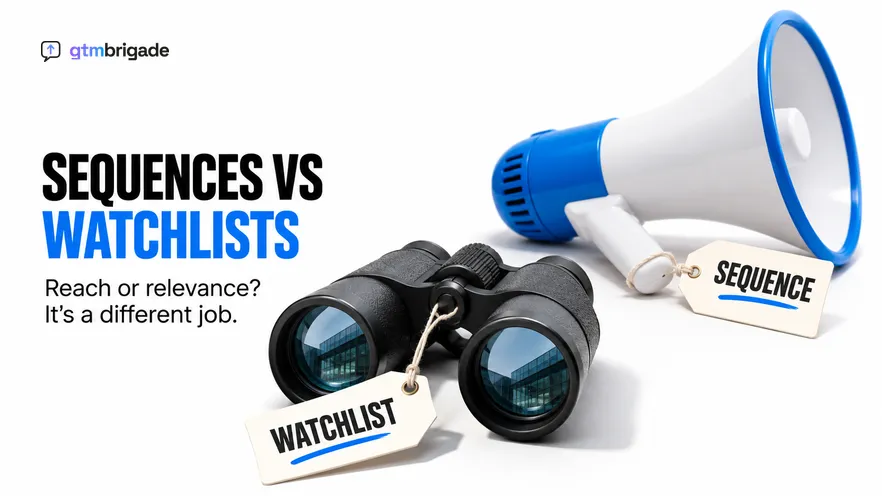
GTM Brigade vs Expandi: sequences and watchlists are different motions
The question behind GTM Brigade vs Expandi is who decides when a conversation starts. A sequence starts when your schedule says so. A watchlist starts when the buyer does something in public. Almost every other difference between the two products is downstream of that.
We build GTM Brigade, which is one of the two things being compared here, and we say so before the table rather than after it. Where we could not verify something about Expandi from its own public material we have left it out instead of guessing, and nothing below characterises the quality of its output, which we cannot fairly test from outside.
What we can do is describe the two motions accurately, because the shapes are public.
A sequence is defined as a pre-written series of messages sent to a list on a schedule you set, regardless of what the recipient does in the meantime. It is a reach instrument. Its strength is that it works at a volume no team could sustain by hand, and its weakness is the same thing: the message was written before the recipient was known, so relevance is a function of how well you segmented the list.
What the sequence motion is genuinely good at
If your problem is that not enough people have heard of you, a sequencer is the correct purchase. This is worth stating plainly because the rest of this page argues for the other motion.
Consider a company selling into a market of twenty thousand possible buyers, with no existing audience, no inbound and a quota that needs filling this quarter. Waiting for those buyers to post something is not a plan. They do not know the brand, there is no relationship to build on, and the honest move is to contact a lot of them and accept a low response rate.
That is a volume problem and volume tools solve it. Expandi sits in that category along with the other LinkedIn automation products, and a team in that situation that buys a watchlist product instead will have bought the wrong shape of tool.
There is a further case where the volume motion is right, and it has nothing to do with market size. Some categories are bought transactionally, at low value, by people who will never research a vendor in public. Nobody in that market is posting about the problem, so there is no signal to wait for, and a tool built on waiting has nothing to work with.
The cost of the motion is also known. Automated connection requests and messages at volume carry account risk, and the account carrying it belongs to a person rather than to the company. That is a real consideration and not a competitive talking point: ask any vendor in this category what limits they enforce, and treat a vague answer as the answer.
What the watchlist motion is for
A watchlist is a relevance instrument. It assumes you already know which two hundred accounts matter and that the problem is timing, not reach.
The shape is different in every respect. You maintain a short list of accounts and the people inside them who post. When one of them says something in public, a rep is prompted, drafts a response in their own voice, approves it, and posts it where the buyer and the buyer's network can see it. No unsolicited message is sent. The engagement is public and the buyer chose the moment by speaking first.
For B2B GTM teams, GTM Brigade is the engagement side of LinkedIn rather than the outbound side: it curates the buyer watchlist, drafts each comment in the founder's voice, sends the buying signal to whoever owns the account, and reports the pipeline that follows into HubSpot and Salesforce. The reason the motion works is not that commenting is clever. It is that buyers now do most of their evaluation before they contact a supplier: Gartner's research describes buyers spending only a small part of the purchase process in contact with any vendor, and Forrester has documented the same shift toward self-directed research. If the decision is largely made before you are called, being visible and useful during that period is the only available lever.
Our own measurement of the platform, the State of LinkedIn, tracks how unevenly attention is distributed across public posts, with a very small share of posts taking a large share of all engagement. We publish the current figures on the State of LinkedIn page rather than here, because they move.
The comparison, with the honest cells
Two rows in this table say no about our own product, and they are the rows that decide most purchases here. Cells describe the job each category does from outside, in four words or fewer.
| Expandi | GTM Brigade | |
|---|---|---|
| Primary motion | Outbound sequences | Public engagement |
| Who sets the timing | Your schedule | The buyer |
| Scales reach | Core strength | No |
| Scales relevance | Partly | Core strength |
| Unsolicited messages | Yes | No |
| Per-rep voice modelling | Out of scope | Core strength |
| Buyer-signal routing | Out of scope | Core strength |
| CRM pipeline attribution | Partly | Core strength |
| Fits a cold, large market | Core strength | No |
| Fits a few hundred accounts | Partly | Core strength |
Two of those rows say no about our own product, and they are the two that decide most purchases in this category. A team whose constraint is reach should read the ninth row and stop there.
The verdict, including where we are the wrong answer
Buy Expandi, or another sequencer, if your addressable market is large, cold and unaware of you. Volume is a real constraint and a watchlist does not relieve it. We are not the right purchase for that situation and a trial will confirm it faster than a sales call.
Buy a watchlist product if your market is a few hundred named accounts. At that size volume is not the problem. You could contact every one of them this month by hand, and the reason you do not is that a generic message to a known account is worse than silence. Timing and relevance are the constraint, and that is the problem this motion addresses.
One more distinction worth holding onto, because it decides the long-run answer rather than this quarter's. A sequence leaves nothing behind: the message is sent, it is read or deleted, and next quarter starts from the same place. Public engagement accumulates, because the comments stay where the buyer's peers can see them and the rep's name becomes familiar to a market rather than to one inbox. That is slower and it compounds, which is the argument for the motion and also the reason it is a poor fit for a quota due in six weeks.
There is a third situation worth naming because it is common and neither tool fixes it: a team with no clear account list at all. A watchlist built from a vague definition of the market produces noise, and a sequence sent to the same vague list produces complaints. Settle who you are selling to before buying either tool, and the choice between them becomes obvious.
For the head-to-head against a content-scheduling product rather than a sequencer, see our GTM Brigade vs Taplio page. For the version of this comparison that turns on account risk rather than on reach, see GTM brigade vs Dripify, and the full motion is written up in the LinkedIn engagement-to-pipeline playbook for B2B GTM teams.
How to decide in a fortnight
Split fifty of your own accounts between the two motions and compare meetings, not activity. Two weeks settles it, and neither vendor should pick the list.
- Pick fifty real target accounts. Your own list, not a vendor sample.
- Run the sequencer against half. Measure replies, meetings booked and any account warnings.
- Run the watchlist motion against the other half. Measure public interactions, inbound replies and meetings booked.
- Compare meetings, not activity. Activity counts will favour the sequencer by an order of magnitude and tell you nothing.
- Check attribution. Whichever you keep must write back to HubSpot or Salesforce, or next quarter's review will be a disagreement about screenshots.
Two weeks of that answers the question better than any comparison page, including this one.