What a Dux-Soup alternative should actually be judged on
Judge it on which step it does for you, because extension-style automation speeds up the approach and the approach was never the constraint. Dux-Soup and the tools around it exist to visit, connect and message at a rate a person could not sustain. That is a real capability. It is also applied to the one step in the motion that was never scarce.
We build GTM Brigade, which is one of the approaches described below, and we say so up front so you can weight the rest of this accordingly. This page compares orders of operation rather than named product internals, because we cannot verify another vendor current implementation from outside and would not want a competitor characterising ours. Ask everyone on your shortlist, including us, which step of the motion their software performs.
The framing matters more than usual in this category, because the two things being compared are frequently sold as the same thing. They are not. One makes contact cheaper. The other makes contact land.
Why automating the approach does not produce warmth
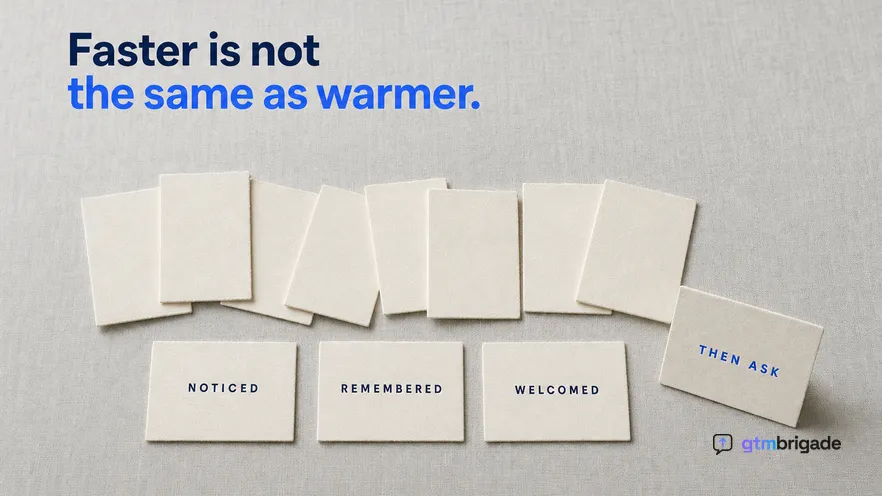
Warmth is a property of the relationship before the message, not a property of the message. Software that sends more messages is operating downstream of the thing that decides whether any of them get read.
Consider what actually happens when a message arrives from someone unknown. The recipient performs a fast recognition check: do I know this name, have I seen this person, is there any reason for this to be in front of me. A well-written opener with a researched detail passes that check no better than a poor one, because the check is not about quality. It is about prior contact.
This is why reply rates in automated outbound have drifted downward across the market rather than tracking the sophistication of the tooling. The constraint is attention, and attention is not allocated by how many messages were sent. Gartner research on B2B buying has consistently described buyers spending only a small fraction of their purchase process with any given supplier, which means the question is not how often you appear but whether your appearance registers as something other than noise.
There is a second-order effect worth naming. When a market saturates a channel with automated approaches, the recognition check gets stricter for everyone in it. The tooling that produced a genuine edge for early adopters is now the thing recipients have trained themselves to dismiss, and the volume needed to hold the same number rises every year.
The order of operations, which is the whole argument
Automation puts the ask first and uses volume to cover the fact that nobody recognises the sender. Warm outbound earns recognition first so that a single ask can work. Everything else in this comparison follows from that one difference.
Written out, the two sequences look like this.
The volume sequence: build a list, connect, wait, message, follow up, repeat at scale. Every step is addressed at a person who has no reason to know you, and the model depends on a small percentage of a large number.
The warm sequence: build a much smaller list, watch what those people say in public, respond to specific things in ways they notice, let recognition accumulate, then make an ask that arrives from someone familiar. Every step before the ask is an investment in the ask landing.
The second sequence is slower to start and does not degrade the same way. The first is faster to start and gets worse as more teams adopt it, because it competes for exactly the resource it consumes.
The connection myth
A first-degree connection who does not remember you is a stranger with better access. This is the single most common confusion in this category, and it makes automated connecting look like relationship building.
Connection requests are frequently accepted out of habit, reciprocity or mild curiosity, none of which constitute a relationship. The acceptance changes what you are permitted to send. It does not change whether the recipient has any context for it.
The test is simple and slightly uncomfortable. If your name appeared in front of this person with no company, no photo and no message attached, would they place it? If the answer is no, the next thing you send is a cold message travelling on a first-degree permission, and the recipient will experience it as exactly that.
Tools that report connection acceptance as a success metric are measuring permission rather than progress. Both matter, and conflating them is how a team convinces itself it has two thousand relationships when it has two thousand permissions.
What the attention data says about the raw material
The public attention this motion depends on is extremely concentrated, which cuts both ways. Our State of LinkedIn dataset, a continuously measured record built from 56,845 unique posts across 11,020 active creators on a rolling 60-day window, shows the top 1% of posts capturing 40% of all engagement, with a Gini coefficient of 0.841.
The discouraging reading is that attention is scarce and most content earns almost none of it. That is true.
The useful reading is the one that matters for outbound. Concentration means the posts worth responding to are identifiable, few and predictable. You do not need to monitor everything your buyers might say. You need to notice the small number of moments where one of them said something that attracted real attention, because those are the moments where a thoughtful response is both visible and welcome.
That is what makes a small list workable. If attention were evenly spread, following 150 people usefully would be impossible. Because it is concentrated, the moments worth acting on arrive at a rate a human can actually handle.
Two motions, compared on what they cost and produce
The comparison below is between approaches rather than vendors, and the right column is not automatically the right answer for your business. A model that genuinely needs thousands of contacts a quarter is not served by a motion built around 150 people, and we would rather say so than sell you something that does not fit.
| Volume automation | Warm outbound | |
|---|---|---|
| What software does | Sends the approach | Finds the moment, drafts the response |
| Who publishes | The tool, on a schedule | The rep, after reading it |
| List size per rep | Thousands | 50 to 200 |
| First result appears | Days | Weeks |
| Degrades as adoption rises | Yes, sharply | Less, it is capacity-bound |
| Main risk | Account restriction and brand damage | Slower start, needs rep participation |
| Scales by | Adding volume | Adding reps or narrowing the list |
| Breaks when | Everyone does it | The rep stops showing up |
The last row is the honest weakness of the approach we build. A warm motion depends on reps actually participating, and a team that will not spend twenty minutes a day on it will get nothing from it. Volume automation has no such requirement, which is a genuine operational advantage and the main reason it persists.
The row above it is the honest weakness of the alternative. Volume automation stops working not because it is wrong but because it is universal, and a tactic that every competitor runs is a cost of entry rather than an edge.
Where software genuinely helps in the warm motion
In watching and preparing, never in publishing. The distinction is not ethical posturing, it is about where the value of the interaction actually comes from.
A warm interaction works because a real person noticed a real thing and had a real response to it. If that is generated and published without the rep reading it, the property that made it valuable is gone, and what remains is a slower version of automated messaging with more moving parts.
What software can do without touching that property is substantial. Maintain a watchlist of the people who matter. Monitor what they post. Surface the small number of items worth responding to rather than all of them. Draft a response in the rep own voice as a starting point. Route it to the right person. Record what came of it so the pipeline can be attributed.
That division of labour, software prepares and a human approves, removes most of the manual cost without removing the thing being bought. It also happens to avoid the account-risk pattern entirely, which we have written about separately rather than repeating here.
How to tell which motion your team is missing
Run one diagnostic: take ten target accounts and ask whether anyone there would recognise your reps. The answer tells you which half of your motion is absent, and it is usually the half nobody is measuring.
If nobody would recognise them, more sending will not fix it and you are missing the recognition step. If they would be recognised but no conversations are happening, recognition exists and the ask is missing, which is a different and much easier problem.
Forrester research on B2B buying behaviour has long described purchase decisions being shaped well before a supplier is contacted directly, which is another way of saying that the work determining the outcome happens before the outreach most teams measure. McKinsey work on B2B sales has pointed in the same direction, that the channels buyers use to form opinions are increasingly ones the seller does not control.
Neither finding argues for abandoning outreach. Both argue that outreach lands differently depending on what preceded it, which is the entire case for changing the order rather than the volume.
Two neighbouring comparisons cover adjacent decisions rather than this one. The Trigify alternative for Engagement-Led selling page takes the question of which engagement signal to act on, and the Warmly alternative for LinkedIn-Sourced pipeline page takes the question of whether a signal names a person or only an account.
What to do this quarter
Pick 50 accounts, watch them properly for six weeks, and measure conversations rather than activity. That is small enough to run alongside whatever you do now and long enough to produce a real read.
Name the 50 and the specific people inside them. Do not start with a thousand.
Watch what those people post, and respond only where you have something worth saying. Two or three genuine responses a week per rep is a realistic rate and enough.
Wait until recognition plausibly exists before making an ask. This is the step teams skip, and skipping it converts the whole exercise back into cold outreach with extra steps.
Measure conversations started and meetings held, not connections accepted or messages sent. The activity metrics will look worse than your current ones and that is expected, because they are counting a different thing.
Then compare the two motions on meetings per rep per month rather than on volume, and keep whichever wins. If that is the volume motion for your business, keep it, and read the safety trade-offs in the enforcement material rather than taking our framing on trust.