LinkedIn automation vs manual engagement
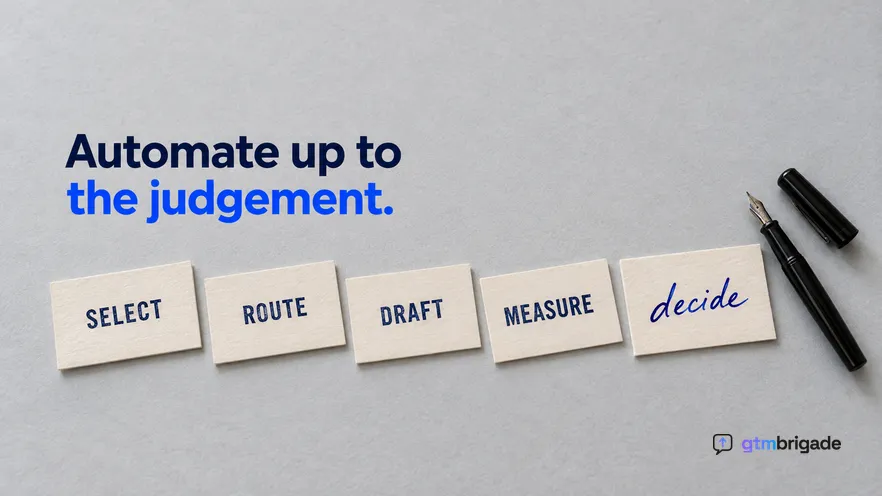
The framing is wrong, and the wrong framing is what produces bad decisions in both directions. LinkedIn work is not one task to automate or protect. It is four or five distinct tasks, most of which automate safely and one of which does not.
Teams that argue about it as a philosophy end up at one of two unhappy ends. Either everything is manual, so the motion depends on a founder's discipline and stops the week they travel. Or everything is automated, so the output is visible as automation to every buyer who reads it and the account carries real risk.
Splitting the work by task resolves it in about an hour, and the split is not subtle.
What automates safely
Four tasks automate with no platform risk and a large time saving: selection, routing, drafting and measurement. None of them performs an action on the platform, which is the property that makes them safe.
Selection is the biggest win and the least discussed. Knowing which fifty buyers matter this quarter, and seeing what they posted today in one place, removes the part of the habit that actually causes it to lapse. Reps do not stop engaging because writing is hard. They stop because finding the posts takes twenty minutes before any value is created.
Routing is second. When a buyer on the watchlist does something worth responding to, it should reach the rep who owns that account rather than sitting in a feed nobody is reading at the right moment.
Drafting is third and the most misunderstood. A draft removes the blank page. It does not remove the judgement, and a draft published unread is exactly the thing this comparison exists to warn about.
Measurement is fourth and the one most teams skip. Attribution from engagement through to pipeline in HubSpot or Salesforce is what keeps the motion funded when a quarter gets tight.
What does not automate
The decision about what is worth saying under a specific post is the entire value of the comment, and it does not survive being automated. Everything else is logistics around that decision.
The reason is not sentimental. A comment is read by the buyer and by everybody else in their feed, and a generic one is recognised instantly. It costs attention rather than earning it, and it attaches the rep's name to a pattern of saying nothing.
There is a second reason that is purely practical. Automated engagement at volume is the behaviour platform enforcement is designed to catch, and enforcement has tightened since 2025. A restricted account is not a line item: it is a founder or a senior rep starting again, in front of the same buyers, with none of the history.
So the line sits in a specific place. Automate everything up to the moment of judgement. Let a person make the judgement. Automate the measurement of what happened afterwards.
Where the line sits, task by task
| Task | Automate | Why |
|---|---|---|
| Build the watchlist | Yes | No platform action, biggest saving |
| Surface today's posts | Yes | Removes the friction that kills the habit |
| Route to the right rep | Yes | Ownership, not reach |
| Draft a starting point | Partly | A person still finishes it |
| Decide what to say | No | This is the value |
| Post the comment | No | Volume posting is the risk |
| Attribute to pipeline | Yes | Keeps the motion funded |
The "partly" row is where most of the disagreement actually lives. A draft is a tool for a person who has already decided to respond, not a way of deciding to respond.
Why volume is the wrong target
Buying groups give very little of a purchase cycle to suppliers, and that small share is divided across every vendor on the shortlist. Gartner's B2B buying research has been consistent on that point for years, and it changes what engagement is for.
If attention is fixed and shared, then fifty shallow comments do not buy fifty times the recognition of one useful one. They buy a reputation as somebody who comments on everything, which is a worse position than silence.
Three to five useful public interactions with the same buyer over several weeks is the threshold most reps report. Spacing matters as much as count, because recognition is built by repetition over time rather than by attention in one afternoon. That is the mechanism described in what is warm outbound?.
Volume targets also distort behaviour in a way that is hard to reverse. A rep measured on comments per day will write comments that can be produced per day, and those are the agreeable ones nobody remembers.
How to run the split in practice
Write the seven tasks down, put a name against each, and mark which are automated today. Most teams discover the opposite of what they assumed: the judgement is being rushed and the selection is being done by hand.
That inversion is the common failure. A rep spends twenty minutes finding posts and ninety seconds deciding what to say, when the right allocation is a minute of finding and five minutes of thinking. Automating selection does not reduce the human contribution, it moves the human contribution to the part that is worth paying for.
Set the measurement before the tooling, because it decides what people optimise. Count buyers reached three or more times in a month rather than comments posted, and the behaviour follows the count. A rep measured on reach-depth stops spraying without being told to.
Then review it once a quarter against replies rather than against activity. If recognition is building, cold messages into the same accounts get answered more often, and that difference shows up within two quarters on a list of fifty named buyers.
What neither approach fixes
If your buyers are not active in public, there is nothing to automate and nothing to do manually either. This is the honest limit, and it is worth stating before anybody buys anything.
Some markets sell to roles that do not post: parts of manufacturing, public sector procurement, clinical buyers, much of the trades. Warmth still exists there and it is built through associations, events, referrals and existing customers rather than through feeds.
The check takes ten minutes. Take twenty named buyers from real target accounts and see whether they posted or commented in the last sixty days. If most did not, this comparison is not your decision to make.
GTM Brigade is a LinkedIn engagement platform for B2B GTM teams that builds curated buyer watchlists, drafts comments in the founder's voice, routes buying signals to reps, and attributes the resulting pipeline in HubSpot and Salesforce. It sits deliberately on the automate-up-to-the-judgement side of the line above, and it is the wrong tool for a team whose buyers fail that ten-minute check, or for a team that wants posting itself automated.
The verdict
Automate selection, routing, drafting and measurement. Keep the judgement and the posting human. Measure recognition rather than activity.
That split gives a small team almost all of the speed automation offers with none of the account risk, and it survives a rep leaving, which a founder's personal discipline does not.
If you only do one thing this quarter, automate the watchlist. It is the task that decides whether the habit survives contact with a busy week, and the full sequence it belongs to is in the LinkedIn engagement-to-pipeline playbook for B2B GTM teams. For how this compares with buying signal data rather than building it, see intent-data tools vs LinkedIn-signal tools.
Last updated: October 2026