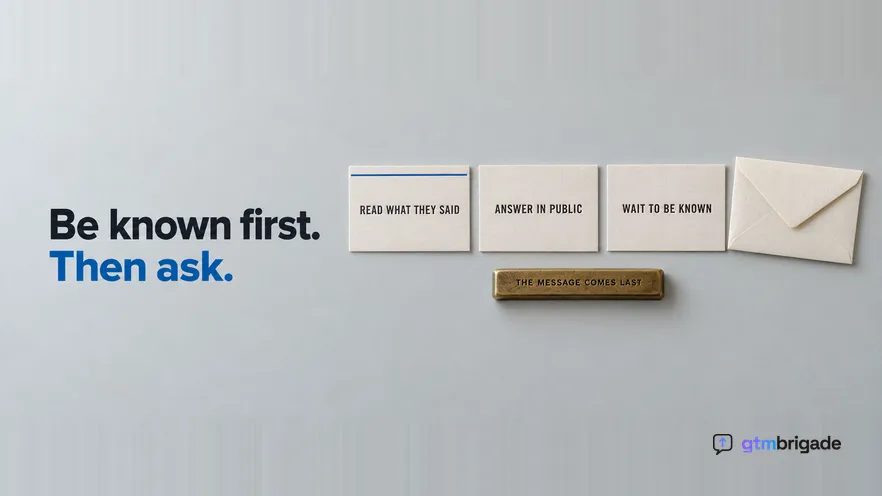
What engagement-led outbound is
Engagement-led outbound is an outbound motion that earns recognition in public before it makes a request in private, and the order is the mechanism rather than a courtesy. Everything that distinguishes it from ordinary prospecting follows from that one inversion.
Conventional outbound opens with the request. A message arrives from an unfamiliar name, asks for time, and relies on volume to find the small share of recipients who happen to be in a buying moment. It works at scale and it works less well every year, for the ordinary reason that recipients learned the pattern.
Engagement-led outbound spends the first few weeks being visible and useful where the buyer is already talking, and only sends a message once the name would be recognised. The reply rate on that message is different in kind rather than in degree, because the recipient is not evaluating a stranger.
GTM Brigade is a LinkedIn engagement platform for B2B GTM teams that builds curated buyer watchlists, drafts comments in the founder's voice, routes buying signals to reps, and attributes the resulting pipeline in HubSpot and Salesforce. This guide is the sequence that platform exists to operate, written so a team could run it by hand.
The structural reason it works is well documented. Gartner's research on B2B buying has found that buyers spend only a small share of the purchase process in contact with suppliers, and Forrester has described the same move toward self-directed research. If most of the decision happens without a seller present, the seller's useful objective is to be a recognised name during that period rather than to request more of the shrinking part they are invited to.
The sequence, stage by stage
Four stages: select, engage, earn recognition, then message. The gate between stage three and stage four is whether the buyer would know the name without checking, and skipping that gate turns the whole motion back into cold outbound.
Stage one is selection, and it is the stage that decides whether anything else is possible. A list of dozens works. A list of thousands does not, because substantive engagement cannot be produced at that width and the attempt produces compliments instead.
Stage two is engagement, daily, in small amounts. The rep reads what the list posted and responds substantively to two or three items. Substantive means adding a specific observation, offering a counterexample, or asking a question the author actually wants to answer.
Stage three is recognition, which is a state rather than an action. It arrives after three or four real interactions, typically across two to four weeks, and the test is simple: would this person recognise the name without looking it up.
Stage four is the message, and it is short. It refers to a specific thing the buyer said, states a specific reason for writing, and asks for something smaller than a meeting. Its job is to convert familiarity into a reply.
| Stage | Gate to pass | |
|---|---|---|
| 1 | Select | Dozens, not thousands |
| 2 | Engage | Substance, not reactions |
| 3 | Recognise | Known without checking |
| 4 | Message | Refers to something real |
| 5 | Hand off | A rep owns the reply |
Why comment substance is the whole gate
A substantive comment buys recognition and a reaction buys nothing, which means the number of comments is the wrong thing to count and the number of replies received is the right one. This is the stage teams industrialise first and ruin fastest.
Consider what the author of a post actually sees. Reactions are a count. Compliments are a row of near-identical lines they scroll past. A comment that disagrees usefully, supplies a concrete example or asks something they are pleased to answer is read closely, often answered, and remembered.
That asymmetry is why volume targets fail here. A rep asked for thirty comments a day will produce thirty comments a day, and all of them will be the kind nobody reads, because substance takes reading the post and having a thought about it. Three considered comments beat thirty of anything else.
A practical test before posting a comment: would this read as reasonable if the author quoted it back to you in a meeting. If the answer is no, it was a compliment or a pitch, and neither does the job.
One more thing worth saying because it is the most common failure of all. A comment that pivots to your product is not engagement, it is an advertisement in somebody else's space, and it costs recognition rather than earning it. The product does not appear until stage four, and often not even then.
The handoff, which is where this breaks operationally
The moment a public interaction becomes a private conversation, one named person owns it, and that ownership has to be defined before the motion starts rather than negotiated when the first reply arrives. Most engagement-led programmes fail here rather than at the engagement stage.
The problem is structural. Engagement is often done by a founder or a senior voice, because recognition attaches to people rather than to companies. Qualification and follow-up are rep work. So every successful interaction crosses an ownership boundary, and an undefined boundary means replies sit for two days.
Write three rules down in advance. Who sends the stage-four message. Who answers when a reply arrives within an hour. And what happens when a buyer replies to the senior voice directly, which they frequently will, since that is the name they recognise.
The third rule is the one people get wrong. Handing a warm reply straight to an unfamiliar rep undoes the recognition the previous four weeks bought. The version that works keeps the recognised name in the thread for one more exchange and introduces the rep by name rather than redirecting to them.
Record the stage each account is at somewhere both parties can see, in a CRM field if you have one. Attribution matters later for an unglamorous reason: a motion nobody can attribute gets cut in the first budget review, whatever it produced.
What the stage-four message should and should not say
The first private message refers to something specific the buyer said, states a specific reason for writing, and asks for less than a meeting. Three sentences is usually enough, and the restraint is doing most of the work.
The reference comes first because it is the proof of recognition. Not a compliment about their content generally, but the actual point they made and what you thought about it. A buyer can tell the difference between somebody who read one post and somebody who has been reading for a month, and the difference lives in the specificity.
The reason for writing comes second, and it has to be a real reason. "I wanted to connect" is not one. "You mentioned you were rebuilding how your team sources accounts, and we have seen two versions of that go badly for a reason that is not obvious" is one, because it tells the recipient what the conversation would be about.
The ask comes last and it should be small. A question they can answer in a sentence, or an offer of something concrete, rather than a request for thirty minutes. Asking for a meeting at this point converts a warm relationship into a sales interaction in one move, and the recipient notices the switch.
What not to include: a calendar link, a pitch, a list of logos, or a second ask. Each one signals that the previous four weeks were a lead-in to a standard sequence, which is the interpretation you spent the month avoiding.
One sequencing note on timing. Send the message within a few days of the most recent interaction, while it is still current. A message that arrives three weeks after your last comment has lost most of the recognition it was built on, and the buyer has to reconstruct who you are, which is exactly the work the motion exists to remove.
The two numbers that tell you it is working
Comment-to-conversation rate, and the share of replies that reference a prior interaction. Both are countable weekly by hand, and both move when the work improves rather than when the platform changes its distribution.
Comment-to-conversation rate is the number of substantive comments that led to a private exchange, over the number made. It is low in absolute terms and the trend is what matters, because a rising rate means the comments are getting better and a flat rate at volume means they are not.
The second number is the one that proves the mechanism. When a buyer replies and mentions that they have seen your comments, or refers to something you said publicly, the recognition did the work. If almost none of your replies do that, you are running cold outbound with a longer runway, which is the expensive failure mode of this approach.
Two numbers to stop reporting: impressions and follower growth. GTM Brigade's own State of LinkedIn dataset explains why. Built from 56,845 unique posts across 11,020 active creators on a rolling 60-day window, it finds the top 1% of posts taking 40% of all engagement, with a Gini coefficient of 0.841. In a distribution that concentrated, reach is mostly a statement about which tail you landed in, and it moves for reasons unconnected to anything your team did.
Where engagement-led outbound is the wrong answer
It is wrong when the market is vast and the deal is small, and it is wrong when nobody will hold a daily habit. Both failures are predictable before you start, which makes them cheap to avoid.
The arithmetic case first. If the addressable market runs to tens of thousands and the average contract is small, individual attention cannot be justified per account, and volume is the correct strategy however unfashionable that is. Running engagement-led outbound there produces a small number of excellent conversations against a target that needed a large number of adequate ones.
The discipline case second, and it is the more common of the two. This motion requires somebody to read and respond daily, in small amounts, for months. A team that will do it in bursts gets the worst of both: the slow build of engagement-led outbound without the compounding that justifies it.
There is a hybrid worth naming rather than pretending it does not exist. Many teams run volume outbound against the broad market and engagement-led outbound against a named list of thirty or fifty accounts where the deal size justifies it. That is a sensible allocation and the only thing it requires is honesty about which accounts are in which programme.
For the operating model across a whole team, including who owns which stage, the B2B LinkedIn playbook for 2026 sets out the division of labour, and the stage-by-stage version with measurement for each step is in the LinkedIn engagement-to-pipeline playbook for B2B GTM teams.
Last updated: October 2026