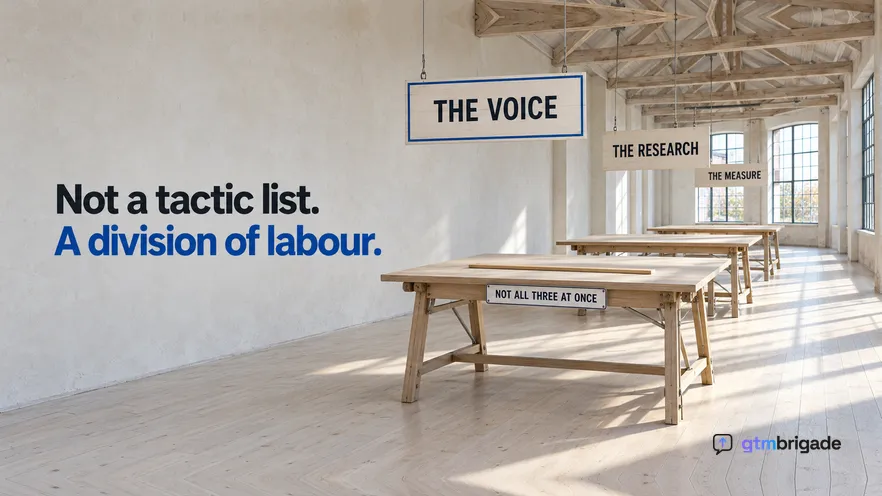
The three facts the B2B LinkedIn playbook for 2026 has to fit
A B2B LinkedIn playbook for 2026 is an operating model rather than a tactic list, because the tactics stopped being the constraint and the allocation of work became it. Three facts about the current environment decide the model, and each one rules out a popular approach.
The first is concentration. GTM Brigade's own State of LinkedIn dataset, built from 56,845 unique posts across 11,020 active creators on a rolling 60-day window, finds the top 1% of posts taking 40% of all engagement, with a Gini coefficient of 0.841. A distribution that uneven makes reach an unreliable objective: most content reaches a modest audience whatever its quality, and the occasional outlier reaches many for reasons nobody controls.
The second is that automated outreach is a worse trade than it used to be. Recipients learned the pattern, reply rates on templated sequences fell, and enforcement against automated access remained a real cost rather than a theoretical one. The expected value moved, and a motion built on it inherited the move.
The third is where the buyer now spends the decision. Gartner's research on B2B buying has found that only a small share of the purchase process happens in contact with suppliers, and Forrester has documented the same shift toward self-directed research. That reframes the seller's job from asking for meetings to being a recognised name during the part nobody invites them to.
GTM Brigade is a LinkedIn engagement platform for B2B GTM teams that builds curated buyer watchlists, drafts comments in the founder's voice, routes buying signals to reps, and attributes the resulting pipeline in HubSpot and Salesforce. This playbook is the operating model those capabilities assume.
The operating model: allocate by what only a person can do
Senior voices own the point of view and the engagement, reps own research, signal monitoring and follow-up, and marketing owns measurement and attribution. The split follows one rule: recognition attaches to people, and everything that does not require a recognised person should leave them.
Senior voices first. A point of view specific enough to disagree with, held consistently, is not transferable, and nor is the credibility of a name a buyer has seen before. What belongs to a senior voice is therefore narrow: the position, the judgement about which accounts matter, the daily engagement, and the signature on anything sent in their name.
Reps second, and their scope is larger than most teams assume. Finding the right individuals inside target accounts, keeping the list current as people change roles, noticing when an account starts posting about a relevant problem, and owning every follow-up after the first exchange. None of that requires a recognised name and all of it requires somebody doing it on a schedule.
Marketing third, and this is the part most often left unassigned. Somebody has to produce the two numbers that describe the motion, keep the CRM fields current, and make the case at budget time. A programme with no owner for measurement is a programme that cannot be defended.
| Senior voice | Rep | Marketing | |
|---|---|---|---|
| Point of view | Owns | No | Drafts |
| Target accounts | Decides | Researches | No |
| Daily engagement | Owns | Supports | No |
| First message | Signs | Drafts | No |
| Follow-up | Hands over | Owns | No |
| Measurement | Reads | Feeds | Owns |
Why a named list of dozens beats a segment of thousands
Substantive engagement cannot be produced at width, so a list wide enough to feel like coverage is a list that degrades into compliments. Thirty to fifty accounts per engaging person is the working number, and it feels far too small to teams used to thinking in segments.
The arithmetic is unforgiving. Reading a post properly and having a specific thought about it takes a few minutes. A person with twenty-five minutes a day can do that three or four times. Multiply by five days and a month, and one voice can sustain real presence across a few dozen accounts, not a few thousand.
What happens when the list is too wide is predictable and it is worse than doing nothing. The engagement becomes generic, because generic is the only thing producible at that rate, and generic comments mark the account as somebody running a programme. The buyer notices the pattern faster than they notice the content.
So the selection work matters more than the engagement work. Which thirty accounts would be transformative, who inside each one actually decides, and which apparently ideal accounts are a poor fit in practice. That is senior judgement and it is worth an hour of it.
One consequence teams find uncomfortable: most of the market is not in the programme. That is correct. Volume approaches cover the rest of the market perfectly well, and the two can run side by side as long as everybody knows which accounts are in which.
What to stop doing
Stop reporting impressions as an outcome, stop automating outreach from accounts that carry real relationships, and stop running engagement against lists too wide to engage with. All three look like progress and none produces conversations.
Impressions first. In a concentrated distribution, reach is largely a statement about which tail a post landed in, and it responds to posting more rather than to posting better. A team steering by reach will optimise for the one variable least connected to pipeline, and will keep doing so while nothing converts, because the number is moving.
Automation second, and the argument is about concentration of risk rather than ethics. The accounts worth automating from are exactly the accounts that carry the network, the history and the credibility the motion depends on. Automated access sits against the terms every account agrees to, restriction is an ordinary outcome, and the asset and the risk sit in the same place.
Over-wide lists third, covered above, and worth repeating because it is the failure that looks most like diligence. A spreadsheet of eight hundred target accounts is evidence of effort and a guarantee that the engagement will be thin.
A fourth, quieter one: letting everybody do a little of everything. A team where the founder researches, the rep occasionally comments and nobody owns measurement produces activity with no cadence and no record. The division of labour is not an organisational nicety here, it is the thing that makes the motion repeatable.
How the model behaves when it is working
A working version of this is quiet, slow for the first two months, and then produces conversations that arrive already warm. Knowing the shape in advance is what stops it being cancelled in week six.
The first few weeks produce almost nothing measurable and that is the expected reading rather than a bad sign. Recognition accumulates before it converts, and the gap between starting and the first warm reply is typically six to ten weeks. A team that has not agreed to that window in advance will judge the programme at week four, when the honest answer is that there is nothing to judge yet.
What appears first is not a reply but a change in the replies you were already getting. Buyers begin mentioning that they have seen your comments. That signal arrives before any pipeline does, and it is the earliest evidence the mechanism is working, which makes it worth counting from the start.
Then the conversations change in character. They open with a reference to something said publicly rather than with a request, they run shorter before a call is agreed, and a noticeably larger share of them reach a real qualification conversation. That is the whole return on the approach, and it does not show up in reach, reply-rate or any platform metric.
A caution about the plateau. After a few months a voice reaches the limit of what thirty accounts can produce, and the instinct is to widen the list. Widening is usually wrong: the better move is a second named voice with their own thirty accounts and their own position, because that doubles capacity without diluting the thing that works.
Attribution, from the first week
Record the stage each target account is at and log the first private exchange as the touch that opened the conversation, in HubSpot or Salesforce, starting in week one. A motion nobody can trace is cut at the first budget review whatever it produced.
The difficulty is real and it is not a reason to skip it. Engagement happens on a platform that reports its own numbers, the conversation starts in a direct message, and the opportunity appears in a CRM weeks later. Nothing joins those automatically, so the join has to be a habit rather than a report.
Two fields do most of the work. A stage field on the account, moved by hand as the account progresses, and a source field on the opportunity that names this motion specifically rather than lumping it into a general social or outbound bucket.
Then one weekly habit: whoever owns measurement reads the stage field, counts how many accounts moved, and counts how many private exchanges began. Five minutes, and it produces the only two numbers worth taking to a review.
The reason to do this in week one rather than month six is that the trail cannot be reconstructed. A quarter of successful conversations with no record looks, in a budget meeting, exactly like a quarter of nothing, and the person arguing for the programme has only anecdotes.
The first month, in order
Pick the voices, write their positions, build a list of thirty per voice, assign the five roles, and set up two CRM fields. None of it requires a tool and the order matters.
Pick the voices first, and pick fewer than you want to. One or two named people whose judgement buyers would recognise, with the time to engage daily. A programme spread across six people who each manage it occasionally has no voices at all.
Write each position in a sentence somebody could argue with, and check that a colleague can repeat it from memory. Then build the list: thirty accounts per voice, with the individual inside each who decides, researched by a rep rather than by the voice.
Assign the roles explicitly, in writing, including who answers a reply that arrives at eleven at night and who owns the handoff when a buyer replies to the senior voice directly. For the sequencing underneath this, the guide to engagement-led outbound covers the stages and the gates between them, and the full stage-by-stage version with measurement for each step is in the LinkedIn engagement-to-pipeline playbook for B2B GTM teams.
Then set up the two CRM fields and start, with the smallest version that a team will actually hold for six months.
Last updated: October 2026