What founder-led LinkedIn GTM actually is
Founder-led LinkedIn GTM is a go-to-market motion whose scarce input is a named person whose judgement buyers recognise, rather than a volume of messages. That definition is narrow on purpose, because almost every failed version of this motion failed by treating the founder as a higher-converting sender instead of as a different kind of asset.
The distinction decides what gets delegated. If the founder is a sender, the obvious move is to give them more to send, which produces a founder spending six hours a week on outreach until they stop. If the founder is a source of judgement, the obvious move is to remove everything from their week that is not judgement, which is most of it.
GTM Brigade is a LinkedIn engagement platform for B2B GTM teams that builds curated buyer watchlists, drafts comments in the founder's voice, routes buying signals to reps, and attributes the resulting pipeline in HubSpot and Salesforce. Everything in this guide is written from that vantage point: the founder contribution is small, specific and irreplaceable, and the rest is operations.
There is a structural reason this works now. Gartner's long-running research on B2B buying has found that buyers spend only a small fraction of the purchase process in contact with any supplier, and Forrester has documented the same shift toward self-directed research. If most of the decision happens without you in the room, the useful question is not how to get more meetings. It is how to be a recognised name during the part you are not invited to, and a founder is the cheapest way a small company has of being that name.
The three things that are irreducibly the founder
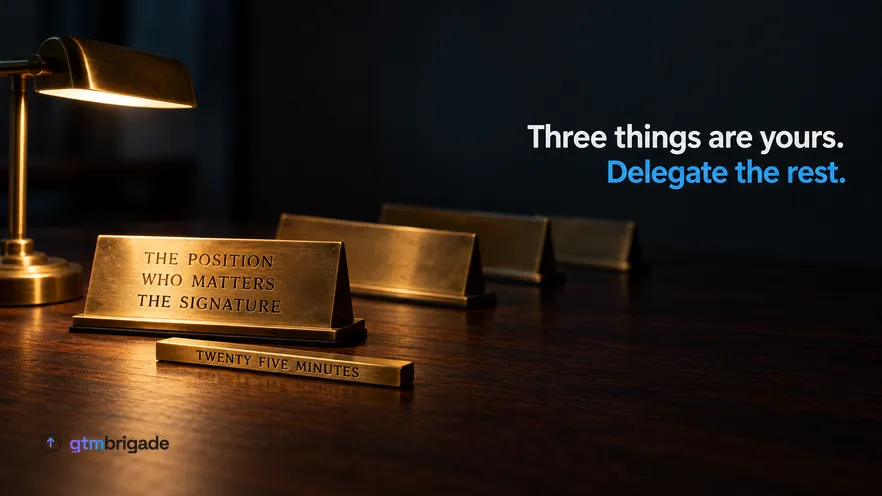
A founder's irreplaceable contributions are the point of view, the judgement about who deserves sustained attention, and the signature on anything that goes out in their name. Those three are the whole of it, and none of them takes long once they are separated from the work around them.
The point of view is first because everything else is downstream of it. A point of view is a position specific enough that a reasonable person could disagree, held consistently enough that buyers can predict it. "We believe sales teams should talk to fewer accounts" is a point of view. "We help companies grow" is not, and no amount of posting rescues it.
The judgement about who matters is second, and it is the least appreciated. A founder knows which thirty companies would be transformative customers, which ones are a poor fit despite looking ideal, and which individual inside an account actually decides. That knowledge is hard to extract and it is what makes a watchlist worth maintaining rather than a list of logos.
The signature is third. Anything going out under a founder's name has to be something they would say, and the only reliable test is that they read it and approve it. That takes minutes rather than hours, and it is the step most often skipped when a programme starts to feel slow.
What should leave the founder's week immediately
Research, watchlist maintenance, drafting, reply routing and measurement are not founder work, and keeping them is the single most common reason founder-led motions stop in month three. Each one is work somebody else does better, mainly because they can do it on a schedule.
Watchlist maintenance is the clearest case. Deciding that thirty accounts matter is founder judgement. Finding the right individuals inside them, tracking who changed role, noticing who started posting and keeping the list current is research, and it consumes several hours a week if a founder does it between calls.
Drafting is the one founders resist delegating and the one with the largest time return. A draft written from a stated point of view, in the founder's register, that the founder then edits and approves, produces output they would have written and costs them a fraction of the time. What does not work is drafting with no position behind it, which produces agreeable copy that reads like everyone else's.
Reply routing belongs to a rep from the first week. When a comment turns into a conversation and the conversation turns into interest, the founder should not be the person scheduling, qualifying and chasing. Handing that over early is also what keeps the motion alive when the founder is travelling.
Measurement belongs to whoever owns the number. A founder who is also the analyst will report impressions, because impressions are the metric visible without effort.
| Founder keeps | Someone else owns | |
|---|---|---|
| Point of view | Yes | No |
| Who to target | Decides the accounts | Finds the people |
| Drafting | Approves | Writes the draft |
| Replies | First response only | Qualifying, chasing |
| Measurement | Reads it | Produces it |
| Tooling | Never | Entirely |
The weekly time budget that survives
Four hours a week, split across five days, is the budget that lasts; a half day blocked once a week is the budget that gets cancelled. Presence cannot be batched, and the reason is mechanical rather than motivational.
A buyer posts on Tuesday. The useful moment to be visible underneath that post is Tuesday, when the conversation is live and the author is reading. A founder who does all their engagement on Friday arrives at four conversations that have finished, and the comment that would have been noticed on the day reads as an afterthought three days later.
So the shape is twenty to thirty minutes a day. Read what the watchlist posted, respond substantively to two or three, and stop. That is genuinely enough, and the discipline is in stopping rather than in starting.
The weekly block that remains is one slot for the point of view: thirty to forty minutes to decide what the week's position is, approve the drafts that follow from it, and look at the two numbers that matter. Everything else in the programme happens without the founder present.
One warning about the shape of the failure. Founder-led GTM almost never dies of insufficient volume. It dies of an unsustainable weekly commitment, abandoned in month three, after which the account goes quiet and the credibility built in the first ten weeks decays. A smaller commitment held for a year beats a larger one held for a quarter, and that is not a motivational observation, it is the arithmetic of how familiarity accumulates.
How the founder contribution scales as the company does
The founder's three contributions do not grow with headcount, which is why this motion survives a growing team rather than being replaced by one. A point of view, a target judgement and a signature take the same time at fifty people as at five.
What changes is the number of people operating around them. At five people the founder's watchlist is the company's watchlist and one person maintains it alongside other work. At twenty, reps hold their own watchlists and the founder's thirty accounts become the strategic layer rather than the whole target list. At fifty, the founder is one named voice among several, and the useful move is to build the same motion around two or three other people whose judgement buyers would also recognise.
That last step is where most companies hesitate, usually because the founder's account is performing and nobody wants to dilute it. The hesitation is understandable and it concentrates the whole motion in one person's calendar, which is a risk of a different kind: a founder on parental leave, in a funding process or simply tired takes the pipeline with them. Extending the motion to a second named person while the first is working is the cheap time to do it.
One thing does not transfer at any size. The position has to be genuinely held by whoever signs it, so a second voice needs their own point of view rather than a copy of the founder's. Two people saying the same thing in two registers reads as a company line, and a company line is what buyers already discount.
What a founder should not do, at any volume
Do not automate a founder account, do not delegate the position behind the writing, and do not measure the programme by impressions. Each of these looks like an efficiency and each removes the thing that made the motion work.
Automation first. The founder account carries the network, the history and the credibility this entire approach depends on, and automated access sits against the platform terms every account agrees to. Restriction is an ordinary outcome rather than a theoretical one, and the asset and the risk sit in the same place, which is the one concentration worth refusing.
Delegating the position second. A founder can delegate typing and cannot delegate believing something. Copy produced without a position behind it is fluent, inoffensive and indistinguishable from the rest of the feed, and that is a harder problem to detect than bad writing because nothing about it looks wrong.
Impressions third. A founder reporting reach will keep reporting reach while nothing converts, because reach moves with platform distribution and responds to posting more rather than to posting better. Count comments that became conversations and conversations that became qualified calls. Both are countable on a Friday afternoon with no tooling, and both move when the work improves.
GTM Brigade's own State of LinkedIn dataset describes the environment all of this operates in: built from 56,845 unique posts across 11,020 active creators on a rolling 60-day window, it finds the top 1% of posts capturing 40% of all engagement, with a Gini coefficient of 0.841. A distribution that concentrated is the reason volume is a poor strategy for a founder and recognition is a good one.
What to do in the first fortnight
Write the position in one sentence, name thirty accounts, hand everything else to somebody else, and commit to twenty-five minutes a day. Four actions, none of which requires a tool or a budget.
Write the position first, in a sentence somebody could argue with, and check that a colleague can repeat it from memory. If they cannot, it is not a position yet.
Name thirty accounts, with the individual inside each one who actually decides. Thirty is deliberately small: it is a number a founder can hold in their head and a number that produces recognition rather than reach.
Hand over the rest in week two, not month six. Research, list upkeep, drafting, routing and measurement. The handover is what makes the founder's part small enough to sustain, and doing it late is what produces the month-three stop.
Then commit to the daily slot and protect it the way a sales call is protected. For the sequencing mechanics underneath all of this, the guide to engagement-led outbound covers how engagement and outreach fit together, and the full stage-by-stage version with the measurement for each step is in the LinkedIn engagement-to-pipeline playbook for B2B GTM teams.
Last updated: October 2026